Winter Driving in the UK: Complete Safety Guide 2026
James has been writing about UK roads, traffic law, and vehicle regulation for over 8 years. He holds a full UK Category B licence and has driven extensively on the UK motorway network.
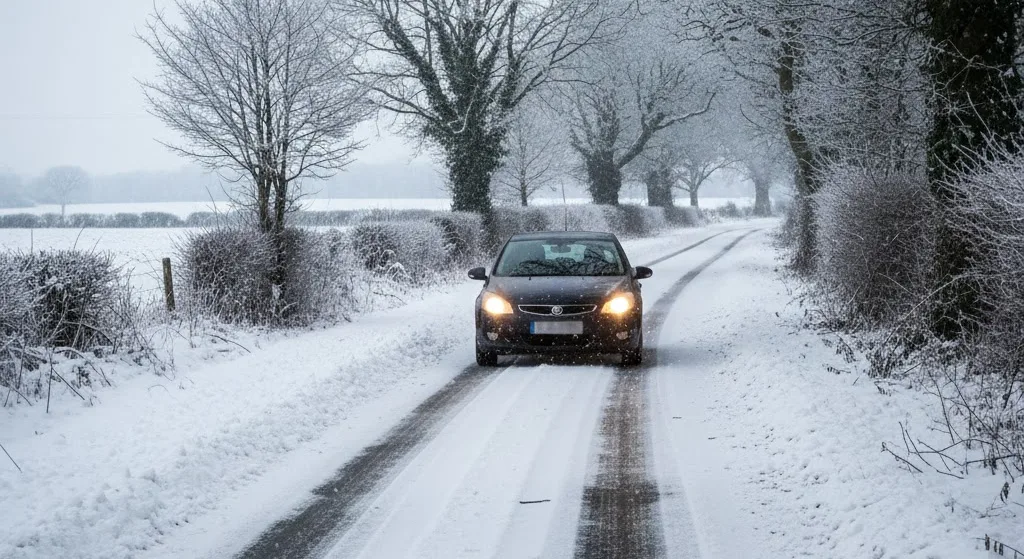
The UK's winter weather is unpredictable. Snow can fall in November and last until March in Scotland. Black ice forms without warning on motorway bridges. Dense fog can reduce visibility to near zero on rural A-roads. Every year, thousands of drivers are involved in preventable winter accidents — many caused by insufficient preparation and unfamiliarity with how vehicles handle in cold conditions. This guide covers everything you need to know to drive safely in UK winter conditions, from tyre choices to motorway survival if your car breaks down in freezing temperatures.
Preparing Your Vehicle Before Winter
A winter breakdown is far more dangerous than a summer one. Before the cold months set in — ideally before October — run through a full vehicle check. Many garages offer free winter vehicle checks, and it's worth booking one even if you don't feel anything is wrong.
Full Winter Vehicle Checklist
| Item | What to Check | Why It Matters |
|---|---|---|
| Tyres | Tread depth ≥3mm, correct pressure, no sidewall cracks | Grip on wet/icy roads drops sharply below 3mm |
| Battery | Load test the battery — not just a voltage check | Cold reduces battery capacity by up to 50%; engine starting loads are higher |
| Antifreeze | Check concentration — should protect to at least −25°C | Engine block cracking from a frozen coolant system is catastrophic |
| Screenwash | Top up with winter-grade fluid rated to −15°C or lower | Summer screenwash freezes in the reservoir and jets; driving with a dirty screen is illegal |
| Wiper blades | Check rubber condition; consider winter wiper blades | Torn blades smear rather than clear; winter blades handle ice build-up better |
| Lights | All bulbs working, lenses clean, aim not too high | Shorter days mean more driving in darkness; dirty lenses cut output significantly |
| Brakes | No grinding, pulling, or excessive pedal travel | Stopping distances are already longer in winter — worn brakes compound the risk |
| 4WD/AWD system | Test mode switching if applicable | 4WD doesn't reduce stopping distance — but it does help pulling away on ice |
Winter Tyres in the UK: Everything You Need to Know
Winter tyres are not mandatory in the UK, unlike Germany (required when conditions demand it), Austria (November to April), and several other European countries. However, the absence of a legal requirement doesn't mean you shouldn't consider them — particularly if you live in Scotland, Wales, or the north of England.
The key thing most drivers don't know: winter tyres aren't just for snow. The rubber compound in a winter tyre stays soft and pliable below 7°C, giving better grip on cold, wet tarmac — which is the typical UK winter road surface. A summer tyre at 3°C has the grip of a hardened rubber eraser.
Winter Tyre Performance: The Numbers
| Condition | Summer Tyre Braking | Winter Tyre Braking | Difference |
|---|---|---|---|
| Wet, 3°C, 80 km/h | ~48 metres | ~38 metres | −21% (one car length shorter) |
| Snowy, −5°C, 50 km/h | ~65 metres | ~25 metres | −62% (dramatic difference) |
| Icy, −10°C, 30 km/h | ~35 metres | ~18 metres | −49% |
Approximate figures from European tyre testing bodies. Actual results vary by tyre brand and vehicle.
How Much Do Winter Tyres Cost?
A set of four winter tyres for a typical family car (e.g. Ford Focus, VW Golf) costs between £300 and £700 fitted, depending on brand and tyre size. Premium brands such as Michelin, Continental, and Bridgestone typically sit at the top of the range; budget brands (Falken, Kormoran) at the lower end. The additional cost of a second set of steel wheels to swap at each season — so you don't have to pay for fitting twice annually — is roughly £150–300.
When you use winter tyres from November to March, your summer tyres aren't wearing out — so overall tyre life is similar. The real cost is the capital outlay and storage.
All-Season Tyres: A UK-Appropriate Compromise
All-season (or "all-weather") tyres have grown in popularity in the UK because they perform adequately across the full temperature range without requiring a seasonal tyre swap. Look for the Three-Peak Mountain Snowflake (3PMSF) symbol — a mountain with a snowflake inside — which indicates the tyre has passed standardised snow performance tests. This symbol is more meaningful than "M+S" (mud and snow), which is a self-certification that does not guarantee winter performance.
Which Should You Choose?
If you drive fewer than 10,000 miles a year and rarely venture onto A or B roads in snow: all-season tyres are the practical choice. If you commute daily through Scottish winters or frequently drive high moorland routes: dedicated winter tyres will significantly improve your safety.
Black Ice: The Most Dangerous Winter Hazard
Black ice is thin, transparent ice on the road surface that's almost invisible. It forms most commonly:
- When temperatures are around 0°C and moisture is present — rain, dew, or melting snow
- On bridges and flyovers, which cool faster than regular road because air circulates beneath them
- In shaded areas where sun doesn't reach to melt ice
- On roads that were wet after overnight rain when temperatures drop below freezing
- During clear, cold nights — particularly in early morning around 6–8am
Black ice can form even when the official temperature reading is above 0°C — road surface temperature is often colder than air temperature, particularly at night and on exposed routes. A useful indicator: if your windscreen is icing up, the road surface is almost certainly at or below freezing.
What to Do If You Hit Black Ice
- Do not brake suddenly — this will lock the wheels and cause a skid
- Do not turn the steering wheel sharply — you need to maintain straight-line stability
- Lift off the accelerator gently — allow the car to slow naturally
- Keep the steering wheel straight or make only very small corrections
- If you have a manual car, depress the clutch to remove engine braking (which can also cause wheel lock)
- If you skid, steer gently into the direction of the skid — countersteering (opposite lock) often makes it worse
- If braking is unavoidable and you have ABS, apply firm continuous pressure — do not pump the pedal. ABS is designed to prevent wheel lock; let it work.
Driving in Snow
Snow driving demands a fundamentally different technique to normal driving. The golden rule is smoothness — smooth acceleration, smooth braking, smooth steering. Sudden inputs in any direction cause wheels to lose traction.
Key Techniques for Snow Driving
- Pull away in second gear (or select "winter mode" on automatics) to reduce wheel spin on slippery surfaces
- Increase following distance to at least 10 seconds — stopping distances in snow can be 10 times longer than on dry tarmac
- Brake on the straight, not mid-corner — get your speed down before the bend and let the car run through it
- Look further ahead than normal — anticipate junctions, roundabouts, and other vehicles well in advance
- Use engine braking to slow down — change down through the gears rather than relying on the footbrake
- Clear all snow and ice from every window, lights, number plates, and the roof before moving — snow falling from a roof onto following drivers is dangerous and can result in a police warning or fine
- Avoid sudden lane changes on motorways — compressed snow between lanes can be icy and unpredictable
Legal Reminder: Clearing Snow
Under the Road Vehicles Lighting Regulations 1989, you must ensure all lights and reflectors are clear. More broadly, driving with an obstructed windscreen can lead to prosecution for dangerous or careless driving. Never drive off with snow only partially cleared — even if you're in a hurry.
Driving in Fog
Fog is responsible for some of the worst multi-vehicle collisions on UK motorways. In November and December, dense fog patches can form suddenly, particularly in low-lying areas, river valleys, and motorway routes through open countryside.
Fog Driving Rules and Technique
- Use rear fog lights when visibility drops below 100 metres — this is a legal requirement in the UK. Switch them off when visibility improves (they dazzle following drivers and mask your brake lights)
- Front fog lights (if fitted) help illuminate the road surface close to the car — use them in the same conditions as rear fogs
- Do not use full beam (main beam) in fog — the light reflects off the water particles and reduces visibility further
- Reduce speed substantially — you must be able to stop within the distance you can see. If visibility is 30 metres, you cannot safely drive at 60 mph.
- Increase following distance — in fog, it's even harder to judge how far ahead the car in front is
- Keep the windscreen demisted — use the air conditioning (even in winter) to clear moisture quickly
- Be aware that fog patches are uneven — you may drive through a clear section only to hit dense fog again without warning
Motorway Winter Driving
Motorways are generally the safest roads in winter because they're prioritised for gritting and benefit from better drainage. However, they're not immune to winter hazards — and a breakdown on a motorway in freezing temperatures creates serious additional risks.
Motorway Gritting
All motorways and major A-roads in England are prioritised for salting by Highways England (now National Highways). Gritting begins when road surface temperatures are forecast to drop to 1°C — not 0°C — to ensure the salt is down before ice forms. Most motorways are gritted within two hours of a decision being made. Salt is effective down to approximately −8°C; below that, additional sand may be used.
Important: just because a road has been gritted doesn't mean it's safe to drive at normal speeds. Salt takes time to work, and freshly gritted roads can initially be more slippery than untreated ones as the salt brine forms. Drive accordingly.
Spray and Reduced Visibility on Motorways
In wet winter conditions, HGVs generate large plumes of spray that can temporarily reduce visibility to near zero when you overtake or when they pass you. Maintain a greater gap behind lorries than you would in dry weather. When overtaking, do so decisively and return to the left lane promptly — don't linger in the spray zone.
Smart Motorway Breakdown in Winter
Breaking down on a smart motorway (All Lane Running) with no hard shoulder is particularly dangerous in winter, when poor visibility makes a stationary vehicle even less visible to approaching traffic. If your car develops a fault:
- Move to the left as quickly as safely possible — aim for an Emergency Refuge Area (ERA), indicated by blue signs with orange SOS symbols at roughly 1-mile intervals
- If you cannot reach an ERA, pull left as far as possible and switch on hazard lights
- Call 999 immediately — explain you are on a motorway with no hard shoulder
- Get everyone out of the car via the left-side doors and stand behind the nearside barrier — not in front of the car
- Do not attempt to repair the vehicle or retrieve belongings
Highways England's technology centre monitors traffic cameras and will usually set a Red X over your lane and divert traffic, but do not rely on this and treat the situation as an emergency.
Rural Road Winter Driving
Rural B-roads and unclassified lanes are lowest priority for gritting. In Scotland, rural Wales, and the north of England, they may not be gritted at all. On these roads:
- Reduce speed significantly — many rural roads have poor drainage and drain slowly into ditches on both sides; a skid off a rural road is much harder to recover from
- Pass through dips and hollows carefully — these collect cold air and ice first, and water can flood the road and freeze
- Look for grit bins — many parishes maintain grit bins at strategic points on steep hills. The grit is free to use
- On hill starts, pick up enough speed at the bottom of the hill so that momentum carries you over the crest — stopping partway up a snowy hill makes restarting almost impossible
- On steep descents, select a low gear before the descent begins and use engine braking throughout — avoid using the footbrake as a primary means of speed control
- Single-track roads need extra care — snow-covered passing places can be hard to see, and you may need to reverse downhill to a passing place
Night Driving in Winter
Winter nights are long. Sunrise in London in December isn't until after 8am; in Edinburgh, it's after 8:45am. Many commuters and school-run drivers are on the road before first light, and return home after dark. Ice and black ice that formed overnight is at its most treacherous in these early-morning and early-evening windows.
- Allow 10–15 minutes to defrost and demist the vehicle properly before moving
- In frost conditions, start the engine and turn on air-conditioning + blower on the windscreen before scraping — the warm air helps clear the inside while you clear the outside
- Check tyre pressures when cold — cold air contracts and pressures drop by roughly 1 PSI for every 10°C drop in temperature
- Make sure all lights are working — a blown rear brake light at night in icy conditions dramatically increases rear-end collision risk
- Keep dipped headlights on during the day when visibility is poor, even in daytime — modern daytime running lights do not illuminate the rear of the vehicle
Winter Emergency Kit
A winter emergency kit takes up little space in the boot and can be genuinely life-saving if you break down in freezing conditions or become stuck in a snowdrift on a rural road. Build your kit before November.
| Item | Why You Need It |
|---|---|
| Ice scraper and de-icer spray | For clearing windows before departure — don't rely on just the heater |
| Warm blanket | Essential if the car breaks down and engine warmth is lost; hypothermia risk rises quickly in a cold vehicle |
| Warm gloves, hat, waterproof jacket | You may need to get out of the vehicle in freezing conditions |
| Torch (LED, with spare batteries) | Long winter nights mean breakdowns often happen in darkness |
| High-visibility vest | Required in many European countries; essential for safety if you exit the vehicle on a road |
| Jump leads or portable battery pack | Cold weather is the number one cause of battery failure; having jump leads means a discharged battery doesn't end the journey |
| Snow shovel (collapsible) | Digging out around tyres may allow you to free a stuck vehicle |
| Traction aids (sand, cat litter, or traction mats) | Spread under drive wheels to provide grip when stuck in snow |
| First aid kit | Should be in the car year-round; particularly important in isolated winter locations |
| Snacks and water | If you're stuck in a traffic queue for several hours in cold weather, food and hydration matter |
| Phone charging cable/power bank | Cold drains phone batteries rapidly; a dead phone in a breakdown is a serious problem |
| Breakdown cover details | Know your provider's number and membership number before you need it |
What to Do If You Get Stuck in Snow
Getting stuck in snow on a rural road or in a snowdrift is a genuine emergency risk, particularly for elderly or vulnerable drivers. Follow these steps:
- Stay with your vehicle unless help is clearly visible and reachable on foot in safe conditions — vehicles are far more visible to rescuers than a person on foot in a snowstorm
- Call 999 if on a motorway or A-road, or your breakdown provider if on a minor road. Give your exact location — enable location sharing on your phone if you can
- Keep the engine running for warmth, but before doing so, check that the exhaust pipe is clear of snow. Carbon monoxide from a blocked exhaust can build up inside the vehicle and be fatal
- Run the engine sparingly if concerned about fuel — about 10 minutes per hour typically provides sufficient warmth; keep the fan on a low setting
- Open a window slightly when the engine is running to ensure fresh air circulation
- Switch on hazard lights — especially important at night or in low visibility conditions
- Move around inside the vehicle to generate body heat if the engine is off
- If you attempt to free the car, dig around all four tyres first and place traction mats or grit under the drive wheels. Attempt to rock the car gently — too much wheel spin digs you in deeper
Planning Your Winter Journey
Before setting out in poor winter conditions, check these sources:
- Met Office weather warnings — the Met Office issues yellow, amber, and red weather warnings. An amber or red snow/ice warning on your route should prompt serious reconsideration of travel plans
- Traffic England / Traffic Scotland / Traffic Wales — live road condition maps updated in near-real-time
- One.network — for road closures and planned works that may affect your route
- Your sat nav or mapping app's traffic layer — shows slowdowns and incidents that may indicate icy conditions ahead
Is Your Journey Necessary?
The most effective winter driving advice is also the simplest: if you don't need to travel, don't. When the Met Office issues a red weather warning, emergency services actively ask people to stay off the roads. A delayed journey is always preferable to an accident, a breakdown in the middle of nowhere, or contributing to the congestion that blocks roads for emergency vehicles.
Winter Driving Speed Guidance
The Highway Code states clearly that you must drive at a speed appropriate to the conditions. Posted speed limits are legal maximums for ideal conditions — not targets to be achieved regardless of weather. In snow, ice, or heavy rain, appropriate speeds are often well below the limit.
| Speed Limit | Suggested Winter Maximum (Snow/Ice) | Stopping Distance (Dry) | Stopping Distance (Ice, approx.) |
|---|---|---|---|
| 20 mph | 15 mph | 12 metres | ~60 metres |
| 30 mph | 15–20 mph | 23 metres | ~130 metres |
| 60 mph | 30–40 mph | 73 metres | ~500+ metres |
| 70 mph | 40–50 mph | 96 metres | ~700+ metres |
Ice stopping distances are approximate — actual figures vary enormously by tyre type, road surface, vehicle weight, and temperature. Treat these as illustrations of the scale of the problem, not precise measurements.
Frequently Asked Questions
Are winter tyres compulsory in the UK?
No. Unlike Germany, Austria, Sweden, and many other European countries, the UK does not make winter tyres mandatory. However, if you drive in conditions where winter tyres would provide safety benefits and you have an accident, your insurance company may take into account whether your tyres were appropriate for the conditions.
What is the legal minimum tread depth in winter?
The legal minimum is 1.6mm across the central three-quarters of the tread, around the full circumference. However, the AA, IAM RoadSmart, and most tyre manufacturers recommend a winter minimum of 3mm. Grip decreases significantly below this threshold in cold and wet conditions. Penalty for under-legal tread is up to £2,500 and 3 points per tyre.
Can I get a fine for not clearing snow from my car?
You cannot be fined specifically for snow on your car, but you can be prosecuted under existing laws. Driving with an obstructed windscreen can result in a careless driving charge. If snow falls from your roof and causes an accident, you could face prosecution for dangerous driving. Snow on number plates can also attract a fine.
Does 4WD make my car safer on ice?
4WD and AWD help you pull away on slippery surfaces, but they do not reduce stopping distances on ice — that's determined by tyres and brakes, not drivetrain. Many 4WD drivers overestimate their vehicle's capability in icy conditions and take corners or brake points they can't safely manage. Braking and cornering ability on ice is essentially the same regardless of how many wheels are driven.