UK Speed Limits Explained: Complete 2026 Guide
James has been writing about UK roads, traffic law, and vehicle regulation for over 8 years. He holds a full UK Category B licence and has driven extensively on the UK motorway network.
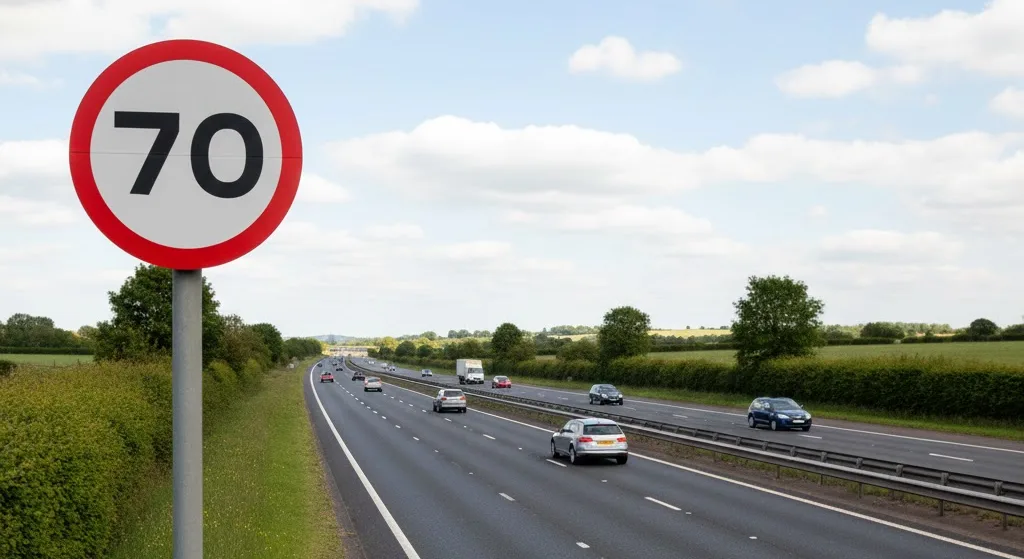
UK speed limits apply to every driver on every road, but the rules are more complex than most people realise. The limit varies not just by road type but by vehicle type, towing status, road conditions, and — increasingly — by the decisions of local authorities. This guide covers every speed limit that applies in the UK, the signs used to indicate them, the enforcement methods used to detect violations, and the full range of penalties for exceeding them.
How UK Speed Limits Are Set
Speed limits in the UK are set at three levels: national (by statute, applying to all roads of a given type by default), local (set by local authorities for specific roads), and variable (set in real time by traffic management systems on smart motorways).
The national speed limit — indicated by a white circular sign with a black diagonal stripe — is not a single fixed speed. It means "the national speed limit applies to this road for this vehicle type." The actual maximum speed depends on the type of road you are on and the type of vehicle you are driving.
Local authorities can set lower limits on specific roads for safety or environmental reasons. The most common local limit is 20 mph in residential areas, school zones, and town centres. Some areas have 40 mph limits on rural A-roads where the standard national limit would be 60 mph.
Speed Limits for Cars and Motorcycles
These are the default national speed limits for standard cars and motorcycles (excluding vehicles towing):
| Road Type | Speed Limit | Notes |
|---|---|---|
| Motorways | 70 mph | May be lower due to variable limits |
| Dual carriageways | 70 mph | Must be a physically divided carriageway |
| Single carriageways (rural) | 60 mph | National speed limit applies outside built-up areas |
| Built-up areas (street lighting) | 30 mph | Applies wherever there are street lights unless signed otherwise |
The street lighting rule
A 30 mph limit is implied wherever there are street lights — even without a speed limit sign. This applies to many residential streets, village roads, and main roads through built-up areas. If you see street lights and no other posted limit, assume 30 mph.
Speed Limits for Vans and Light Goods Vehicles
Vans and car-derived vans (CDVs) have the same speed limits as cars on most roads, with one important exception: on single carriageways, vans over 2 tonnes Maximum Authorised Mass (MAM) are limited to 50 mph, not 60 mph.
| Road Type | Car-derived vans / vans up to 2t | Vans over 2t (up to 3.5t) |
|---|---|---|
| Motorways | 70 mph | 70 mph |
| Dual carriageways | 70 mph | 70 mph |
| Single carriageways | 60 mph | 50 mph |
| Built-up areas | 30 mph | 30 mph |
Speed Limits When Towing
Towing a caravan, trailer, or any other load reduces your vehicle's braking performance and stability, and UK law reflects this with lower speed limits for towing vehicles. These apply to all vehicles — cars, vans, and larger — when they are towing.
| Road Type | Car towing / Car with trailer |
|---|---|
| Motorways | 60 mph |
| Dual carriageways | 60 mph |
| Single carriageways | 50 mph |
| Built-up areas | 30 mph |
For a full guide to towing rules, including weight limits, tow bar requirements, and licence requirements, see our guide to towing in the UK.
Speed Limits for Buses, Coaches, and Large Goods Vehicles
Larger vehicles are subject to lower speed limits across all road types:
| Road Type | Buses/Coaches | HGVs (over 7.5t) |
|---|---|---|
| Motorways | 70 mph | 60 mph |
| Dual carriageways | 60 mph | 60 mph |
| Single carriageways | 50 mph | 50 mph |
| Built-up areas | 30 mph | 30 mph |
Most modern HGVs and coaches are fitted with speed limiters that physically prevent them from exceeding 90 km/h (56 mph) and 100 km/h (62 mph) respectively. Tampering with or disabling a speed limiter is a serious criminal offence.
20 mph Zones: The UK's Expanding Local Limits
One of the most significant developments in UK speed limits in recent years has been the rapid expansion of 20 mph zones, particularly in Wales and in many English cities.
Wales: National Default 20 mph
In September 2023, Wales became the first UK nation to lower the default speed limit on restricted roads (those with street lighting) from 30 mph to 20 mph. This is now the default throughout Wales unless signs indicate otherwise. Higher limits (30 mph or more) apply on roads where local authorities have assessed that a higher limit is appropriate — typically busier A-roads and through routes.
If you are driving in Wales, the effective default in built-up areas is 20 mph, not 30 mph. The road signs use the same format as elsewhere in the UK — a speed limit sign with 20 in the circle. Where 30 mph applies on specific roads in Wales, it will be signed.
England: Local Authority Decisions
In England, 20 mph zones and limits continue to be set by individual local authorities. Most major cities — including London, Manchester, Birmingham, Sheffield, and Bristol — have introduced 20 mph limits across large areas of their residential road networks. Some have set 20 mph as a default across all residential streets.
As of 2026, there is no national default 20 mph in England. The Department for Transport has been consulting on the issue but has not legislated. This means the situation varies significantly: a residential street in one local authority may be 20 mph, while a comparable street in a neighbouring area is still 30 mph.
Scotland: School Zones and Roads
Scotland has introduced 20 mph as the default limit for the majority of roads in city centres, town centres, and residential areas, following legislation in 2025. The specifics of implementation vary by local authority, but drivers should assume 20 mph in built-up areas throughout Scotland unless signed otherwise.
Variable Speed Limits on Smart Motorways
Smart motorways use overhead gantry signs to display speed limits that change in real time based on traffic conditions, incidents, or weather. These variable speed limits (VSLs) are legally mandatory when displayed in the standard circular red-border format — not advisory.
A VSL can reduce the motorway speed limit to as low as 20 mph in severe incidents, though 40 or 50 mph are the most common temporary limits applied during congestion management. Average speed cameras measure your speed between consecutive gantries, so brief compliance at a camera point while speeding between them will still result in a penalty.
When there is no speed limit displayed on a smart motorway gantry — the sign is blank or shows only a white blank space — the national speed limit of 70 mph applies. If the gantry is showing an amber advisory speed (without a red circle), this is a recommendation, not a legal limit, though following it is strongly advised.
Temporary Speed Limits and Roadworks
Roadworks on motorways and major roads are typically accompanied by temporary speed limits, usually 50 mph. These are indicated by circular red-border signs and are fully enforceable. Average speed cameras are commonly deployed in roadworks sections to enforce the limit consistently throughout the works zone.
A common misunderstanding: the lower speed limit applies throughout the roadworks zone — not just when workers are physically present. Signs indicating "Speed cameras operating" or "Average speed check" apply to the entire zone during its operational period.
Speeding in an active roadworks zone carries the same penalties as speeding anywhere else, but courts often take a dimmer view of speeding where workers may be present. Some roadworks offences can result in higher fines and more points if there were workers in the vicinity.
Speed Limit Signs: A Complete Reference
Understanding every type of speed limit sign is essential for compliance:
- Red circle with number: Mandatory maximum speed limit for this road for your vehicle type. Applies immediately at the sign.
- White circle with black diagonal stripe: National speed limit applies (see tables above for your vehicle type and road type).
- Repeater signs: Smaller circular signs posted along roads to remind drivers of the current limit, used in 20 mph and 40 mph zones and on long stretches where the limit might otherwise be forgotten.
- Overhead gantry sign (motorway): Red circle with number — mandatory and camera-enforced. Blank or no sign — national speed limit applies.
- Amber advisory sign (motorway, no red border): Recommended speed only — not legally enforceable but strongly advised.
- Variable message signs with text: Speed limit may be shown alongside incident information or hazard warnings.
Speed limit signs marked with a "zone begins" sign apply until a corresponding "zone ends" or different limit sign is reached. In a 20 mph zone, for example, you do not need a repeater sign on every road within the zone — the zone boundary sign establishes the limit.
Speeding Penalties in Detail
UK speeding penalties are tiered based on how far above the limit you were travelling. The sentencing guidelines apply to court cases; fixed penalty notices are the standard outcome for minor violations.
Fixed Penalty Notice (FPN)
For most speeding offences caught by camera or stopped by police, you will receive a Notice of Intended Prosecution (NIP) within 14 days, followed by an opportunity to accept a Fixed Penalty:
- Fine: £100
- Penalty points: 3 points on your licence
- Validity: Points stay on your licence for 4 years from date of offence
Speed Awareness Course
For minor speeding — typically within a band of 10% plus 9 mph above the limit — you may be offered a speed awareness course as an alternative to the fixed penalty. For example, in a 30 mph zone, this would typically apply if you were caught at 35–42 mph.
The course costs around £80–100 and takes approximately 4 hours. It results in no points on your licence. You can only attend a course if you have not attended one in the previous 3 years. Not all police forces offer courses — it is at their discretion.
Court summons and sentencing bands
More serious speeding — particularly at significant levels above the limit — will result in a court summons. The Magistrates' Court Sentencing Guidelines provide three bands:
| Band | Example (30 mph zone) | Fine | Points |
|---|---|---|---|
| Band A | 31–40 mph | 50% of weekly income | 3 points |
| Band B | 41–50 mph | 100% of weekly income | 4–6 points or disqualification 7–28 days |
| Band C | 51 mph+ | 150% of weekly income | 6 points or disqualification 7–56 days |
Fines in court are based on a percentage of your weekly take-home income, with a minimum of £100 and a maximum of £1,000 (£2,500 for motorway speeding). Judges can also impose costs (prosecution costs), a victim surcharge, and — for serious cases — an immediate driving ban.
New drivers: lower threshold
Drivers who passed their test less than 2 years ago are subject to a lower threshold for disqualification. If you accumulate 6 or more penalty points within 2 years of passing your test, your licence is revoked automatically — you do not need to reach the standard 12-point threshold that applies to established drivers.
This means a new driver caught at a speed that generates 6 penalty points in a court case — or two separate 3-point fixed penalty notices — will lose their licence and must retake both the theory and practical tests before driving again.
Speed Enforcement Methods
Understanding how speed is enforced helps drivers understand what they may encounter on UK roads:
- Fixed speed cameras (Gatso, Truvelo etc.): Measure speed at a single point. Usually marked with yellow paint on the road and yellow/grey camera housings. Some forces mark approach roads with strips to indicate camera zones ahead.
- Average speed cameras (SPECS, VECTOR): Measure your average speed between two or more cameras spaced some distance apart. Common in roadworks zones and on some A-roads and motorways. Cannot be beaten by braking at the camera and accelerating between them.
- Mobile speed cameras: Officers using hand-held or vehicle-mounted laser or radar devices. Can operate from stationary vehicles or from moving vehicles in some jurisdictions.
- Unmarked police vehicles: Officers in unmarked cars can follow vehicles, measure speed using calibrated speedometers, and stop drivers. Approved for use on all road types.
- Automated Number Plate Recognition (ANPR): Used in combination with speed data to enforce average speed zones at scale.
Driving at the Right Speed: Beyond the Legal Limit
Speed limits define the maximum permissible speed — not the appropriate speed for conditions. Driving at 60 mph on a rural single-carriageway road in dense fog, heavy rain, or icy conditions may be within the legal limit but constitutes careless or dangerous driving.
The Highway Code states: "You must always drive at a speed that will allow you to stop well within the distance you can see to be clear." This is not optional guidance — it is a legal requirement.
Factors that should lead you to drive below the posted speed limit include:
- Poor visibility (fog, heavy rain, dusk, dawn)
- Slippery road surfaces (wet, icy, loose gravel)
- Road narrowing, bends with restricted sightlines
- Pedestrians or cyclists near the carriageway
- School zones during opening and closing times
- Animals on or near the road
- Emergency vehicles ahead or approaching
- Heavy traffic requiring frequent braking
Quick Reference Summary
| Vehicle | Built-up | Single carriageway | Dual carriageway | Motorway |
|---|---|---|---|---|
| Car / motorcycle | 30 | 60 | 70 | 70 |
| Car towing | 30 | 50 | 60 | 60 |
| Van / CDV up to 2t | 30 | 60 | 70 | 70 |
| Van over 2t (up to 3.5t) | 30 | 50 | 70 | 70 |
| Bus / coach | 30 | 50 | 60 | 70 |
| HGV over 7.5t | 30 | 50 | 60 | 60 |
All limits in mph. These are national defaults — local limits may be lower.
Related Articles
Frequently Asked Questions
What is the speed limit on a UK motorway?
The national speed limit on UK motorways is 70 mph for cars and motorcycles in good conditions. This drops to 60 mph for cars towing trailers or caravans, 60 mph for goods vehicles over 7.5 tonnes, and 60 mph for vehicles adapted for over 8 passengers (minibuses and coaches). On smart motorways, variable speed limits shown on overhead gantry signs are legally enforceable and can reduce the limit to 60, 50 or 40 mph — these override the national limit.
What is the default speed limit in a built-up area?
The default speed limit in a built-up area (defined as a road with street lighting) is 30 mph. This applies automatically wherever street lights are present and no other limit is signed. Many residential areas now have 20 mph zones imposed by local councils — these are signed at the zone entry and often reinforced with road markings. Scotland and Wales have made 20 mph the default in built-up areas unless signed otherwise — a significant change from England's 30 mph default.
What speed limit applies on a single carriageway A-road?
The national speed limit on a single carriageway A-road is 60 mph for cars. This is often confused with motorway limits. Single carriageways — roads with one lane in each direction separated by a painted white line — have a lower national limit than dual carriageways (70 mph) and motorways (70 mph). The single carriageway limit drops further for vehicles towing, HGVs, and minibuses. Local speed cameras and mobile units enforce single carriageway limits heavily, particularly at accident blackspots.
Can councils set their own speed limits?
Yes — local authorities can set speed limits below the national default on roads within their jurisdiction. The most common is the 20 mph zone in residential areas, school zones, and town centres. Councils can also apply for 40 mph limits on rural roads, or in exceptional cases request lower limits. Speed limit orders must be confirmed by the Secretary of State for Transport for limits below 20 mph. Variable speed limits on smart motorways are set nationally by National Highways, not local councils.
What is the 10% + 2 mph speed camera tolerance?
The '10% + 2 mph' tolerance is a prosecution policy used by most UK police forces — they typically do not issue a Notice of Intended Prosecution unless you exceed the limit by 10% plus 2 mph. For a 30 mph zone, that means 35 mph; for a 70 mph motorway, that means 79 mph. This is NOT a legal right — it is a discretionary policy that can be withdrawn at any time, and average speed camera systems are often calibrated to trigger below this threshold. Travelling at the limit is always the safest and legally safest approach.