UK Vehicle Breakdown: Complete Safety Guide 2026
James has been writing about UK roads, traffic law, and vehicle regulation for over 8 years. He holds a full UK Category B licence and has driven extensively on the UK motorway network.
A breakdown can happen to any driver at any time — regardless of vehicle age, condition, or how careful you are. What separates a manageable inconvenience from a life-threatening situation is knowing exactly what to do in the first few minutes. This guide covers every scenario you might face, from the correct procedure on a smart motorway with no hard shoulder to what to do on a remote country road in winter, plus the pre-journey preparation that makes a breakdown significantly less likely.
Emergency Numbers
999 — if you or anyone else is in immediate danger, or if your vehicle has stopped in a live lane on a motorway.
National Highways: 0300 123 5000 — non-emergency breakdown assistance on the English motorway and major A-road network.
Save your breakdown provider's number in your phone before you need it.
Recognising Warning Signs Before You Break Down
Many breakdowns are not sudden — vehicles give warning signs that give you time to act before you are completely stranded. Recognising these early can allow you to pull over in a safe location rather than being forced to stop in a dangerous one.
- Temperature gauge rising: Overheating can cause catastrophic engine damage within minutes. Pull over safely as soon as possible. Do not remove the radiator cap while the engine is hot.
- Oil warning light: Low oil pressure can seize an engine almost immediately. Stop driving as soon as it is safe.
- Vibration or pulling to one side: May indicate a tyre problem. Slow down gradually and steer to a safe area. Do not brake hard — this can cause loss of control.
- Smoke from the bonnet or burning smell: Could be oil burning on a hot engine, overheating coolant, or — most seriously — an electrical fire. Pull over immediately and switch off the engine.
- Battery/charging warning light: The alternator may have failed. Your battery is now your only power source — lights, power steering assist, and other systems may fail within minutes. Get off the road quickly.
- Loss of power steering: The wheel becomes suddenly much heavier to turn. Pull over — steering at speed without power assistance requires significant strength and concentration.
- Clunking, grinding, or unusual sounds: Can indicate anything from a wheel bearing failure to a driveshaft problem. Unusual sounds should be investigated — do not ignore them.
Breaking Down on a Traditional Motorway (with Hard Shoulder)
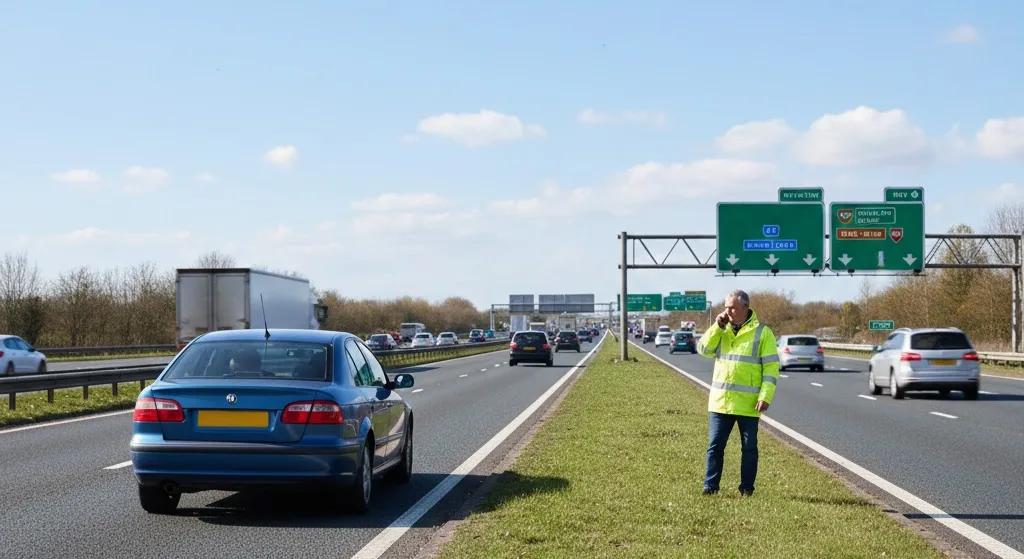
Traditional motorways — those without smart motorway designation — retain a hard shoulder: a paved lane to the left of the carriageway, separated by a solid white line. If your vehicle develops a problem on one of these, the procedure is:
- Signal left and move to the hard shoulder. Do this as early and as smoothly as possible. If you can see an exit, aim for that first — getting off the motorway entirely is always preferable.
- Pull as far to the left as possible, ideally with your wheels on or near the verge. Turn the wheels to the left so that if the vehicle is struck from behind, it will be deflected away from the live lanes.
- Switch on your hazard warning lights immediately — do this as you are pulling over, not after you have stopped.
- Exit the vehicle from the left (passenger) side. Do not open the driver's door — you could be struck by traffic in the hard shoulder or by vehicles that have drifted from lane 1.
- Get behind the safety barrier if one is present. Move well up the embankment if possible. Do not stand directly behind or in front of your vehicle — position yourself upstream of it (to your right as you face the carriageway) so that if the vehicle is struck, it will not be pushed into you.
- Do not attempt roadside repairs. Changing a tyre on a hard shoulder is extremely dangerous. Call for professional help.
- Call for help. Use the orange SOS emergency telephones (located every mile) if your mobile has no signal — they connect directly to National Highways and provide your exact location automatically. Otherwise, call your breakdown provider.
- If you have passengers, get everyone out of the vehicle and behind the barrier. Children and animals should be kept well away from the vehicle.
- Keep pets in the vehicle or on a lead. An animal loose on a motorway causes serious accidents.
- When returning to the vehicle to await help (only if no safer alternative exists), stay in the vehicle with the seatbelt fastened. Sit away from the side facing traffic if possible.
Warning triangles on motorways
Never place a warning triangle on or near a motorway. Walking back along a live carriageway to place one is far more dangerous than the benefit it provides. Warning triangles are intended for use on other roads, not motorways.
Breaking Down on a Smart Motorway (All Lane Running — No Hard Shoulder)
All Lane Running (ALR) smart motorways are the most challenging breakdown scenario, because the hard shoulder has been permanently converted to a running lane. If you break down between Emergency Refuge Areas (ERAs), you may be stopped in a live lane of fast-moving traffic.
If you notice a problem developing (before the breakdown)
- Move into the leftmost lane as early as possible.
- Look for the next ERA — marked with blue signs showing a telephone symbol and typically spaced every 1.5 miles (though some older sections have gaps of up to 2.5 miles).
- Put the car in neutral and coast if necessary to reach the ERA — maintaining momentum is worth it even at very low speed.
- If the ERA is too far and the vehicle is failing, make the decision to stop as far left as possible rather than stopping suddenly in lane 3.
If you reach an ERA
- Pull as far into the ERA as possible, away from the running lanes.
- Switch on hazard lights.
- Exit from the passenger side and stay behind the barrier.
- Use the SOS telephone in the ERA — it connects directly to National Highways, provides your exact location, and the operator can close the lane above you if necessary.
- Wait for a Traffic Officer or your breakdown provider. Do not attempt to walk away from the ERA along the carriageway.
- When leaving the ERA, build up speed to at least 50 mph before merging into the running lane.
If you break down in a live lane (worst case)
- Switch on hazard lights immediately.
- Call 999. This is a life-threatening emergency. Give the motorway number, the nearest junction numbers (these are posted at regular intervals on motorway boundary markers), and describe your situation.
- If it is safe to exit (check mirrors and blind spots — fast-moving traffic may be approaching), exit from the passenger side and get behind any available barrier. If there is no barrier, get as far from the carriageway as possible.
- If it is NOT safe to exit (traffic is passing too close to the passenger door), stay in the vehicle with your seatbelt fastened. Call 999 from inside the vehicle. Do not open any door into moving traffic.
- Stopped Vehicle Detection (SVD) technology should detect your stationary vehicle and automatically display a Red X above your lane within approximately 20–30 seconds on equipped sections — but do not rely on this. Some sections are not yet equipped.
The most important rule on a smart motorway
If you break down in a live lane and it is not safe to exit the vehicle, stay in the vehicle with your seatbelt on and call 999 immediately. Do not attempt to push the vehicle. Do not walk along the carriageway. A vehicle — even a stationary one — offers significant protection compared to a person standing in a live lane.
Breaking Down on a Rural Road or Country Lane
Breakdowns on rural roads present different challenges — mobile signal may be poor, emergency services response times are longer, and the road may be narrow with poor visibility. However, traffic speeds are typically lower, reducing the immediate danger.
- Try to get as far off the road as possible. On narrow country lanes, even a few feet can make a significant difference. Look for a passing place, a field entrance, or a wider verge.
- Choose your stopping location carefully. Avoid stopping on or just after a blind bend, on the brow of a hill, or in a dip where your vehicle will not be visible to approaching traffic.
- Switch on hazard lights.
- Place a warning triangle. Unlike on motorways, warning triangles are effective and appropriate on rural roads. Place it at least 45 metres behind your vehicle on the approach side, around a bend if necessary so drivers have warning before the hazard. Carry it — do not run — to the placement position.
- Stay off the road. Wait behind the vehicle or well to the side, not in the road itself.
- If you have no mobile signal, you may need to walk to find it. Try to get to higher ground, or look for a farm or house where you can call for help. Note your location carefully — the nearest village name, any road number or junction marker — so you can direct recovery services.
- In darkness, wear a high-visibility jacket if you have one, and use a torch. Make yourself as visible as possible to approaching traffic.
Breaking Down in a Tunnel or on a Bridge
Tunnels and bridges present specific challenges — limited space, no hard shoulder, and often poor ventilation.
- If possible, exit the tunnel or bridge before stopping. Coasting to the exit is almost always better than stopping inside.
- If you must stop inside a tunnel, pull over as far as possible to the left. Switch on hazard lights. Leave the engine running briefly if you need to avoid blocking ventilation, but switch it off before any fire risk.
- Use the SOS telephones located at regular intervals in all major UK tunnels.
- If there is any sign of fire or smoke, exit the vehicle immediately. Tunnel fires can develop extremely rapidly. Move to the nearest emergency exit door (marked with green signs in all UK tunnels).
- The Dartford Tunnel, Queensway Tunnel (Birkenhead), and Mersey Tunnel all have dedicated emergency response teams and procedures — follow the instructions of tunnel operators.
Breakdown Cover: What You Need to Know
Breakdown cover is not compulsory in the UK, but driving without it — particularly on motorways or long journeys — can be very costly. Recovery charges for a motorway breakdown can exceed £300 without cover.
Levels of cover
- Roadside assistance: A technician comes to you and attempts to fix the vehicle at the roadside. If they cannot fix it within a short period, the level of onward assistance depends on your policy.
- Recovery: If the vehicle cannot be repaired at the roadside, it is transported to a garage of your choice (within a distance limit) or the nearest garage. Essential for motorway breakdowns.
- At home cover: Extends coverage to breakdowns that happen at or near your home address — where basic roadside cover often does not apply.
- Onward journey: Provides for hotel accommodation, car hire, or alternative transport if your vehicle cannot be repaired same-day.
- European cover: Extends to breakdowns abroad — essential if you are crossing the Channel.
Major UK breakdown providers include the AA, RAC, Green Flag, and many insurance companies that offer breakdown cover as an add-on. Compare the levels of cover carefully — the cheapest policies often exclude recovery or onward journey assistance, which are the most valuable components.
Essential Emergency Kit
While you cannot prevent every breakdown, you can significantly reduce its impact by carrying the right equipment. The following items should be in every UK vehicle:
For visibility and safety
- High-visibility jacket (EN ISO 20471): Wear this before exiting the vehicle on any high-speed road. Keep it in the passenger compartment, not the boot — you may not be able to access the boot safely.
- Warning triangle: For use on non-motorway roads. Carry it in the passenger compartment as well.
- Torch with spare batteries (or LED torch with long battery life): For night breakdowns. LED head torches leave both hands free.
- Reflective warning light: A flashing LED beacon placed behind the vehicle is visible from much further than a warning triangle.
For vehicle recovery
- Jump leads or a portable battery jump starter: Battery failure is the most common cause of breakdown. A quality lithium jump starter is compact and can start most petrol and diesel engines multiple times.
- Tyre inflator and sealant: Many modern vehicles no longer carry a spare wheel. A tyre inflator can get you moving after a slow puncture. Note that sealant-repaired tyres cannot be subsequently repaired — only replaced.
- Spare wheel (or puncture repair kit if fitted): Know where it is, know how to access it, and know whether it is a full-size spare or a temporary use spare (which has a lower speed rating and distance limit).
- Wheel brace and locking wheel nut key: These should come with the vehicle — but make sure you know where they are and that the locking wheel nut key is present before you need it.
- Tow rope: For being moved off a carriageway quickly if needed.
For comfort and communication
- Charged mobile phone and portable power bank: Your most important single item. A dead phone on a motorway is a serious safety issue.
- Breakdown provider phone number saved in your phone.
- Water and snacks: You may wait more than an hour for recovery, particularly in busy periods or adverse weather.
- Warm clothing and blanket: A winter breakdown with a flat battery means no heating. Hypothermia is a real risk in cold weather, particularly for elderly drivers, children, or anyone waiting for extended periods.
- First aid kit: For any injuries sustained in the breakdown or while exiting the vehicle.
- Pen and paper: To note the breakdown location, insurer details, or third party information in the event of an accident.
Preventing Breakdowns: Pre-Journey Checks
The RAC and AA consistently report that the most common causes of breakdown callouts are entirely preventable:
| Cause | Prevention |
|---|---|
| Flat or under-inflated tyre | Check pressures monthly and before long journeys |
| Flat battery | Have battery tested annually on vehicles over 3 years old |
| Fuel starvation / running out of fuel | Plan fuel stops — never let tank drop below quarter |
| Engine overheating | Check coolant level monthly and before long trips |
| Engine oil failure | Check oil level monthly with dipstick |
| Misfuelling (wrong fuel) | Check the pump label before inserting — diesel nozzles do not fit petrol filler necks |
| Alternator or electrical failure | Regular servicing identifies deteriorating components |
Plan Your Journey Before You Set Off
Check for toll road charges, plan fuel stops, and know your route — preparation reduces both breakdown risk and the impact if something goes wrong.
Plan Your Route