Motorway Driving Tips UK: Complete Safety Guide 2026
James has been writing about UK roads, traffic law, and vehicle regulation for over 8 years. He holds a full UK Category B licence and has driven extensively on the UK motorway network.
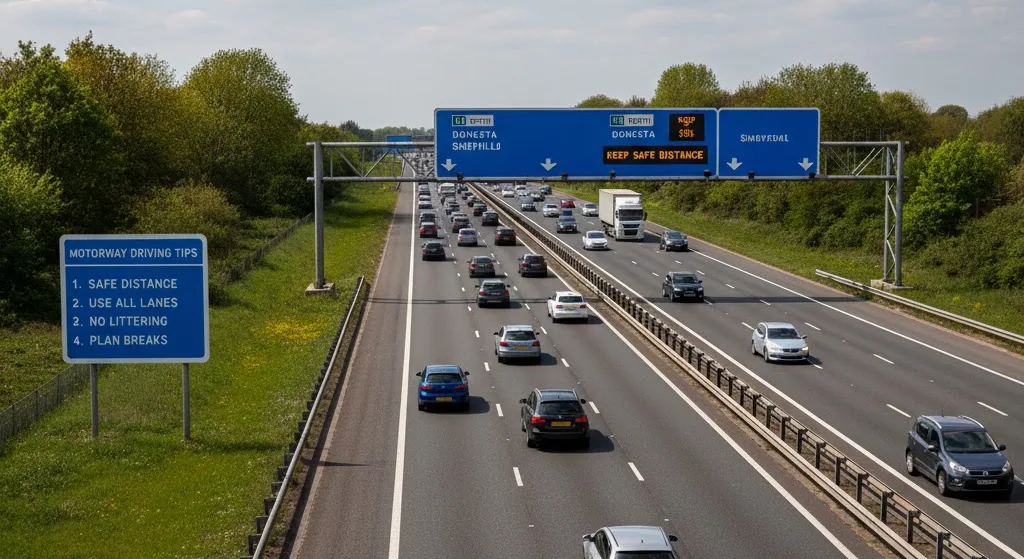
Motorways carry around a third of all UK traffic but account for only about 5% of road casualties — making them statistically the safest type of road in the country. Yet they present unique hazards that require specific skills, awareness, and preparation. Whether you are a newly qualified driver about to tackle a motorway for the first time, or an experienced driver looking to sharpen your technique, this guide covers everything from lane discipline to handling a breakdown on a smart motorway.
Before You Set Off: Pre-Journey Checks
The most common cause of motorway breakdowns is not mechanical failure but driver neglect — failing to check basic vehicle conditions before a long journey. Before any significant motorway trip:
- Tyre pressures: Check all four tyres when cold (before you have driven more than a mile). Under-inflation causes overheating at motorway speeds and is a leading cause of tyre blowouts. Find the correct pressures in your vehicle's handbook or inside the fuel cap or door frame.
- Tyre tread depth: The legal minimum is 1.6mm across the central three-quarters of the tread around the full circumference, but tyres begin to lose effectiveness in wet conditions from around 3mm. A tyre that is legal but worn still represents a risk at 70 mph.
- Engine oil: Check with the dipstick on a level surface with the engine cold. Running low on oil can cause irreparable engine damage within minutes, and a seized engine on a motorway is a dangerous and expensive breakdown.
- Coolant level: Check the reservoir when cold. Overheating is another common motorway breakdown cause, particularly in summer or when towing.
- Fuel: Sounds obvious, but running low on fuel on a motorway can be more than just inconvenient. Deliberately running out of fuel on a motorway can constitute a careless driving offence. Plan your fuel stops in advance, particularly on long journeys at night when service stations can be far apart.
- Windscreen washer fluid: At 70 mph, a dirty windscreen can reduce visibility dramatically within seconds of a lorry passing. Keep the reservoir full.
- Lights: A quick walk around the car before setting off will identify any blown bulbs. A faulty brake light is not only illegal but significantly increases your rear-end collision risk.
- Breakdown cover: Know your breakdown provider's number before you need it. Save it in your phone. If you are not covered, consider arranging a day policy for a long journey — they are available from most providers.
Lane Discipline: The Foundation of Safe Motorway Driving
Lane discipline is the single most important skill on a motorway, and the area where UK drivers most commonly make errors. The Highway Code is clear on this: keep left unless overtaking. This is not advisory guidance — it is a legal requirement.
Understanding the lanes
- Lane 1 (left lane): The default driving lane for all vehicles. You should be in this lane unless you are overtaking. Return to lane 1 as soon as it is safe to do so after overtaking.
- Lane 2 (middle lane): For overtaking slower vehicles in lane 1. Once you have completed the overtake and there is a safe gap ahead in lane 1, move back into lane 1.
- Lane 3 (right lane): For overtaking traffic in lane 2, or for a continuous overtaking manoeuvre when lane 1 and 2 are both occupied with slower vehicles ahead. Not a "fast lane" to cruise in.
Middle lane hogging is illegal
Driving in lane 2 when lane 1 is clear ahead of you is known as "middle lane hogging" and constitutes careless driving under the Road Traffic Act. Fixed penalty: £100 fine and 3 penalty points. It also forces overtaking traffic to move to lane 3 unnecessarily, reducing safety margins for everyone. If you are being tailgated in lane 2, move to lane 1 — not because the tailgater is right to tailgate, but because it resolves the situation safely.
Overtaking correctly
Overtaking on the motorway should be a smooth, planned manoeuvre — not a reaction to finding yourself behind a slow vehicle. The correct procedure:
- Check your mirrors — centre, then right-side mirror — to assess traffic in the lane you intend to move into.
- Check your blind spot over your right shoulder, particularly for motorcyclists who may be travelling faster than they appear.
- Signal right in good time before moving.
- Move into the outer lane when there is a safe gap ahead and behind.
- Increase your speed to complete the overtake promptly — do not match the pace of the vehicle you are passing and linger alongside it.
- Once you have passed and there is sufficient clear road ahead of the overtaken vehicle, signal left and return to lane 1.
Undertaking — overtaking on the left — is generally illegal in the UK. The only exceptions are in very slow-moving queuing traffic where your lane is moving faster than the lane to your right, or when a left-turn slip road is signed. Do not use the hard shoulder to undertake.
Safe Following Distance
Tailgating is one of the most dangerous behaviours on the motorway. At 70 mph, a vehicle is travelling at approximately 31 metres per second. If you are less than 2 seconds behind the vehicle ahead and it brakes suddenly, you have almost no chance of stopping in time.
The two-second rule
The two-second rule is a minimum for dry conditions at motorway speeds. To apply it:
- Pick a fixed point on the road ahead — a bridge, a road sign, a patch of tarmac.
- As the vehicle ahead passes that point, begin counting: "one-thousand-and-one, one-thousand-and-two."
- You should not reach the same fixed point until you have finished counting.
- If you pass it before finishing, you are too close. Ease off the accelerator — do not brake — to create more space.
Adjusting for conditions
- Wet roads: Double the gap to at least 4 seconds. Wet tarmac significantly extends stopping distances.
- Fog: Follow the 2-second rule for visibility — you should be able to stop within your range of vision. If you can only see 30 metres ahead, you should not be travelling at a speed where you cannot stop within 30 metres.
- Ice or snow: Stopping distances can be up to 10 times longer than on dry roads. A gap of 10 seconds or more may be appropriate. If in doubt, do not use the motorway at all.
- Towing a caravan or trailer: Your stopping distance is significantly longer. Add at least 50% to the minimum gap.
- Driving a large van or HGV: Larger vehicles take longer to stop. Maintain a greater gap proportional to your vehicle's weight and length.
Operation Tramline — a National Highways enforcement initiative — uses unmarked vehicles with forward-facing cameras mounted high enough to film into car cabs. Officers can issue fixed penalty notices for tailgating observed over extended periods on the motorway network. Tailgating prosecutions are increasing year on year.
Joining the Motorway
Joining a motorway via a slip road requires a smooth acceleration and good judgement of gaps in traffic. Poor slip road behaviour is a common cause of motorway accidents.
- Use the full length of the slip road to accelerate to motorway speed — typically 60–70 mph. Joining at 40–50 mph forces vehicles behind you to brake and creates a compression wave in lane 1.
- Look ahead and use your mirrors to assess the gaps in lane 1 as you travel along the slip road. Do not wait until you are at the merge point to look.
- Signal right to indicate your intention to join, but check that it is safe before moving.
- Give way to motorway traffic — vehicles already on the motorway have priority. Do not force your way in or expect lane 1 traffic to slow or move out for you.
- If there is no safe gap, slow down on the slip road rather than merging unsafely. Some slip roads have enough length to allow you to wait for a gap.
Leaving the Motorway
Leaving the motorway sounds straightforward, but speed blindness — where your perception of speed becomes distorted after sustained high-speed driving — is a real and dangerous phenomenon. After 30 minutes at 70 mph, 40 mph on a slip road feels like a crawl, but it is enough to kill in a collision.
- Move into lane 1 well before your exit — do not leave it until the last moment. Watch for the countdown markers (300, 200, 100 yards before the exit) and prepare in advance.
- Signal left as you approach the exit.
- Brake on the slip road, not on the motorway. Reducing speed before the slip road causes unnecessary braking in lane 1 behind you.
- Check your speedometer on the slip road. You will almost certainly be going faster than you think — particularly if you have been driving at a steady 70 mph for some time.
- Obey the speed limit signs on and after the slip road. Speed limit cameras are often positioned on or after motorway exit routes.
Smart Motorways: What's Different
Over 500 miles of the UK motorway network are now designated as smart motorways, with some or all of the traditional hard shoulder converted to a running lane. The key differences you need to know:
- Variable speed limits on overhead gantries are mandatory and camera-enforced — obey them exactly as you would a fixed speed limit sign.
- Red X signals on overhead gantries mean the lane below is closed. It is illegal to drive in a Red X lane. Fixed penalty: £100 and 3 points.
- Emergency Refuge Areas (ERAs) replace the hard shoulder as a place of safety. Look for the orange and blue signs. They are spaced approximately every 1.5 miles.
- If you break down and cannot reach an ERA, switch on hazard lights and call 999 — it is an emergency.
For a complete guide to smart motorways, see our dedicated Smart Motorways Guide.
Breaking Down on a Motorway
Even with thorough pre-journey checks, breakdowns happen. Knowing what to do in advance — and having rehearsed it mentally — can save your life.
If you can reach an exit or service area
- Leave the motorway at the next exit or service area. Do not stop on the carriageway unless you have no alternative.
- Coast in neutral if necessary to reach the exit — maintaining momentum is worth it even at low speed.
- Once safely off the motorway, call your breakdown provider.
If you must stop on the hard shoulder (traditional motorways)
- Pull onto the hard shoulder and stop as far to the left as possible, with your wheels turned to the left (so if you are struck from behind, the vehicle is deflected away from live traffic).
- Switch on hazard lights immediately.
- If you have them, place a warning triangle at least 45 metres behind the vehicle (but do not do this on a smart motorway with no hard shoulder).
- Exit the vehicle from the left (passenger) side — never the right (traffic) side.
- Get behind the barrier or as far from the road as possible. If there is no barrier, move well up the embankment.
- Do not stand behind the vehicle.
- Call your breakdown provider, or use the SOS phone at the orange emergency telephone posts (every mile on traditional motorways).
- When recovered, wait in the vehicle if there is no safe place outside — it is safer than standing on the verge in some cases.
Never walk along a motorway carriageway
Walking along a live motorway lane, or even on the hard shoulder, is extremely dangerous and illegal. If your vehicle breaks down beyond walking distance of an emergency telephone, stay in the vehicle (seatbelt on) and call 999 if you feel unsafe. Highway Traffic Officers are typically on the motorway network within 20–30 minutes.
Motorway Driving in Bad Weather
UK weather can change rapidly, and conditions that are perfectly manageable at 70 mph can become treacherous with minimal warning.
Rain and spray
Heavy rain reduces visibility, extends stopping distances, and increases aquaplaning risk. When there is spray from other vehicles, reduce your speed, increase following distance to at least 4 seconds, and use dipped headlights (even in daytime, when visibility is significantly reduced).
Aquaplaning occurs when a film of water builds up between your tyres and the road surface faster than the tread can disperse it. Warning signs include suddenly light steering and a feeling of the car floating. If you aquaplane: do not brake hard; ease off the accelerator smoothly; keep the steering straight; allow speed to reduce naturally until grip returns.
Fog
Switch on fog lights when visibility drops below 100 metres. Switch them off when visibility improves — driving with fog lights in clear conditions can dazzle other drivers and is an offence. Reduce speed to match your visibility: you must be able to stop in the distance you can see clearly.
"Motorway fog accidents" — where multiple vehicles collide in chain-reaction crashes in dense fog — are almost always caused by drivers travelling at inappropriate speeds and following too closely. The safest decision in very dense fog is often not to travel at all.
Strong winds and crosswinds
High-sided vehicles (lorries, motorhomes, caravans) are vulnerable to crosswinds, particularly when emerging from sheltered sections of motorway (cutting through hills, bridge approaches, leaving gaps between trees). Overtaking a lorry in strong wind can expose you to a sudden gust that may push you across the lane. Be extra cautious when the forecast includes strong winds.
Ice and snow
Motorways are usually gritted before residential roads in severe weather, but ice can still form in sheltered sections, on bridges, and early in the morning before gritters have been out. If you must use a motorway in icy conditions: reduce speed to 50 mph or below; increase following distance to at least 10 seconds; avoid sudden steering, acceleration, or braking inputs; and never use cruise control on icy roads.
Dealing with Traffic Jams Safely
Stop-start traffic jams are where rear-end collisions are most common on motorways, because drivers underestimate how quickly traffic in front can slow or stop. "Shunt" accidents in queuing traffic are the most frequent type of motorway collision.
- Use the two-second rule even in slow traffic — the vehicle in front can still stop faster than you expect at 20 mph.
- Watch brake lights several vehicles ahead rather than just the vehicle directly in front. Earlier warning = more time to react.
- In stop-start traffic, leave enough space so that when traffic stops completely, you can see the rear tyres of the vehicle in front touching the road — this gives you space to manoeuvre if needed.
- Do not use your phone, even at a standstill in a traffic queue on a motorway. The offence applies whenever the engine is running.
- Keep your vehicle in gear when stationary in a motorway queue — you need to be able to move immediately if needed.
Driver Fatigue: One of the Most Underrated Hazards
Tiredness is a factor in around 20% of serious road accidents and up to 25% of fatal and serious crashes on monotonous roads like motorways. The brain struggles to maintain vigilance in the low-stimulation environment of a long motorway journey, particularly between 2am–6am (the "fatigue window") and to a lesser extent between 2pm–4pm.
Signs of fatigue while driving include: difficulty focusing; blinking frequently; difficulty remembering the last few miles; drifting within the lane or crossing lane markings; missing exits or road signs; feeling heavy-headed or yawning repeatedly.
What to do: The only reliable remedy for fatigue is sleep. Short-term measures include:
- Pull into a service area and take a 15–20 minute nap. This is the most effective short-term intervention.
- Drink two cups of caffeinated coffee or energy drink before the nap — caffeine takes about 20 minutes to reach peak effect, so you may feel its benefit as you wake up.
- Do not rely on opening the window, turning up the radio, or other "staying awake" measures — these do not address the underlying fatigue.
- Plan journeys to avoid the main fatigue windows if possible. If you must travel overnight, take a break every 2 hours.
Fuel Efficiency on the Motorway
Motorway driving is actually more fuel-efficient than urban stop-start driving for most cars — but only if you drive smoothly and at moderate speeds. Fuel consumption increases significantly above 60–65 mph due to air resistance:
- Driving at 80 mph uses approximately 25% more fuel than at 70 mph for a typical car.
- Driving at 70 mph uses approximately 9% more fuel than at 60 mph.
- Use cruise control on long, steady sections to maintain a constant speed — this eliminates the unconscious speed creep and braking cycles that add up to significant extra fuel consumption.
- Leave plenty of following distance so you can react to slowing traffic with a gradual easing off the accelerator rather than braking. Braking wastes all the energy you have just used to accelerate.
- Remove roof boxes or roof bars when not in use. A roof box can increase fuel consumption by 10–15% at motorway speeds due to increased aerodynamic drag.
- Ensure tyres are inflated to the correct pressure. Under-inflated tyres increase rolling resistance and fuel consumption.
Motorway Driving and the Law: Key Offences and Penalties
| Offence | Penalty | Points |
|---|---|---|
| Speeding (fixed penalty) | £100 | 3 |
| Speeding (court summons, motorway) | Up to £2,500 | 3–6 + possible ban |
| Middle lane hogging (careless driving) | £100 | 3 |
| Tailgating (careless driving) | £100 | 3 |
| Driving in Red X lane (smart motorway) | £100 | 3 |
| Using a mobile phone while driving | £200 | 6 |
| Not wearing a seatbelt | Up to £500 | No points, but fine |
| Dangerous driving | Unlimited fine | Disqualification |
Plan Your Motorway Journey
Calculate fuel and toll costs before you set off — including M6 Toll, Dartford Crossing and all UK toll roads.
Calculate CostsRelated Articles
Frequently Asked Questions
What is the correct lane discipline on a UK motorway?
The Highway Code requires drivers to keep left unless overtaking. The middle lane should only be used when overtaking slower vehicles in the left lane — not as a cruising lane. The right lane is for overtaking only. Middle lane hogging is a specific offence under careless driving legislation and carries a £100 Fixed Penalty Notice and 3 points. After overtaking, return to the left lane as soon as it is safe to do so.
How close should I drive to the car in front on a motorway?
The two-second rule applies at motorway speeds as a minimum — allow at least two seconds of gap between you and the vehicle in front under dry conditions. In wet weather, the gap should be doubled to four seconds. At 70 mph, two seconds represents approximately 63 metres of distance. Many drivers significantly underestimate this distance. A useful method: pick a fixed point (bridge, lamp post) and count two seconds after the vehicle ahead passes it before you reach the same point.
What should I do if I miss my motorway exit?
Continue to the next junction and leave there — never reverse on a motorway or slip road, as reversing on a motorway is illegal and extremely dangerous. Once off the motorway, use the road network to return or re-join. The additional distance is frustrating but minor compared to the risk of a rear-end collision. Plan your route in advance and set navigation instructions before you join the motorway to avoid missing exits.
Can learner drivers use motorways?
Yes — since June 2018, learner drivers in England, Scotland and Wales can use motorways, but only when accompanied by an approved driving instructor (ADI) in a dual-control vehicle. They may not practice on motorways with a private supervising driver. Once passed, new drivers can use motorways independently, but the government recommends taking Pass Plus or motorway familiarisation lessons to build confidence on high-speed roads.
When should I use my hazard lights on a motorway?
Hazard lights should only be used on a motorway in two situations: when your vehicle is stationary and causing a hazard (breakdown, accident), or as a brief warning signal to vehicles behind that there is a sudden, unexpected hazard ahead — for example, sudden stop-start traffic forming at speed. Do not drive with hazard lights on in heavy rain or as a general warning — this is illegal, masks your indicator signals, and makes it harder for other drivers to react correctly to your movement.