EV Charging on UK Motorways: Complete Planning Guide 2026
James has been writing about UK roads, traffic law, and vehicle regulation for over 8 years. He holds a full UK Category B licence and has driven extensively on the UK motorway network.
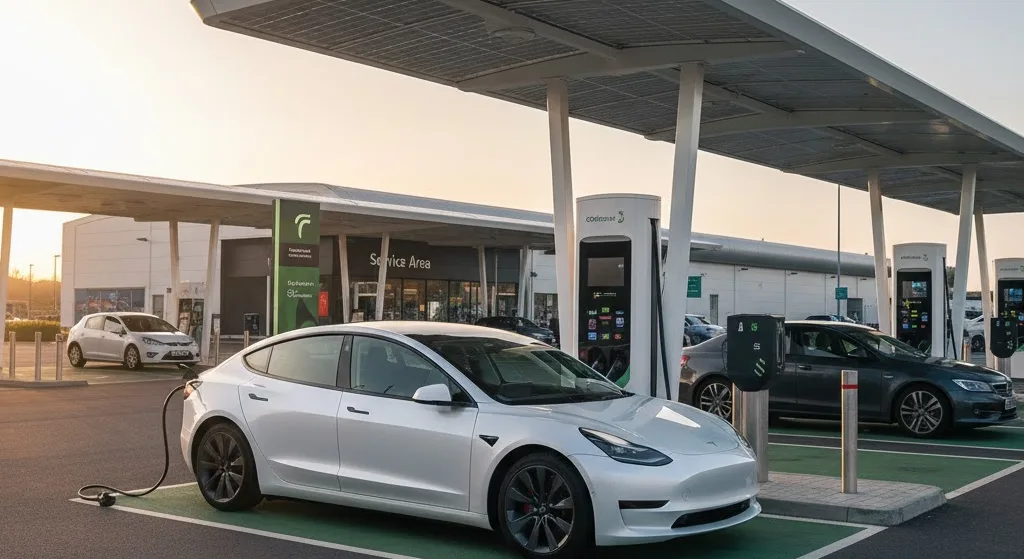
Long-distance EV travel on UK motorways has improved dramatically since 2022. The UK now has over 70,000 public charge points across the country, with rapid and ultra-rapid chargers at almost every motorway service station on the main network. But the charging landscape remains fragmented, with different networks, different speeds, different payment methods, and significant variation in price. This guide gives you everything you need to plan a UK motorway journey in an electric vehicle in 2026 — including real-world range expectations, cost comparisons, network-by-network breakdown, and the apps that make it manageable.
The UK Motorway Charging Network in 2026
The UK government set a target for all motorway service areas (MSAs) to have 6 or more rapid charge points by 2023, and the reality in 2026 has largely met or exceeded that. Most MSAs on the main motorway network (M1, M6, M25, M4, M3, M40) now have between 6 and 24 charge points. The density varies significantly by location and by operator.
The main operators at UK motorway services in 2026:
Major Charging Networks at UK Motorway Services
| Network | Max Speed | Approx. Price (2026) | Payment |
|---|---|---|---|
| Gridserve Electric Highway | 350 kW | 79p/kWh | Contactless card; no app required |
| Osprey | 150 kW | 75–85p/kWh | Contactless card |
| Tesla Supercharger (non-Tesla) | 250 kW | 55–65p/kWh | Tesla app or contactless card |
| BP Pulse | 150 kW | 65–80p/kWh | BP Pulse app or contactless |
| Ionity | 350 kW | 70–90p/kWh (members lower) | Ionity app or partner apps; contactless |
| Pod Point (EDF) | 50 kW | 55–75p/kWh | Pod Point app or contactless |
Prices are approximate as of early 2026 and vary by location and time. Networks may offer lower member rates. Confirm current prices on each network's app before charging.
Charging Speeds Explained
Understanding charging speed is essential for planning stops. The key figure is the charger's maximum power output in kilowatts (kW) — but what you receive is also limited by your car's maximum charge acceptance rate. A 350kW charger is useless if your car can only accept 100kW.
| Charger Type | Speed | Time to 80% (60kWh battery) | Where Found |
|---|---|---|---|
| Slow (AC) | 3–7 kW | 7–14 hours | Home, hotels, some car parks |
| Fast (AC) | 7–22 kW | 2–6 hours | Car parks, supermarkets, destinations |
| Rapid (DC) | 50–100 kW | 35–60 minutes | Motorway services, A-road locations |
| Ultra-Rapid (DC) | 150–350 kW | 12–25 minutes | Premium motorway hubs, Gridserve sites |
The 10–80% Rule
Most EVs charge fastest between 10% and 80% — battery chemistry means charging slows significantly above 80% as the management system protects the cells. For motorway stop planning, target arriving at the charger with 10–20% remaining and charging to 80%. This gives you the fastest possible stop time. On longer journeys, two 20-minute rapid stops are usually quicker than one 45-minute stop aiming for 95%.
Real-World EV Range: What to Expect
Manufacturers' WLTP range figures are typically achievable under ideal conditions (moderate temperature, 60–70 mph, flat road, no heating/AC). Real-world motorway range at 70 mph in varied UK conditions is typically 15–30% lower than the WLTP figure. This gap is the source of much "range anxiety" — planning based on WLTP and then finding the actual range is lower.
| EV Model (example) | WLTP Range | Real-World Motorway (70 mph, mild weather) | Winter (cold, 70 mph) |
|---|---|---|---|
| Tesla Model 3 Long Range | 374 miles | ~290 miles | ~210 miles |
| BMW iX3 | 286 miles | ~230 miles | ~165 miles |
| Volkswagen ID.4 | 330 miles | ~260 miles | ~185 miles |
| Nissan Leaf (40kWh) | 168 miles | ~130 miles | ~90 miles |
| Kia EV6 Long Range | 328 miles | ~265 miles | ~190 miles |
Approximate figures for guidance — actual range varies significantly by driving style, temperature, payload, and tyre type. Check your vehicle's specific data before a long journey.
Factors That Reduce EV Range
- Speed — aerodynamic drag increases with the square of speed. Going from 60 mph to 70 mph increases energy use by approximately 20–25%. The single most effective way to extend EV range is to slow down.
- Cold weather — both battery chemistry (less efficient in cold) and cabin heating loads reduce range. In sub-zero conditions, range can be 30–40% lower than mild-weather figures.
- Motorway headwinds — a 10 mph headwind can reduce range by 10–15%.
- Air conditioning in hot weather — less impactful than heating, but can cost 5–10% of range.
- Roof boxes or bike racks — increase aerodynamic drag significantly. A fully loaded roof box can reduce range by 15–20% at motorway speeds.
- Number of passengers and luggage — heavier loads mean more energy to accelerate.
Charging Costs vs Petrol: 2026 Comparison
| Charging/Fuel Type | Cost per kWh / per litre | Cost per 100 miles (typical efficient vehicle) |
|---|---|---|
| Home EV charging (off-peak tariff) | 7–15p/kWh | £2–5 |
| Home EV charging (standard tariff) | 24–30p/kWh | £7–9 |
| Public fast charger | 35–55p/kWh | £11–17 |
| Motorway rapid charger | 65–85p/kWh | £20–26 |
| Tesla Supercharger (non-Tesla) | 55–65p/kWh | £17–20 |
| Petrol (unleaded, 45 MPG car) | ~£1.47/litre (early 2026) | ~£20 |
| Diesel (55 MPG car) | ~£1.53/litre (early 2026) | ~£17 |
The key takeaway: charging entirely at home (particularly on an off-peak EV tariff like Octopus Go or OVO Drive) makes electric motoring dramatically cheaper than petrol. Using only motorway rapid chargers, the cost advantage over diesel is significantly reduced — and for shorter, efficient diesel cars, you may pay similar amounts. The economics of EVs work best when the majority of charging happens at home.
Planning a Motorway EV Journey
Step 1: Check Your Real-World Range
Before planning charge stops, establish your realistic motorway range under expected conditions. If it's winter, knock 25–30% off your WLTP figure. If you're driving at 70 mph against a headwind, knock off another 10–15%. Use your car's in-built consumption display from previous motorway journeys as the best guide.
Step 2: Use a Route Planner That Understands Your Car
General mapping apps (Google Maps, Apple Maps) now include basic EV charging stop suggestions, but A Better Route Planner (ABRP) is significantly more sophisticated: it knows the specific charge curve for hundreds of EV models, accounts for real-world range at your expected speed, temperature, and payload, and suggests optimal charge stops with expected wait times.
Most modern EVs (Tesla, BMW, Mercedes EQ, Hyundai/Kia E-GMP) have built-in route planners that are closely integrated with the battery management system — these tend to be the most accurate for their specific vehicle. Use the in-car system as your primary planning tool, backed up by ABRP or Zap-Map for contingency planning.
Step 3: Identify Primary and Backup Charge Stops
For each planned charge stop:
- Identify the primary stop (the recommended rapid charger at the MSA)
- Identify a backup stop 5–15 miles before it (in case your primary is all occupied)
- Note the network operator so you can check live availability before you arrive
- Have the network's app or contactless payment ready before you need it
Step 4: Arrive with 10–20% Remaining
Arriving at a charger with 10–20% battery optimises the charge speed you'll receive (the battery accepts peak current when partially depleted). Arriving with 5% creates anxiety if the charger is occupied or has a fault — there's no margin for error. Arriving with 30% means you left your previous stop too early and are paying more for a partial charge.
Common EV Motorway Charging Problems and Solutions
| Problem | Cause | Solution |
|---|---|---|
| Charger won't start | Faulty charger, network outage, payment issue, wrong cable type | Try a different socket; call the network's helpline (number on charger); try contactless if app failed |
| All chargers occupied | Peak times (Friday afternoon, bank holidays, summer motorways) | Check live availability on Zap-Map before arrival; have a backup stop identified; peak times are predictable — plan to charge slightly earlier or later |
| Charging slower than expected | Battery above 80%, cold battery, sharing charger capacity with another vehicle | Pre-condition battery if cold; accept slower rate above 80%; move on when sufficiently charged rather than waiting for 100% |
| ICE'd (non-EV parked in charge bay) | Inconsiderate parking in EV-only bays | Report to MSA staff; parking enforcement at many MSAs now active; use Zap-Map to report for other EV drivers |
| Cable not reaching car | Parked too far from the charger unit | Pull forward or reverse; cables are typically 4–5m; position your charge port close to the unit |
Winter EV Charging: What Changes
Winter is the most demanding time for EV motorway travel. Range drops, charging speeds may be slower (cold batteries accept less current), and demand for charge points is higher as drivers stop more frequently.
- Pre-condition the battery while still plugged in at home before departure. Most EVs allow you to schedule cabin heating and battery pre-warming to start while still on the home charger — you leave with both battery and cabin at optimal temperature without using stored energy.
- Plan more frequent, shorter stops rather than fewer, longer ones. In winter, arriving with 20% rather than 10% gives more margin.
- Use seat heating instead of cabin heating where possible — seat heaters are far more energy-efficient than blowing hot air into a cold cabin.
- Battery warming feature: most modern EVs have automatic battery pre-conditioning when navigation is set to a charger — the battery management system heats the battery during the approach to the charger to maximise charge acceptance speed. Ensure navigation is active rather than manually driving to a charger.
- Expect charging to start slower on very cold days — the first few minutes may show lower power until the battery warms up slightly.
EV Charging and Toll Roads
EVs have significant advantages when it comes to UK road charges:
- ULEZ and Clean Air Zones — fully electric vehicles are exempt from the London ULEZ charge (£12.50/day) and all UK city Clean Air Zone charges (Birmingham, Bristol, Bath, Bradford). This is a substantial saving for anyone driving regularly into city centres.
- Dartford Crossing — fully electric vehicles in 100% zero-emission tax class are exempt from the Dart-Charge (normally £2.50 per crossing). This is confirmed via the DVLA vehicle tax class — ensure your EV is registered as zero-emission, not just low-emission.
- M6 Toll — unfortunately, EVs are not exempt from the M6 Toll. You pay the standard Class B rate (£7.60 in 2026) regardless of powertrain.
Money-Saving Tips for EV Motorway Charging
- Home charge as much as possible before departure — leave with a full battery, reducing the number of motorway stops needed
- Sign up for network memberships that match your regular routes — Ionity Passport, BP Pulse monthly, and Osprey subscriptions all offer discounted rates vs pay-as-you-go
- Use Tesla Superchargers where open to non-Tesla — often 15–20p/kWh cheaper than competing rapid networks at comparable locations
- Avoid 80–100% charging at motorway prices — slow charging above 80% at 80p/kWh is extremely expensive per mile of range added
- Use retail park or supermarket chargers where available near motorway junctions — these are often significantly cheaper (30–50p/kWh) than on-motorway services
- Drive at 60–65 mph if time allows — the range extension vs 70 mph is 15–20%, meaning one fewer stop on long journeys
Best Apps for UK EV Motorway Travel
| App | Best For | Platform |
|---|---|---|
| Zap-Map | UK-wide charger map with live availability | iOS, Android, web |
| A Better Route Planner (ABRP) | Full route planning with car-specific range calculations and charging stop optimisation | iOS, Android, web |
| Gridserve app | Live status, pricing, and remote start for Gridserve network (majority of MSA chargers) | iOS, Android |
| Tesla app | Required for non-Tesla users at Tesla Superchargers; shows pricing and stall availability | iOS, Android |
| Octopus Energy app | Smart home charging scheduling; Electroverse feature allows payment across 500+ networks with one card | iOS, Android |
Frequently Asked Questions
How long does a motorway rapid charge take?
At a 50kW rapid charger, expect 45–60 minutes to 80% from 20% starting charge in a mid-range EV. At a 150–350kW ultra-rapid charger (now standard at most major MSAs), expect 15–25 minutes to 80% if your car can accept those speeds. Remember: charging above 80% takes disproportionately long — most motorway stops should target 80%, not 100%.
Are there enough charge points on UK motorways?
On the main motorway network in 2026, charger availability has improved significantly. However, on busy bank holiday weekends and peak Friday afternoons, queues can form at popular stops on the M1, M6, and M4. Checking live availability via Zap-Map and having a backup stop planned is still important for reliable planning.
Can I use any charger with any EV?
In the UK, all modern EVs (except Tesla vehicles using the original Type 2 Tesla port) use either a Type 2 AC connector or a CCS2 DC connector. All current public rapid and ultra-rapid chargers in the UK offer CCS2 as standard. Older Nissan Leafs use CHAdeMO for DC rapid charging — this connector type is being phased out and is absent from many newer installations. Tesla vehicles now also accept CCS2. Check your car's charge port before travelling.