How to Calculate UK Fuel Costs: Complete 2026 Guide
James has been writing about UK roads, traffic law, and vehicle regulation for over 8 years. He holds a full UK Category B licence and has driven extensively on the UK motorway network.
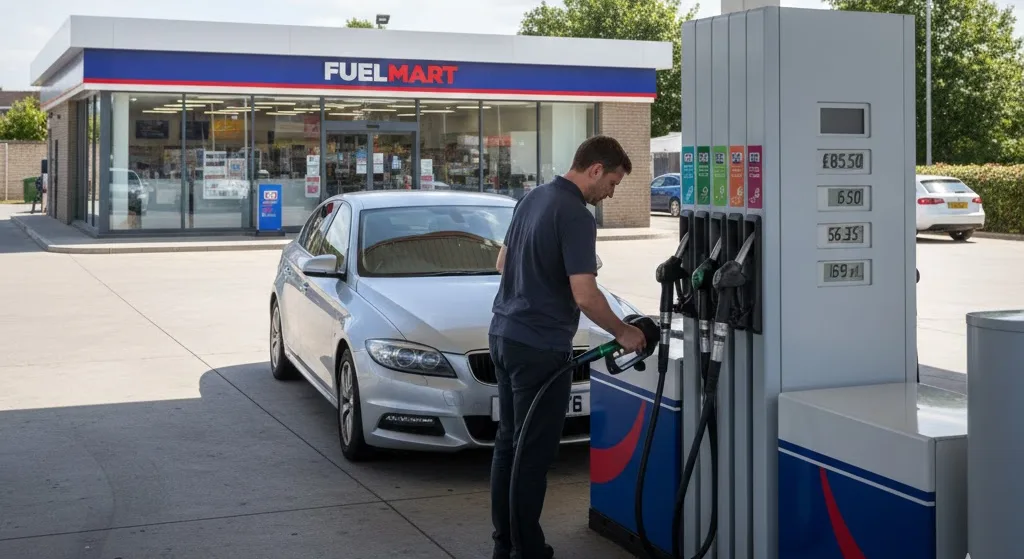
Knowing what a journey will cost in fuel before you set off lets you budget accurately, decide whether driving is cheaper than the train, and plan fuel stops on longer routes. This guide walks through exactly how to calculate fuel costs for any UK journey, explains the difference between MPG and L/100km, gives real worked examples for common routes, and covers practical ways to cut your fuel bill by up to 20% without changing how far you drive.
Understanding Fuel Consumption: MPG, L/100km, and How UK Figures Differ from Reality
Fuel consumption in the UK is most commonly expressed in miles per gallon (MPG) — the number of miles your vehicle travels on one imperial gallon of fuel (4.546 litres). The higher the MPG figure, the more efficient the vehicle.
European specifications often use litres per 100 kilometres (L/100km), which works in the opposite direction — a lower figure means better fuel economy. Some newer UK vehicles display both.
Converting between MPG and L/100km
To convert MPG to L/100km: divide 282.5 by the MPG figure.
To convert L/100km to MPG: divide 282.5 by the L/100km figure.
Example: A car with a published fuel economy of 50 MPG equals 282.5 ÷ 50 = 5.65 L/100km.
Why official MPG figures are misleading
The official fuel economy figures on new car specifications are generated under WLTP (Worldwide Harmonised Light Vehicles Test Procedure) laboratory conditions — standardised test cycles that do not reflect real-world driving. In practice, most drivers achieve 10–25% below the official MPG figure, depending on:
- Driving style — aggressive acceleration and hard braking reduce economy significantly.
- Speed — fuel consumption rises sharply above 60 mph due to air resistance.
- Load — a full car with luggage uses more fuel than an empty one.
- Climate — air conditioning in summer and heating in winter both reduce efficiency. Cold weather also thickens engine oil and increases rolling resistance.
- Traffic — stop-start urban driving is much less efficient than steady motorway cruising.
- Tyre condition — under-inflated or worn tyres increase rolling resistance.
For fuel cost calculations, use your actual observed MPG if you know it (many cars display a trip computer with fuel economy data), or take the official figure and apply a 15–20% reduction as a realistic estimate.
Average MPG by Vehicle Type (Real-World Estimates)
| Vehicle Type | Real-World MPG (Petrol) | Real-World MPG (Diesel) |
|---|---|---|
| Small city car (e.g. Ford Fiesta, VW Polo) | 42–52 MPG | 50–60 MPG |
| Medium family car (e.g. Ford Focus, VW Golf) | 36–46 MPG | 45–55 MPG |
| Large car / saloon (e.g. BMW 3 Series, Skoda Octavia) | 30–42 MPG | 40–52 MPG |
| SUV / crossover (e.g. Nissan Qashqai, Kia Sportage) | 28–38 MPG | 36–46 MPG |
| Large 4x4 / premium SUV | 20–30 MPG | 28–38 MPG |
| Hybrid (petrol, e.g. Toyota Yaris Cross, Honda Jazz) | 50–65 MPG | N/A (petrol only) |
| Plug-in hybrid (PHEV, e.g. Mitsubishi Outlander) | 35–50 MPG (on petrol alone) | N/A |
| Van (small, e.g. Ford Transit Connect) | 28–36 MPG | 36–46 MPG |
| Van (large, e.g. Mercedes Sprinter, Ford Transit) | 22–30 MPG | 28–38 MPG |
These are real-world estimates. Your actual consumption will depend on driving style, load, and conditions.
The Fuel Cost Formula: Step by Step
The basic formula for calculating fuel cost in the UK (where fuel is sold by the litre and consumption is measured in MPG) is:
Fuel Cost = (Distance in miles ÷ MPG) × 4.546 × Price per litre
Breaking this down:
- (Distance ÷ MPG) gives you how many imperial gallons you will use.
- × 4.546 converts imperial gallons to litres (since fuel is priced in litres at the pump).
- × Price per litre gives you the total cost in pence, which you divide by 100 for pounds.
Alternatively, if you know your fuel consumption in L/100km:
Fuel Cost = (Distance in km ÷ 100) × L/100km × Price per litre
Worked Examples: Common UK Journeys
Example 1: London to Birmingham (120 miles)
Vehicle: Medium petrol car, 40 MPG real-world
Fuel price: £1.45/litre (petrol)
Calculation:
- Gallons used: 120 ÷ 40 = 3 gallons
- Litres used: 3 × 4.546 = 13.64 litres
- Cost: 13.64 × £1.45 = £19.78
Add the M6 Toll if you use it (£6.90 for cars) = total journey cost approximately £26.68.
Example 2: London to Manchester (200 miles)
Vehicle: Medium diesel car, 48 MPG real-world
Fuel price: £1.50/litre (diesel)
Calculation:
- Gallons used: 200 ÷ 48 = 4.17 gallons
- Litres used: 4.17 × 4.546 = 18.96 litres
- Cost: 18.96 × £1.50 = £28.44
Example 3: Edinburgh to Glasgow (46 miles)
Vehicle: Small petrol car, 48 MPG real-world
Fuel price: £1.47/litre (petrol)
Calculation:
- Gallons used: 46 ÷ 48 = 0.96 gallons
- Litres used: 0.96 × 4.546 = 4.36 litres
- Cost: 4.36 × £1.47 = £6.41
UK Fuel Prices in 2026: What to Expect
UK petrol and diesel prices are set daily by fuel retailers and fluctuate based on crude oil prices, refinery costs, currency exchange rates (oil is priced in US dollars), and government duty. The RAC and AA publish daily fuel price data.
As of early 2026, UK pump prices are approximately:
| Fuel Type | Average UK Price (early 2026) | Price per imperial gallon |
|---|---|---|
| E10 unleaded petrol (standard) | ~£1.43/litre | ~£6.50 |
| Super unleaded petrol (E5, 97/99 RON) | ~£1.55/litre | ~£7.05 |
| Diesel (standard) | ~£1.49/litre | ~£6.77 |
| Premium diesel | ~£1.65/litre | ~£7.50 |
Where to find the cheapest fuel
Supermarket fuel stations (Tesco, Morrisons, Sainsbury's, Asda) are typically 3–8p/litre cheaper than motorway service stations, which are the most expensive locations. Motorway services typically charge 10–20p/litre more than the regional average.
PetrolPrices.com and Zap-Map (for EV charging) allow you to compare prices near your route. Planning to fill up before or after a motorway section rather than at the services can save £5–10 on a full tank.
Fuel Costs vs. EV Charging Costs
Electric vehicles are becoming increasingly common, and calculating the cost per mile for an EV requires a different approach. Instead of MPG, EVs use kWh per 100 miles (or miles per kWh).
| EV Efficiency | Cost per mile (home charging ~25p/kWh) | Cost per mile (public rapid ~65p/kWh) |
|---|---|---|
| Efficient EV (e.g. Tesla Model 3, Hyundai Ioniq 6) — ~4 miles/kWh | ~6p/mile | ~16p/mile |
| Typical EV (e.g. Nissan Leaf, VW ID.3) — ~3 miles/kWh | ~8p/mile | ~22p/mile |
| SUV EV (e.g. BMW iX, Kia EV6) — ~2.5 miles/kWh | ~10p/mile | ~26p/mile |
For comparison, a petrol car achieving 40 MPG at £1.43/litre costs approximately 16p per mile in fuel. An EV charged at home costs around 6–10p per mile. The savings are clear for home charging — but rapid charging on long motorway journeys brings EV costs closer to petrol costs.
Practical Ways to Reduce Your Fuel Bill
Small changes in driving behaviour and vehicle maintenance can reduce fuel consumption by 10–20% without sacrificing journey time significantly.
Driving technique
- Accelerate gently: Hard acceleration from rest is the single biggest source of fuel waste in urban driving. Build speed gradually, particularly from traffic lights and roundabouts.
- Read the road ahead: Anticipating traffic lights, junctions, and slowing traffic allows you to ease off the accelerator and coast — converting your speed back to fuel savings rather than heat in your brakes.
- Use a higher gear earlier: Modern engines are efficient at low RPM in high gears. Change up at around 2,000–2,500 RPM for petrol engines, 1,500–2,000 RPM for diesel. Your car's gear change indicator (if fitted) will prompt you.
- Use cruise control on motorways: Cruise control maintains a constant speed much more effectively than most drivers can manually, eliminating the unconscious speed fluctuations that waste fuel.
- Reduce motorway speed: Driving at 60 mph instead of 70 mph uses roughly 9% less fuel. At 80 mph, consumption is approximately 25% higher than at 70 mph. Even a 5 mph reduction on a long journey can make a meaningful difference.
Vehicle preparation
- Maintain correct tyre pressure: Under-inflated tyres increase rolling resistance. The RAC estimates that correctly inflated tyres can improve fuel economy by up to 2%. Check pressures monthly and before long journeys (cold, not after driving).
- Remove unnecessary weight: Every 50 kg of extra weight increases fuel consumption by approximately 1–2%. Remove items you do not need from the boot — roof bars, sports equipment, tools.
- Remove roof boxes and carriers when not in use: A roof box increases drag significantly and can reduce fuel economy by 10–15% at motorway speeds. If you only use it for holidays, take it off between trips.
- Keep the engine serviced: A poorly maintained engine — old spark plugs, dirty air filter, old engine oil — burns more fuel. Regular servicing typically pays for itself in fuel savings over time.
- Turn off air conditioning when not needed: Air conditioning can increase fuel consumption by up to 10% in city driving. At motorway speeds, it is often more efficient to use the air conditioning than to open windows (which increases drag).
Buying fuel smartly
- Avoid motorway services: Motorway service station fuel typically costs 10–20p/litre more than nearby supermarket stations. Planning to fill up before joining the motorway saves money.
- Use supermarket loyalty schemes: Tesco, Morrisons, and Sainsbury's all offer points on fuel purchases. Morrisons More and Tesco Clubcard schemes can generate meaningful savings for regular users.
- Use a cashback credit card: Some credit cards offer 1–2% cashback on fuel purchases. On a household spending £1,500/year on fuel, that is £15–30 in annual cashback — not enormous, but free money nonetheless.
- Fill up in the morning: Fuel expands slightly in warmer temperatures. Filling up early in the day when the fuel in underground tanks is cooler means you get marginally more fuel per litre. This is a minor effect in the UK climate but is measurable.
Quick Fuel Cost Calculator Reference
Use this table to quickly estimate fuel costs for typical journey distances at common MPG values and a petrol price of £1.43/litre:
| Distance | 30 MPG | 40 MPG | 50 MPG | 60 MPG |
|---|---|---|---|---|
| 50 miles | £10.85 | £8.14 | £6.51 | £5.42 |
| 100 miles | £21.69 | £16.27 | £13.02 | £10.85 |
| 200 miles | £43.38 | £32.53 | £26.03 | £21.69 |
| 300 miles | £65.07 | £48.80 | £39.04 | £32.53 |
| 400 miles | £86.76 | £65.07 | £52.06 | £43.38 |
| 500 miles | £108.45 | £81.34 | £65.07 | £54.22 |
Based on petrol at £1.43/litre. For diesel at £1.49/litre, multiply figures by 1.04.
Calculate Fuel and Toll Costs Together
Our free toll calculator combines fuel costs with toll road charges for your complete journey cost — including M6 Toll, Dartford Crossing, and congestion charges.
Open Fuel CalculatorRelated Articles
Frequently Asked Questions
How do I calculate fuel cost for a journey?
Use the formula: (Distance in miles ÷ MPG) × Price per litre × 4.546. For example, a 200-mile journey in a car averaging 45 MPG with diesel at £1.55/litre: (200 ÷ 45) × 1.55 × 4.546 = 4.44 × 1.55 × 4.546 = approximately £31.30. For a quick estimate, divide your MPG into the distance to get gallons used, then multiply gallons by the price per gallon (litres × 4.546).
What is the average fuel consumption for a UK car?
The average real-world fuel consumption for a UK petrol car is approximately 36–42 MPG. Diesel cars typically achieve 45–55 MPG in real-world conditions. Manufacturer figures (WLTP) are usually 10–20% better than what drivers actually achieve — real-world MPG is the more useful number for budgeting. Hybrids achieve 45–60 MPG combined. Full EVs are measured in miles per kWh (typically 3–4 miles/kWh for a mainstream EV).
How much does fuel cost per mile in the UK?
At current UK average prices (approximately £1.50/litre petrol, £1.58/litre diesel), the cost per mile for a typical car is: 40 MPG petrol car = approximately 17p per mile; 50 MPG diesel car = approximately 14p per mile. For a large SUV doing 28 MPG on petrol: approximately 24p per mile. The HMRC approved mileage rate of 45p per mile for the first 10,000 miles covers fuel plus vehicle wear — actual fuel-only cost is substantially lower.
What is the most fuel-efficient speed on a motorway?
For most petrol and diesel cars, fuel efficiency peaks between 45 and 55 mph. At 70 mph (the motorway limit), a typical car uses approximately 15–25% more fuel than at 55 mph due to aerodynamic drag increasing exponentially with speed. Driving at 80 mph uses approximately 25–35% more fuel than 70 mph. Cruise control on motorways can improve fuel economy by 5–10% by eliminating unnecessary speed fluctuations.
How can I reduce my fuel costs?
The most effective strategies are: drive smoothly (harsh acceleration burns 20–30% more fuel); use cruise control on motorways; remove roof boxes and racks when not in use (add 10–25% drag at motorway speed); keep tyres inflated to the correct pressure (under-inflated tyres increase fuel consumption by up to 3%); and plan routes to avoid stop-start traffic. Using a supermarket fuel loyalty scheme can save 5–10p per litre compared to motorway services.