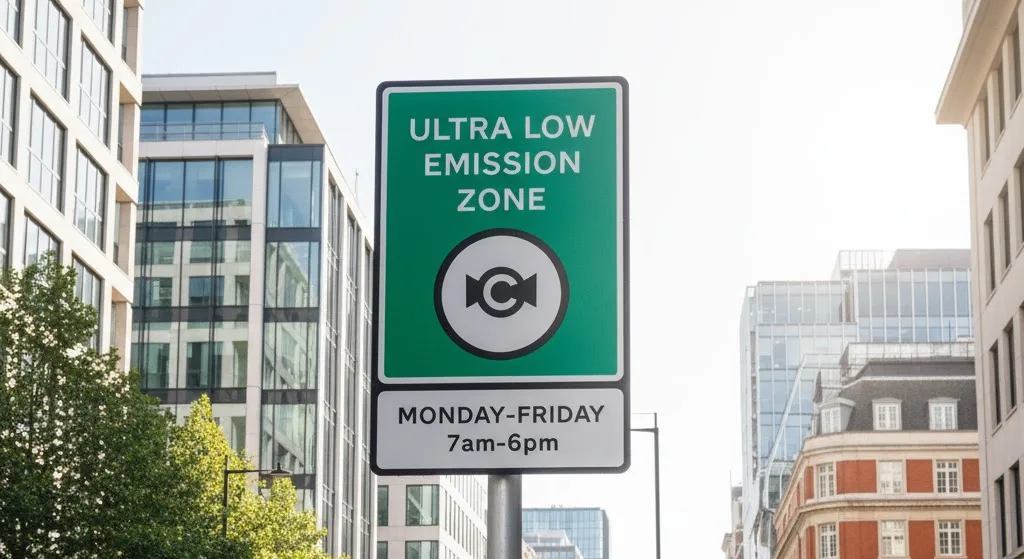
Air quality charges have become a fact of life for UK drivers. London's Ultra Low Emission Zone now covers the entire city, and Clean Air Zones are operating or planned in more than a dozen cities. Whether you drive an older diesel, a petrol car from the early 2000s, or a van, this guide tells you exactly what applies to your vehicle, how much it costs, and how to check and pay before you get hit with a penalty.
What is the ULEZ and Why Does it Exist?
The Ultra Low Emission Zone (ULEZ) is a daily charge applied to vehicles that do not meet certain emissions standards when driving in Greater London. It was introduced by Transport for London (TfL) in April 2019, initially covering the same area as the Congestion Charge zone in central London. It was expanded to the North and South Circular Roads in October 2021, and then extended to cover all 32 London boroughs — effectively the entire area within or near the M25 — in August 2023.
The purpose is straightforward: road transport is the single largest source of harmful nitrogen dioxide (NO₂) in London, and diesel vehicles in particular produce far higher concentrations of NO₂ than newer petrol or electric vehicles. Long-term exposure to NO₂ causes and worsens respiratory conditions. The ULEZ was designed to accelerate the removal of the most polluting vehicles from London's streets.
Since its introduction, TfL has reported significant improvements in air quality across London, with NO₂ levels in the central zone falling substantially faster than in comparable UK cities. However, the expansion of the zone to the outer boroughs in 2023 was controversial, sparking legal challenges from some councils and a significant public debate about the cost burden on lower-income drivers who rely on older vehicles.
ULEZ: The Current Rules in 2026
When does it operate?
The ULEZ operates 24 hours a day, 7 days a week, 365 days a year — including weekends and bank holidays. The only exception is Christmas Day (25 December), when it does not operate. There are no off-peak periods or time windows when it is cheaper or free.
Where does it apply?
Since August 2023, the ULEZ covers all roads within Greater London — all 32 boroughs plus the City of London. This is a substantial area: roughly 600 square miles. If you are driving anywhere within the M25, there is a very good chance you are in the ULEZ. The boundary is marked by signs on roads entering the zone, but given its size, the most reliable approach is to check your vehicle's compliance before travelling to London at all.
Importantly, the ULEZ applies to all roads within the zone — not just central London or major roads. Driving on a residential street, visiting a friend in an outer suburb, or passing through Greater London on the way to somewhere else all count if you are in a non-compliant vehicle.
How much does the ULEZ cost?
| Vehicle Type | Daily Charge |
|---|---|
| Cars, motorcycles, vans up to 3.5t, specialist vehicles | £12.50 |
| Larger vans (3.5t–12t), minibuses (up to 5t) | £12.50 |
| HGVs (over 12t), buses, coaches | £100 |
The £12.50 charge applies regardless of how long you spend in the zone or how many times you enter and exit on the same day — it is a daily charge, not a per-entry or per-mile charge.
Is Your Vehicle ULEZ Compliant?
ULEZ compliance is determined by a vehicle's Euro emissions standard, which is set at the point of manufacture (not registration). The Euro standard depends on the engine technology in the vehicle, and it is stamped in the vehicle's Certificate of Conformity or V5C logbook.
Petrol vehicles
Petrol cars must meet the Euro 4 standard. In practice, this means most petrol cars first registered after January 2006 will be compliant. However, some cars registered just before 2006 may also meet Euro 4 (having been designed to the new standard in advance), and some older vehicles may not meet it despite a later registration.
The safest approach: Check your specific vehicle on the TfL vehicle checker tool (link via the TfL website) using your number plate. Do not assume compliance based on age alone.
Diesel vehicles
Diesel vehicles must meet the Euro 6 standard — a much stricter requirement than for petrol. Euro 6 was phased in from September 2014 for new type approvals and from September 2015 for all new registrations. This means most diesel cars need to have been first registered from around September 2015 onwards to be compliant.
This catches out many drivers who bought a diesel car in 2013 or 2014, believing it was relatively new and modern. A diesel car from that era is typically Euro 5 — and therefore non-compliant, incurring the daily charge.
Electric and hybrid vehicles
Pure electric vehicles (EVs) produce zero tailpipe emissions and are automatically ULEZ compliant — no charge applies.
Plug-in hybrids (PHEVs) are generally compliant if the petrol engine meets Euro 4, which is the case for almost all modern PHEVs. However, older hybrid models (pre-2006) may not be compliant if the petrol engine was pre-Euro 4.
Mild hybrids (which use a small electric motor to assist but cannot run on electric power alone) are treated the same as conventional petrol or diesel vehicles for ULEZ purposes.
Always check with your number plate
Do not assume your vehicle is compliant or non-compliant based on its age or fuel type. The TfL vehicle checker takes your number plate and gives a definitive answer. Manufacturers sometimes applied for Euro standard type approvals earlier than the mandatory dates, meaning some vehicles registered before the cut-off dates are compliant. The only way to know for certain is to check.
ULEZ Exemptions and Discounts
Certain vehicles and drivers are exempt from the ULEZ charge even if the vehicle does not meet the emissions standards:
- Disabled Tax Class vehicles: Vehicles taxed in the Disabled or Disabled Passenger Vehicle tax class (not simply vehicles owned by disabled people — the tax class must be the appropriate one).
- Military vehicles: Vehicles registered to the Ministry of Defence.
- Historic vehicles: Vehicles first registered more than 40 years ago are exempt (rolling 40-year rule, updated annually on 1 January).
- Agricultural vehicles: Tractors and agricultural machinery.
- Non-road mobile machinery.
- Certain emergency vehicles operated by emergency services.
Note that the 9-month grace period that was originally offered when the zone expanded to outer London in August 2023 has now ended. All previously granted temporary exemptions for residents of the outer boroughs have expired.
The Congestion Charge: How It Differs from ULEZ
Many drivers confuse the ULEZ with the Congestion Charge — they are different schemes that may both apply on the same journey in central London.
| Feature | ULEZ | Congestion Charge |
|---|---|---|
| Purpose | Reduce vehicle emissions | Reduce traffic volume |
| Who pays | Non-compliant vehicles only | All vehicles (some exemptions) |
| Operating hours | 24/7, 365 days | Mon–Fri 7am–6pm, Sat–Sun 12pm–6pm |
| Zone | All of Greater London | Central London only |
| Daily charge (car) | £12.50 | £15.00 |
If you are driving a non-compliant vehicle into central London during Congestion Charge hours, you may owe both charges on the same day — up to £27.50 combined.
Clean Air Zones Outside London
The government's national Clean Air Zone (CAZ) framework applies to cities outside London, where councils can introduce charging zones to meet statutory air quality targets. CAZs are classified into four types (A–D) based on which vehicles they charge:
- Class A: Taxis and private hire vehicles only.
- Class B: Taxis, buses, and coaches.
- Class C: Taxis, buses, coaches, and HGVs.
- Class D: All of the above, plus private cars.
For private car drivers, only Class D zones are relevant. Currently operational Class D CAZs include:
Birmingham
Birmingham's Class D CAZ covers all roads within the A4540 Middleway Ring Road — the inner ring road. Non-compliant private cars pay £8 per day. Like the ULEZ, it operates 24 hours a day. Compliance standards mirror those of the ULEZ: Euro 6 diesel or Euro 4 petrol required.
Bristol
Bristol's Class D CAZ covers a central zone roughly bounded by the river, the M32, and the inner city roads. Non-compliant private cars pay £9 per day. The zone operates 24 hours.
Bradford
Bradford introduced a Class D zone covering the city centre, with charges of £9 per day for non-compliant private cars. The zone boundary is marked by signs on approach roads.
Cities with Class B/C zones (taxis and commercial vehicles only)
Several other cities have CAZs that do not charge private cars but do charge taxis, vans, and HGVs. These include Bath, Portsmouth, Sheffield, Newcastle, and others. However, this can change — councils can upgrade their zone class if air quality targets are not being met. Always check before travelling.
Planned and upcoming zones
Several more cities are in advanced stages of introducing or expanding CAZs. Manchester's Greater Manchester Clean Air Zone has been through multiple delays and consultations but remains under consideration. Edinburgh is developing its own Low Emission Zone. Check the government's Clean Air Zone portal for the latest information on your area.
How to Pay: ULEZ and CAZ Payment Methods
Paying the ULEZ
You must pay the ULEZ charge by midnight on the third day after your journey. For example, if you drive through the ULEZ on a Monday, you must pay by midnight on Thursday. You can also pay up to 90 days in advance — useful if you know you are making a trip to London with a non-compliant vehicle.
Payment is made via the TfL website or the official TfL app. You will need your vehicle registration number. There is no option to pay at a physical location.
TfL's automatic number plate recognition (ANPR) cameras operate across the zone, and non-compliant vehicles are identified automatically. If you have not paid and drive through the zone, you will receive a Penalty Charge Notice (PCN).
Paying a Clean Air Zone charge
For CAZs outside London, payment is made through the GOV.UK national Clean Air Zone service. You enter your vehicle registration and the zone you are travelling in, and the service will tell you whether you need to pay and how much. Payment windows vary by city but are typically similar to the ULEZ — you have a short window after travel or can pay in advance.
Beware of scam websites
There are numerous unofficial websites that appear in search results for "pay ULEZ" or "pay Dart Charge" that charge additional processing fees on top of the actual charge — sometimes £5–10 more. Always pay directly via the official TfL website (tfl.gov.uk) for ULEZ and the Congestion Charge, or via GOV.UK for other CAZs. If a website is asking for your payment details and is not on the official domains, close it immediately.
Penalty Charge Notices: What Happens if You Don't Pay?
If you drive a non-compliant vehicle through the ULEZ without paying, TfL will issue a Penalty Charge Notice (PCN) to the registered keeper of the vehicle. The penalties are:
- Cars and vans: £180, reduced to £90 if paid within 14 days.
- HGVs and coaches: £1,000, reduced to £500 if paid within 14 days.
If a PCN remains unpaid, TfL can escalate to debt collection and ultimately pursue the matter through the Traffic Enforcement Centre (TEC). Unpaid PCNs can result in a county court judgment and enforcement by bailiffs. There is also an interest charge of 8% per year on outstanding amounts.
You can challenge a PCN if you believe it was issued in error — for example, if your vehicle is actually compliant and the ANPR camera misread your plate, or if you qualify for an exemption that was not correctly applied. Appeals are handled through the independent adjudicator (London Tribunals for London, or the Traffic Penalty Tribunal elsewhere).
Options if Your Vehicle is Non-Compliant
If you regularly drive into the ULEZ or a CAZ in a non-compliant vehicle, you have several options:
1. Pay the daily charge
For occasional visits, paying the £12.50 daily ULEZ charge may be the most practical option. At five visits per month, that is £62.50 per month — less than a new car payment, but a significant ongoing cost if visits are more frequent.
2. Use public transport for London trips
For journeys specifically into central or inner London, the combination of the ULEZ charge (£12.50) and central London parking costs (often £20–40+ per day in a car park) makes public transport much more economical. National rail, the Underground, or Overground services from outer London or nearby towns may offer a practical park-and-ride alternative.
3. Retrofit your vehicle
Some older diesel vehicles can be retrofitted with equipment to reduce their NOₓ emissions to Euro 6 standards. This is more common for vans and HGVs than for private cars, and costs vary significantly. TfL maintains a list of approved retrofit suppliers. This is worth investigating if you have a relatively new diesel van that falls just outside compliance.
4. Replace your vehicle
If you regularly travel in ULEZ or CAZ areas, replacing a non-compliant vehicle with a compliant one eliminates the charges entirely. The TfL scrappage scheme — which offered grants of up to £2,000 for cars and £9,500 for larger vehicles — ended in October 2023, so this option now comes at full market cost. However, the long-term saving on daily charges may justify the investment if you drive in London frequently.
Summary: Key Points to Remember
- ULEZ covers all of Greater London, 24/7, every day except Christmas Day.
- £12.50 per day for non-compliant cars and vans — check your vehicle using your number plate on the TfL website before assuming compliance.
- Petrol cars need Euro 4 (typically post-January 2006); diesel cars need Euro 6 (typically post-September 2015).
- Pay within 3 days of travel, or up to 90 days in advance, via the official TfL website only.
- CAZs in Birmingham and Bristol also charge private cars — other cities currently charge commercial vehicles only, but this may change.
- Penalties for non-payment are £90–180 for cars — far higher than the daily charge.
- Use the official TfL or GOV.UK sites only — beware of scam payment websites charging extra fees.