Dart Charge Guide 2026: How to Pay the Dartford Crossing
James has been writing about UK roads, traffic law, and vehicle regulation for over 8 years. He holds a full UK Category B licence and has driven extensively on the UK motorway network.
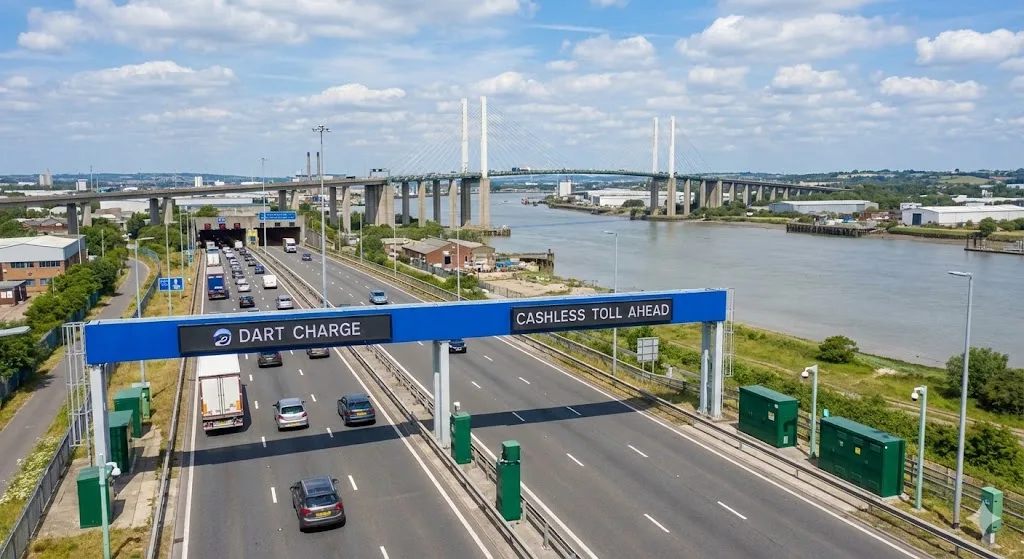
The Dartford Crossing is one of the busiest river crossings in Europe, carrying over 50,000 vehicles a day between Kent and Essex. Since 2014, the crossing has been entirely cashless — payment is made via the Dart Charge system, using ANPR cameras that automatically capture your number plate. This guide covers everything you need to know: current charges, how to pay, account types, exemptions, penalties for non-payment, and the strategic alternatives to crossing at Dartford.
The Dartford Crossing: What It Is
The Dartford Crossing is a dual river crossing on the M25 motorway, between Dartford in Kent (south bank) and Thurrock in Essex (north bank). It consists of two tunnels (used for northbound traffic) and the Queen Elizabeth II Bridge (used for southbound traffic, as the tunnels cannot be used southbound due to ventilation constraints). The crossing opened in stages between 1963 and 1991, with the bridge opening in 1991.
It is the only road crossing of the Thames east of Greater London and the crossing point for the M25 — making it a critical link in the south-east road network. The A2 and M2 (routes to Dover and the Channel Tunnel) feed directly into the crossing from the south, making it heavily used by freight and tourist traffic to and from the continent.
The original tolls were intended to fund the construction of the crossing. However, despite the construction costs being long since recovered, the government chose to maintain the tolls under the Dart Charge scheme when the barrier system was replaced by free-flow ANPR charging in November 2014.
Current Dart Charge Prices 2026
| Vehicle Class | Examples | Charge per crossing |
|---|---|---|
| Class A — Motorcycles | All motorcycles and mopeds | Free |
| Class B — Cars | Cars, taxis, cars with trailers/caravans | £2.50 |
| Class B — Vans/Minibuses | Vans, minibuses (up to 9 seats) | £3.00 |
| Class C — HGV (2 axles) | Lorries, rigid trucks with 2 axles | £6.00 |
| Class C — HGV (3+ axles) | Articulated lorries, 3+ axle vehicles | £6.00 |
These charges apply in both directions — northbound through the tunnels and southbound over the bridge. Account holders pay the same charge as non-account holders for the Dart Charge, though account holders benefit from consolidated billing and never missing a payment.
Towing: A car towing a caravan or trailer is classified as Class B (same as a car without a trailer) and pays the standard £2.50 car rate. The trailer is not charged separately. This is an important distinction from the M6 Toll, where a car with a trailer is classified differently.
Free-Flow Charging: How the System Works
Since November 2014, the Dartford Crossing operates as a free-flow charge: there are no toll booths or barriers. ANPR cameras mounted over the approach roads capture your vehicle's number plate automatically as you drive through at normal motorway speed. You are not required to slow down or stop — the cameras capture vehicles at full speed.
After crossing, the system checks your number plate against records of paid accounts and registered account holders. If no payment is found against your plate by the payment deadline, a Penalty Charge Notice is issued to the registered keeper.
This is why many drivers — particularly those unfamiliar with the system — receive PCNs: they crossed the bridge or tunnels expecting to see a toll booth and, finding none, drove on without realising payment was required. The absence of barriers or obvious payment points is a significant source of confusion for first-time users.
How to Pay: All Payment Methods
Option 1: Pay online (no account needed)
The simplest option for occasional users. Visit the official GOV.UK Dart Charge payment page and enter your vehicle registration number and the date of crossing. You can pay:
- In advance: Up to 90 days before crossing. Useful if you know you have a trip planned.
- On the day: Any time from midnight at the start of the day until midnight at the end of the day you cross.
- Day after: Until midnight on the day after crossing. So if you cross on Tuesday, you have until midnight Wednesday to pay.
Option 2: Pre-Pay Dart Charge Account (best for regular users)
A Pre-Pay account lets you load credit onto an account linked to your vehicle registration. Each time your vehicle crosses, the charge is automatically deducted from your account balance. You receive monthly statements and can set up automatic top-up when the balance falls below a threshold.
Account holders benefit from:
- Never needing to remember to pay — deductions are automatic.
- Monthly statements for expense tracking and accounting.
- Access to crossing history for the past 18 months.
- The ability to add multiple vehicles to one account.
Option 3: Pay by phone
Call 0300 300 0120 to pay by phone. You will need your vehicle registration number and a payment card. The line operates 24 hours a day, 7 days a week. Phone payment is slower than online and is primarily useful if you have no internet access.
Official payment routes only
Pay only through GOV.UK (gov.uk/pay-dartford-crossing-charge) or the official Dart Charge account portal. Third-party websites that appear in search results for "Dart Charge payment" may charge additional processing fees of £5–10. The official service charges no fees beyond the crossing charge itself.
Exemptions: Who Pays Nothing?
The following vehicles are fully exempt from the Dart Charge and do not need to pay or register:
- Motorcycles (Class A): All motorcycles and mopeds. Free in both directions.
- Disabled Tax Class vehicles: Vehicles registered in the Disabled or Disabled Passenger Vehicle tax class. The exemption applies to the vehicle's registration, not to the Blue Badge holder personally — the vehicle must be in the correct tax class.
- Vehicles registered to the emergency services: Police, fire, and ambulance service vehicles registered to those services.
- Military vehicles: UK Ministry of Defence registered vehicles.
Exempt vehicles do not need to pay but should register their vehicle at the official Dart Charge site to ensure their exemption is recorded — an unregistered exempt vehicle may otherwise receive a PCN and have to appeal.
Penalty Charge Notices: Costs and Process
| Stage | Amount | When |
|---|---|---|
| PCN — reduced rate | £35 | If paid within 14 days |
| PCN — full amount | £70 | Standard penalty |
| Charge Certificate | £105 | 28 days after PCN if unpaid |
PCNs are issued to the registered keeper of the vehicle at their DVLA-registered address. If you have recently moved and not updated your vehicle registration, PCNs may be sent to an old address — always keep your V5C address current.
Appealing a Dart Charge PCN: If you believe the PCN was issued in error — you did pay, your vehicle is exempt, or the ANPR misread your plate — you can make a formal representation to the Dart Charge operations team within 28 days. If rejected, you can appeal to the Traffic Penalty Tribunal, an independent body. Always appeal in writing and document your evidence (screenshots of payment confirmation, bank transaction records, etc.).
Crossing at Peak vs. Off-Peak Times
Unlike the M6 Toll, the Dart Charge is a flat rate regardless of time of day. However, the crossing itself experiences significant congestion at peak hours, particularly:
- Southbound on the bridge: Friday afternoons and weekend mornings (outbound holiday traffic).
- Northbound through the tunnels: Sunday afternoons and Monday mornings (return traffic).
- Both directions: Bank holiday weekends create extreme congestion, sometimes with queues of 45–60 minutes or more.
National Highways provides real-time traffic information for the M25 and the crossing at its website. Travelling outside peak windows — early morning (before 7am) or late evening (after 8pm) on weekdays — typically results in free-flow conditions with no queuing.
Alternatives to the Dartford Crossing
If you want to avoid the charge (particularly for freight operators where the charge accumulates across multiple daily crossings), the alternatives are:
- Woolwich Ferry: A free vehicle ferry service operated by Transport for London, connecting Woolwich (south) to North Woolwich (north). Carries vehicles up to 18 tonnes. Significant detour and service frequency limitations — typically 10–15 minute crossing, but waits can be long at busy times. Practical as a cost-saving measure for London-based trips but not for through traffic on the M25.
- London bridges (Tower Bridge westward): For traffic whose origin and destination are both within Greater London, crossing at Tower Bridge, London Bridge, or Waterloo Bridge avoids the Dartford Crossing entirely. However, these add significant distance for through traffic and involve navigating central London.
- Further north-west: Traffic heading from Kent to points north-west of London can sometimes avoid the Dartford Crossing by routing via the M20/M26/M25 anti-clockwise to the A3 or M3 junctions, though this is typically a longer route in distance and time.
M6 Toll Tags: Electronic Payment for the M6 Toll Road
For drivers who frequently use the M6 Toll road (the privately operated motorway between Junctions 3a and 11a of the M6), electronic tags offer a more convenient payment option than queuing at a toll plaza.
The M6 Toll operates manned toll plazas where you pay on exit. However, designated TAG lanes allow tag-equipped vehicles to pass through without stopping, with the charge automatically deducted from a prepaid account. Tag users can drive through at up to 30 mph without stopping.
Current M6 Toll charges (2026 approximate):
| Vehicle class | Peak (6am–11pm weekdays) | Off-peak / weekends |
|---|---|---|
| Car (Class 1) | £7.10 | £6.60 |
| Car + trailer (Class 2) | ~£11.20 | ~£10.60 |
| Motorcycles | £4.20 | £4.20 |
| HGV (2 axles) | £12.30 | £12.30 |
M6 Toll tags are available for personal and business accounts. There are no discounted rates for tag users vs. cash-lane users on the M6 Toll — the benefit is purely convenience (no stopping, no queuing in cash lanes). For a detailed cost comparison of M6 Toll vs. free M6, see our M6 Toll vs M6 guide.
Frequently Asked Questions
How much does the Dartford Crossing cost in 2026?
Cars pay £2.50 per crossing (both directions). Vans and minibuses pay £3.00. HGVs pay £6.00. Motorcycles are free. Cars towing trailers or caravans are classified as cars and pay £2.50.
Do I need an account to pay the Dart Charge?
No — occasional users can pay online without an account at GOV.UK, up to midnight the day after crossing. An account is convenient for frequent users as it automates payment and provides monthly statements.
What happens if I forget to pay?
You will receive a £70 Penalty Charge Notice, reduced to £35 if paid within 14 days. Pay as soon as you receive it — escalation to £105 after 28 days, and ultimately to debt collection.
Is the Dart Charge the same going in both directions?
Yes — the same charge applies northbound (through the tunnels) and southbound (over the Queen Elizabeth II Bridge).