Driving in Wales 2026: 20mph Limits, Road Rules & Scenic Routes
James has been writing about UK roads, traffic law, and vehicle regulation for over 8 years. He holds a full UK Category B licence and has driven extensively on the UK motorway network.
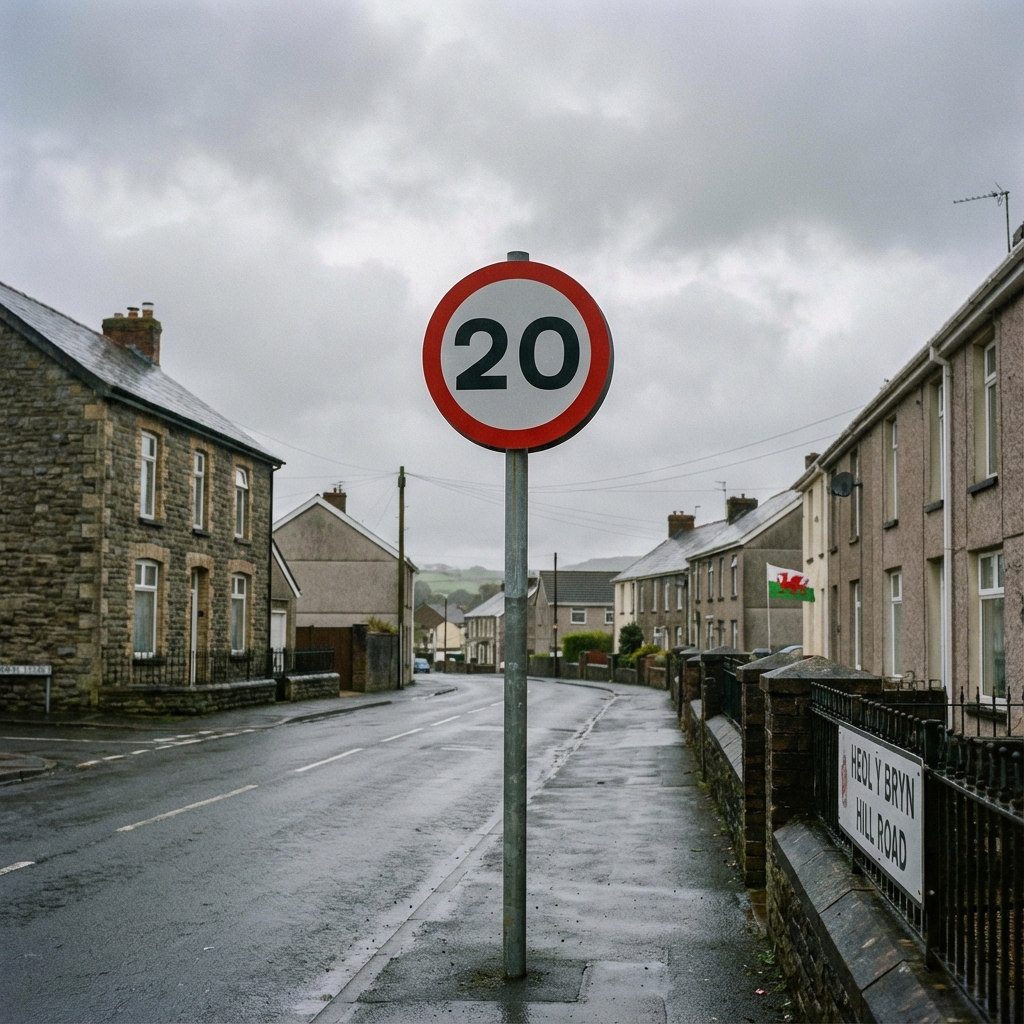
Wales has always been a rewarding country to drive through — dramatic mountain passes, wild coastlines, and quiet market towns that reward a slower pace. Since September 2023, Wales has made that slower pace legally mandatory on most built-up roads. The default speed limit on restricted roads changed from 30mph to 20mph across the entire country, making Wales the first UK nation to implement this change at a national level. Whether you're a regular visitor or a first-timer, this guide covers everything you need to drive in Wales correctly and enjoyably in 2026.
The 20mph Default Limit: Everything You Need to Know
What Changed in September 2023?
On 17 September 2023, the Welsh Government introduced a change to the Road Traffic Regulation Act 1984 as it applies in Wales. The default speed limit on restricted roads was reduced from 30mph to 20mph. This was a blanket national change — every restricted road in Wales changed automatically on that date, unless a specific road had been given an exemption order to remain at 30mph.
The change was introduced under the Welsh Government's Transport Strategy, primarily aimed at reducing road casualties, improving air quality in urban areas, and making streets safer for pedestrians and cyclists. Wales joined a growing number of European countries and cities that use 20mph as the default urban speed.
What is a "Restricted Road"?
A restricted road is a road that has street lighting at regular intervals of no more than 200 yards. Historically, these roads were automatically 30mph throughout the UK. In Wales, they are now automatically 20mph unless a 30mph sign is displayed. If you see streetlights but no speed limit sign, assume 20mph.
Which Roads Are 20mph and Which Are 30mph?
The majority of built-up roads in Wales are now 20mph. Local authorities were permitted to apply for exemptions for specific roads — mainly arterial routes, distributor roads, and roads where 20mph was considered disproportionate. The proportion of exempted roads varies by local authority, but nationally only a small minority of previously-30mph roads retained their 30mph limit.
The practical rule to follow:
- Street lighting present + no speed limit sign = 20mph (in Wales)
- 30mph sign present = 30mph regardless of lighting
- National speed limit sign (white circle with black diagonal stripe) = 60mph on single carriageway or 70mph on dual carriageway — same as England and Scotland
- Motorways = 70mph — same as rest of UK
Speed Limits Summary for Wales 2026
| Road Type | Speed Limit in Wales | How to Identify |
|---|---|---|
| Restricted road (street lighting, no signs) | 20mph | Streetlamps present; no speed limit sign required |
| Exempted restricted road | 30mph | 30mph sign displayed |
| Single carriageway rural road | 60mph | National speed limit signs or no signs + no lighting |
| Dual carriageway | 70mph | Dual carriageway with central reservation |
| Motorway (M4 and A55 expressway) | 70mph | Blue motorway/expressway signs |
Enforcement and Fines
Enforcement of the 20mph limit in Wales operates under the same penalty structure as all UK speeding offences. Police Wales and the four Welsh Police forces enforce the limits using:
- Fixed speed cameras — present at known accident locations and on 20mph roads in urban areas of Cardiff, Swansea, Newport, and other towns
- Mobile speed enforcement — police mobile camera vans, deployed particularly in areas where community complaints about speeding have been raised
- Average speed camera systems — deployed on some 20mph corridors; these measure average speed over a distance rather than instantaneous speed
- Marked and unmarked police vehicles
Penalty Structure
| Detected Speed (20mph zone) | Likely Outcome |
|---|---|
| 21–24mph | Speed Awareness Course offer (£80–100); no points if course accepted |
| 25–34mph | Fixed Penalty Notice: £100, 3 penalty points |
| 35–45mph | Court summons likely: Band B fine (50–100% weekly income), 4–6 points or disqualification |
| 45mph+ | Court summons: Band C fine (125–175% weekly income), 6 points or disqualification up to 56 days |
Speed Awareness Courses are typically offered at the lower end of the speeding threshold — in a 20mph zone, this is generally 24–31mph. The course costs around £80–100, takes half a day, and results in no points on your licence. You can accept a course only once in a three-year period.
Important for visitors: fixed penalty tickets and court summons from Welsh Police are legally enforceable against UK and international licence holders. EU licence holders are subject to enforcement under the Cross-Border Enforcement Directive. Non-EU visitors may face enforcement through reciprocal agreements, and in some cases rental companies may share your details and collect penalties on TfL/police behalf.
Bilingual Road Signs in Wales
All road signs in Wales are bilingual — Welsh text appears above the English text. This has been the case since the Welsh Language Act 1993 and is one of the most visible differences between driving in Wales and driving in England. The Welsh language uses a different alphabet from English in some respects (with sounds like ch, dd, ff, ll, ng, rh, th representing single letters), so place name spellings can look unfamiliar.
Key Welsh road terms to recognise:
| Welsh | English Meaning |
|---|---|
| Araf | Slow |
| Heddlu | Police |
| Ysgol | School |
| Canol y Dref | Town Centre |
| Maes Parcio | Car Park |
| Mynediad | Entrance |
| Allfa / Allanfa | Exit |
| Canolfan | Centre |
| Dim Parcio | No Parking |
| Gyrru'n Araf | Drive Slowly |
| Ffordd Ar Gau | Road Closed |
| Gwasanaethau | Services (motorway services) |
| Harbwr | Harbour |
| Traeth | Beach |
Sat nav systems don't always use Welsh place name spellings or pronunciations — this can cause confusion at junctions where the sat nav says "Swansea" but the sign says "Abertawe" (Swansea's Welsh name). Major bilingual place names worth knowing: Caerdydd (Cardiff), Abertawe (Swansea), Casnewydd (Newport), Wrecsam (Wrexham), Caernarfon (Carnarvon), Aberystwyth (same in English).
The Severn Crossings
The two bridges crossing the Severn Estuary between England and Wales are now completely toll-free. The tolls were removed in December 2018 when the concession period ended and ownership transferred to the UK Government.
| Bridge | Route | Toll |
|---|---|---|
| Severn Bridge | M48 — Bristol to Chepstow | Free since December 2018 |
| Prince of Wales Bridge (Second Severn Crossing) | M4 — Bristol to Newport/Cardiff | Free since December 2018 |
Both bridges are maintained by National Highways (formerly Highways England). There are no toll plazas or charge equipment remaining on either bridge — you can drive straight through.
Main Road Network in Wales
Wales's primary road network is less dense than England's, and the mountain terrain means journeys between north and south Wales can be considerably longer than map distance suggests. Key routes:
| Route | Connects | Notes |
|---|---|---|
| M4 (Prince of Wales Bridge → Cardiff → Swansea) | England to south Wales coast | Main corridor into Wales; toll-free. Ends near Swansea, continues as A48(M)/A48 |
| A55 (North Wales Expressway) | Chester to Holyhead (Irish ferry) | Dual carriageway along the north Wales coast; relatively fast |
| A470 (Wales's "spine road") | Cardiff to Llandudno (north Wales) | Single carriageway through mid-Wales; scenic but slow — allow 4–5 hours Cardiff to Llandudno |
| A40 / A487 (west Wales) | Brecon → Carmarthen → Pembrokeshire; and Aberaeron → Fishguard → Pembrokeshire | Main routes into west Wales; mix of single/dual carriageway |
| Menai Bridges (A5 Telford's Suspension Bridge and A55 Britannia Bridge) | Mainland Wales to Anglesey | Both toll-free. Britannia carries M4/A55; Telford's carries A5 foot and cyclists too |
Rural Road Driving in Wales
Much of the Welsh countryside is reached via single-track or narrow B-roads. Specific hazards include:
- Sheep on the road — especially in Snowdonia, the Brecon Beacons, Pembrokeshire, and the Cambrian Mountains. Sheep wander freely over unfenced mountain roads and can appear suddenly around any bend. If a sheep walks into the road ahead, stop — sheep are generally more confused by a horn than deterred by it. Wait for them to move.
- Single-track lanes — many minor roads in rural Wales are single-track with grass or mud in the centre. Use passing places — pull left when oncoming vehicle approaches. Follow the standard single-track etiquette (see our scenic drives guide for full rules).
- Flooding — Wales receives significantly more rainfall than England (the west coast around Snowdonia and Pembrokeshire is among the wettest in the UK). Minor roads through river valleys flood regularly. Do not attempt to drive through flooded roads — the depth is impossible to judge and even shallow floods can sweep a car off a road or damage the engine.
- Hill roads — passes such as the A4069 Black Mountain Pass (Brecon Beacons) and the A44 through mid-Wales have steep gradients and require appropriate gear use on ascent and descent.
- Agricultural vehicles — tractors and farm vehicles share rural Welsh roads, particularly during harvest season (July–September). Be patient; do not attempt to overtake on blind bends.
Wales-Specific Road Features
Dragon Signs
Welcome to Wales signs bear the Welsh dragon. The equivalent "Welcome to England" signs appear when you cross back eastwards. These signs are at the border at various crossing points — most visibly on the M4 after the Severn Bridge, on the A55 at Chester, and on the A5 near Chirk.
Campervans and Motorhomes
Wales is extremely popular with campervans and motorhomes, particularly for exploring the national parks. Many narrow rural lanes have weight or height restrictions — check before departing with a large vehicle. Pembrokeshire and Snowdonia in particular have lanes unsuitable for vehicles over 2m wide. Many campsites have dedicated motorhome pitches but fill up quickly in peak summer — book well in advance.
Best Scenic Drives in Wales
1. The Black Mountain Pass — A4069
The A4069 from Brynamman to Llangadog crosses the western Brecon Beacons via the Black Mountain ridge, reaching 493 metres at the summit. The road is tight and unguarded on the descent towards the Usk Valley, with sweeping moorland views in all directions. It's used as a test route by car magazines and frequently appears in Top Gear-style "best driving roads" lists. 20mph limit in the village sections at each end; open road limit in between.
2. The Llanberis Pass — A4086
Cuts through the heart of Snowdonia National Park beneath the highest peaks in Wales. The A4086 from Betws-y-Coed to Caernarfon via Llanberis is one of the most spectacular mountain drives in Britain. The Pen-y-Pass car park at the top (pre-booking essential in summer) gives access to walking routes up Yr Wyddfa/Snowdon.
3. Pembrokeshire Coast Road
The B4329 and B4319 through the Pembrokeshire Coast National Park hugs the coastline past some of Wales's most dramatic cliff scenery. Stackpole Head, St Govan's Head, and the Green Bridge of Wales (a sea arch larger than Durdle Door) are highlights. The narrow lanes require slow driving — but the 20mph limit in villages fits naturally.
4. The A470: Wales's Spine Road
The entire A470 from Cardiff to Llandudno is a 186-mile journey through the heart of Wales, passing through the Brecon Beacons, the Cambrian Mountains, and across Snowdonia. It's not fast — plan 5–6 hours with stops — but it's among the most rewarding drives in the country for those with time to enjoy it.
5. The Elan Valley, Powys
A series of reservoirs in mid-Wales built in the early 20th century to supply Birmingham. The lakeside road along Claerwen and Caban Coch reservoirs offers one of mid-Wales's finest drives, with Victorian dam architecture and reflective open water framed by moorland. The nearest town is Rhayader.
Fuel and EV Charging in Wales
Fuel availability in Wales follows a similar pattern to rural England — good on main routes, sparse in remote areas. In mid-Wales and the Cambrian Mountains, petrol stations can be 30+ miles apart. Fill up in town before heading into the mountains.
EV charging in Wales is improving but still lags behind England in rural areas. Cardiff and Swansea have good urban charging infrastructure. On the A55 north Wales coast corridor, charging is available at service areas. In the national parks, charging is available in main towns (Llangollen, Dolgellau, Aberystwyth, Carmarthen) but coverage on minor routes is thin. Use Zap-Map to plan charging stops before entering remote areas.
Frequently Asked Questions
Does the 20mph limit apply on country lanes in Wales?
No. The 20mph default only applies to restricted roads — roads with street lighting at regular intervals. Country lanes without street lighting are not restricted roads and therefore fall under the national speed limit (60mph for a single carriageway, 70mph for dual carriageway). Drive at a speed appropriate to the conditions on country lanes — the limit may be 60mph but driving at that speed on a narrow rural lane is dangerous.
Are there tolls in Wales?
No. Since the Severn Bridge tolls were removed in December 2018, there are no toll roads, bridges, or tunnels in Wales. The Menai Bridges (to Anglesey), the Severn Bridges (from England), and all Welsh A and B roads are free to use.
Do I need to pay anything to drive in Cardiff or Swansea?
No. Unlike London (which has the Congestion Charge and ULEZ), Cardiff and Swansea do not operate any vehicle charge zones. You pay only for parking. There is no daily driving charge in any Welsh city.