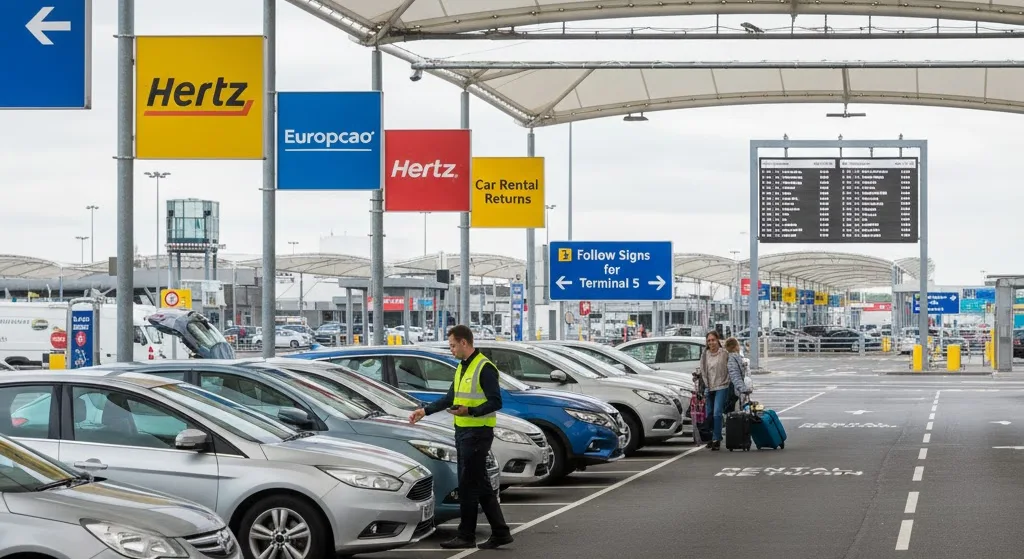
Renting a car is one of the best ways to explore the UK. A hire car unlocks the Scottish Highlands, the Lake District, the Cotswolds, and Cornwall in ways that public transport simply cannot match. But the UK's road rules, charge zones, toll roads, and rental industry quirks catch many visitors off guard — sometimes expensively. This guide covers everything you need to know before you collect the keys.
1. Driving on the Left
The most obvious adjustment for drivers from North America, continental Europe, Australia, and most of Asia is that traffic in the UK drives on the left side of the road. The driver sits on the right side of the car, not the left. If you've never driven on the left before, budget extra time at the start of each day to acclimatise.
The most common mistakes for new left-hand traffic drivers:
- Drifting right after turns — your instinct is to return to the right side. Consciously think "stay left" after every junction
- Roundabouts — UK roundabouts give priority to traffic already on the roundabout, coming from your right. Enter only when clear. Traffic goes clockwise around the roundabout.
- Overtaking — you overtake on the right in the UK. In a right-hand drive car, the passenger sits closest to oncoming traffic, giving the driver a less intuitive view of the road ahead when overtaking
- Multi-lane roads — the left lane is the normal driving lane. The right lane(s) are for overtaking only. Middle-lane hogging is a driving offence.
- Pedestrian crossings — look right first when approaching a crossing on foot, and remind passengers of the same before they open the door into traffic
Sat nav is highly recommended — not just for directions, but because it gives you something to follow at junctions rather than having to think from scratch each time.
2. Manual vs Automatic Gearbox
Approximately 70% of UK cars have manual (stick-shift) gearboxes. This figure is declining, but most budget rental fleets are still predominantly manual. If you drive only automatic, you must specify this at the time of booking — do not assume you can change it at the desk.
Automatic rental cars are:
- More expensive — typically 15–40% premium over equivalent manual
- Less available — popular automatics in small/medium categories book out quickly, especially in peak summer
- More common at premium rental brands (Hertz, Avis, Enterprise) vs budget brands (Europcar, Enterprise's budget lines)
If you can drive manual but haven't done so in a right-hand-drive car before: in a UK car, the gear lever is on your left hand, not your right. This is the main adjustment for drivers used to left-hand-drive manuals. The gear pattern (1-2-3-4-5/6 in the standard H-pattern) is the same.
3. Age Requirements
UK rental companies have varying age policies, but the typical rules are:
| Driver Age | Typical Policy |
|---|---|
| Under 18 | Cannot rent in the UK regardless of foreign licence |
| 18–20 | Very few companies will rent; high deposits; restricted to economy cars only |
| 21–24 | Widely accepted but young driver surcharge applies — typically £10–25/day extra |
| 25–69 | Standard rates; no age surcharge at most companies |
| 70–74 | Accepted by most companies; some require a medical declaration |
| 75+ | Policies vary significantly; some companies decline; others accept with additional documentation |
4. Documents You Need at the Rental Desk
UK rental companies are strict about documentation. Arriving without the right documents will mean you cannot collect the car, even with a confirmed booking.
- Full driving licence — must be valid and have been held for at least 1–2 years (requirements vary by company and vehicle class). Provisional or learner licences are not accepted.
- International Driving Permit (IDP) — required if your licence is not in English or a Latin script (e.g. Chinese, Arabic, Japanese, Thai, Russian Cyrillic). EU/EEA photocard licences do not need an IDP. US, Australian, Canadian licences are generally accepted without one.
- Passport or national ID card — for identity verification. Some companies accept a driving licence as primary ID for EU citizens; most require a passport for non-EU visitors.
- Credit card in the main driver's name — a credit card (not debit) is usually required for the security deposit. The deposit is pre-authorised (blocked) on the card rather than charged, but it can be £500–2,000. Debit cards are accepted at some companies but often attract a higher deposit or limited vehicle choice.
- DVLA check code (UK licence holders only) — UK licence holders are legally required to share their driving record with the rental company via the DVLA Share My Licence service (gov.uk/view-driving-licence). Generate a one-time code before you go — it's valid for 72 hours.
- Booking confirmation — whether printed or on your phone.
Allow Extra Time at the Desk
Even at airports, rental company desks can have queues of 30–60 minutes at peak times (Friday afternoons, bank holidays, the start of school holidays). Document verification and upsell pitches add time. Budget at least an hour between your flight landing and your expected departure from the rental lot.
5. Insurance and the Excess Problem
UK rental cars are legally required to have third-party insurance. Beyond that, most rental prices include:
- Collision Damage Waiver (CDW) — covers damage to the rental car itself, subject to an excess
- Theft Protection (TP) — covers theft of the car, subject to an excess
The excess is the amount you'd pay out of pocket for any claim before the insurance kicks in. UK rental car excesses are typically £800–£2,000. This means if you lightly scratch the bumper in a car park, you could face a £2,000 charge.
At the desk, the agent will offer to sell you a "Super CDW," "Full Cover," or similar product to reduce the excess to £0. This typically costs £15–30/day.
The Better Option: Third-Party Excess Insurance
A standalone car hire excess insurance policy from a third-party insurer (not the rental company) typically costs £5–10/day or £50–80/year for annual cover. It covers you for the excess amount if you make a claim. This is the same protection the rental desk is selling at 3–5 times the price.
Look for policies from providers such as Insurance4CarHire, Questor, or via price comparison sites. Buy before you travel — you cannot add this cover at the rental desk.
What Insurance Typically Does NOT Cover
- Damage to tyres, wheels, windscreen, or underbody (unless you buy specific add-on cover)
- Damage caused by driving on unsuitable roads or off-road
- Damage when a non-authorised driver was driving
- Negligence (e.g. leaving the keys in an unlocked car)
- Personal belongings left in the car
Read the policy wording carefully — or buy a comprehensive third-party policy that specifically includes tyre, windscreen, and underbody cover.
6. Fuel Policies
UK rental companies offer several fuel policies. Understanding these in advance prevents expensive surprises:
| Policy | How It Works | Best For |
|---|---|---|
| Full to Full | Car provided full; return full. If returned low, charged premium rate per litre plus a refuelling fee (£10–30). | Most renters — cheapest if you return the car full |
| Full to Empty | You pre-pay for a full tank at collection; return at any level. No refund for fuel remaining. | Only worth it if you'll use nearly a full tank and want convenience at return |
| Empty to Empty | Car provided empty (or very low); return empty. You buy fuel and use it; return as empty as possible. | Rare policy; tricky to manage near the return point |
| Prepay (fixed amount) | You pay for a set number of litres at collection; return at any level. | Budget planning; not always economical |
The Full to Full policy is the most common and most cost-effective for most renters. Return the car full and you pay the market pump price. The "gotcha" is the premium per-litre rate and admin fee if you forget.
Petrol or Diesel? A Note for Visitors
UK forecourts have separate pumps for petrol (unleaded — green handle) and diesel (black handle). These are not interchangeable — putting diesel into a petrol car (or petrol into a diesel) can cause serious engine damage. Check your rental paperwork carefully for the correct fuel type, and re-read the label on the filler cap each time you fill up, especially on an unfamiliar hire car.
If you're not sure: petrol cars have a smaller filler neck; the diesel nozzle is larger and should not physically fit. Most diesel cars now display "Diesel Only" stickers near the filler cap. Misfuelling is not covered by standard CDW — you'll be liable for the repair, which can cost thousands of pounds.
7. Tolls, Congestion Charges, and Clean Air Zones
This is the area that catches the most rental car visitors off guard. Rental cars have absolutely no exemption from any UK road charge — you are fully responsible for all tolls, charges, and any penalty notices that arise.
The Dartford Crossing
The Dartford Crossing (the QE2 Bridge southbound and two tunnels northbound) carries the M25 over the River Thames east of London. There is no cash toll booth — payment is entirely by number plate recognition (ANPR). Hire cars use UK number plates and are charged automatically.
The charge is £2.50 for cars and must be paid online at Dart-Charge by midnight the day after crossing. If the rental company receives a penalty notice (£70, reduced to £35 if paid within 14 days), they will pay it and invoice you the penalty plus an admin fee — often £25–50.
If you know in advance you'll use the Dartford Crossing, ask the rental company if they can pre-register the vehicle for automatic payment through their fleet account — some will do this for a small fee. Otherwise, pay at Dart-Charge (dartcharge.co.uk) by 11:59pm on the day after your crossing.
London Congestion Charge
If you drive in central London on weekdays (7am–6pm) or weekends (12pm–6pm), you must pay the Congestion Charge of £15 per day. The zone covers roughly the City of London and central London areas (Aldgate, Elephant & Castle, Vauxhall Bridge, Marylebone, King's Cross). Payment is by number plate online, by phone, or by text before midnight on the day of travel.
Most modern rental cars will meet the ULEZ standard (Euro 4 petrol or Euro 6 diesel), so the ULEZ charge typically doesn't apply to hire cars less than a few years old. However, if you're renting an older vehicle, check the ULEZ compliance tool using the vehicle's number plate.
Other Clean Air Zones
Several other UK cities operate Clean Air Zones (CAZs) that charge older or non-compliant vehicles:
| City | Daily Car Charge | Compliance Standard |
|---|---|---|
| London ULEZ | £12.50 | Euro 4 petrol / Euro 6 diesel |
| Birmingham | £8 | Euro 4 petrol / Euro 6 diesel |
| Bristol | £9 | Euro 4 petrol / Euro 6 diesel |
| Bradford | £9 | Euro 4 petrol / Euro 6 diesel |
| Bath | £9 | Euro 4 petrol / Euro 6 diesel |
Most rental cars registered after 2016 will comply with Euro 6 and be exempt from CAZ charges. However, always check using the vehicle's number plate on the relevant city authority website before entering the zone if you're unsure.
M6 Toll
The M6 Toll road runs for 27 miles around Birmingham and is the UK's only privately-operated toll motorway. Payment is at staffed toll plazas — cash and card are both accepted. The charge for a car is £7.60 (2026). Rental cars are not exempt and you pay at the barrier directly — there are no ANPR-only payment points to catch you out.
8. UK Road Rules for Visitors
The UK's road rules are broadly similar to most countries but have several quirks that surprise visitors.
Speed Limits
Speed limits in the UK are in miles per hour (mph), not kilometres. Speed cameras are common and widely used for enforcement. There is no informal tolerance — cameras are set at the limit and prosecutions begin from 1mph over.
| Road Type | Speed Limit (Cars) |
|---|---|
| Streets with lamp posts (built-up areas) | 30 mph (unless signs say otherwise) |
| 20 mph zones (common in cities and near schools) | 20 mph |
| Single carriageway rural roads | 60 mph (national speed limit) |
| Dual carriageway | 70 mph |
| Motorway | 70 mph |
Wales has a national default of 20 mph on restricted roads (roads with lamp posts that previously defaulted to 30). England and Scotland retain 30 mph as the default in lamp-lit areas, though 20 zones are increasingly common in cities.
Roundabouts
The UK uses roundabouts extensively — far more than the US or Australia. Give way to traffic already on the roundabout coming from your right. Traffic flows clockwise. Signal left when you're about to leave the roundabout, regardless of which exit you're taking.
On a multi-lane roundabout: left lane is generally for the first exit or straight on; right lane is for going straight on or taking later exits. Always signal appropriately and check your mirrors as you exit — cycling in roundabouts is common in the UK.
Box Junctions
Yellow criss-cross paint on the road at junctions is a box junction. You must not enter the box unless your exit is clear. If you stop in the box blocking other traffic, you can receive a penalty charge notice of £130 (reduced to £65 if paid within 14 days). Box junction cameras are used in London and increasingly in other cities.
Mobile Phones
It is illegal to hold a mobile phone while driving in the UK, even when stationary in traffic or at a traffic light. This includes texting, browsing, and using apps. The penalty is 6 points on your licence and a £200 fine — which for a foreign visitor translates to points potentially being recorded with your home country's authority (under reciprocal agreements within the EU). Hands-free phone use via a mounted phone holder is legal, but only if you don't touch the phone while driving.
9. Parking in UK Cities
Parking in UK cities can be expensive and confusing. Many urban areas have moved entirely to cashless payment systems.
- Yellow lines — single yellow line means parking restrictions at certain times (check the kerb markings or nearby signs). Double yellow lines mean no waiting at any time.
- Pay by phone — most on-street parking in UK cities is now paid by smartphone app (RingGo, JustPark, PayByPhone). Download these apps before you travel. Payment by coin is increasingly rare.
- Car parks — multi-storey and surface car parks are widespread. Most accept cards; many accept contactless. Some major cities have Park & Ride facilities that are significantly cheaper than city-centre parking.
- Blue Badge disabled parking — blue badge holders can park on yellow lines for up to 3 hours. As a rental car visitor, this does not apply unless you hold a valid Blue Badge.
- Penalty Charge Notices (PCNs) — issued by local councils for parking violations. If a PCN is issued to the rental car, the rental company will pay it and charge you the amount plus an admin fee.
10. Driving on UK Motorways
UK motorways (designated with an M prefix — M1, M25, M6) are generally excellent quality but can be heavily congested, particularly around London, Birmingham, and Manchester. Key points for visitors:
- Keep left — the left lane is for driving; right lanes are for overtaking only. Lane discipline is enforced and middle-lane hogging carries a £100 on-the-spot fine.
- 70 mph limit — strictly enforced by average speed cameras (SPECS) on many sections. These cameras record your number plate at two points and calculate average speed over the distance between them. Speeding between cameras and slowing for them does not help.
- No hard shoulder on smart motorways — an increasing number of motorway sections operate as All Lane Running, where the former hard shoulder is a live traffic lane. Emergency Refuge Areas (ERAs) are placed every 1–1.5 miles.
- Services — motorway service areas (MSAs) are spaced at roughly 28-mile intervals by law. They can be expensive for food and fuel — many drivers choose to exit at a junction and visit a nearby petrol station instead.
- Variable speed limits — overhead gantries on smart motorways display mandatory speed limits in orange. These must be obeyed even if a national speed limit sign is visible further along the road.
11. Breakdown Cover with a Rental Car
Most UK rental cars are covered for breakdown by the rental company's own recovery service. If your car breaks down:
- Check the rental agreement — there will be a 24-hour breakdown number to call
- Move the vehicle to a safe location if possible; use hazard lights
- On a motorway, use the free emergency phones spaced every mile on the hard shoulder (or call 999 if on a smart motorway with no hard shoulder)
- Stay with the vehicle — the rental company's recovery service will come to you
- Do not call the AA, RAC, or another breakdown service independently — the cost will not be reimbursed by the rental company
If you break down on a motorway at night, in bad weather, or in a remote location, wait inside the vehicle or behind the barrier (never on the carriageway) for recovery. Response times on motorways are typically 45–90 minutes.
12. EV and Hybrid Rentals
Electric vehicle (EV) and plug-in hybrid rentals are increasingly available at UK airports and city-centre rental locations. An EV rental can be particularly useful in cities with ULEZ or CAZ charges, as fully electric vehicles are exempt from these charges.
If you're renting an EV, ask the rental company to explain:
- The vehicle's real-world range (typically 80–200 miles depending on model)
- How the charging cable and port work
- Which charging networks are compatible (the UK has several: BP Pulse, Pod Point, Osprey, Gridserve, Osprey, Char.gy)
- Whether there's a specific return charge level required (some companies require the car returned at a minimum state of charge)
Public EV charging in the UK is improving but still patchy in rural areas. Apps like Zap-Map show the UK's public charging network and live availability. Motorway services now typically have rapid chargers (50–150kW), but queues can form at busy times.
Common Rental Car Pitfalls to Avoid
| Pitfall | How to Avoid It |
|---|---|
| Undocumented pre-existing damage | Inspect the car thoroughly and photograph all existing damage before driving away. Ensure the rental agent signs off on your list of pre-existing damage. Do the same at return. |
| Forgetting toll/charge payments | Note every charge zone you enter and pay promptly. Penalty notices from rental companies include admin fees that double or triple the original charge. |
| Returning with a low fuel tank | Keep the Full to Full policy in mind throughout the trip. Fill up at a petrol station near the return point rather than motorway services (more expensive). |
| Misfuelling | Double-check fuel type on the rental documents and filler cap every time you fill up. If you misfuel, do not start the engine — call the rental company immediately. |
| Late return fees | Rental companies charge a full additional day for returns even 30 minutes late. Build buffer time into airport return journeys, especially if travelling via congested roads. |
| Unauthorised drivers | Only drivers listed on the rental agreement are insured. Adding a driver at the desk (usually £5–10/day) is worth it — an accident with an unlisted driver voids the CDW entirely. |
Frequently Asked Questions
Do I need an International Driving Permit for the UK?
If your licence is in English or a Latin script (including EU/EEA licences, US, Australian, Canadian, and South African licences), you do not need an IDP for a short stay in the UK. If your licence is in Arabic, Chinese, Japanese, Thai, Russian, or any other non-Latin script, you do need an IDP in addition to your original licence.
Can I use a debit card to rent a car in the UK?
Some rental companies accept debit cards, but most prefer or require a credit card for the security deposit. If you only have a debit card, check with the specific rental company before booking — many will accept it but with a higher deposit or restricted vehicle choice. Prepaid cards are generally not accepted for the deposit.
Is the Dartford Crossing included in my rental car price?
No. If you use the Dartford Crossing (on the M25 east of London), you must pay the charge (£2.50 for a car) yourself via the Dart-Charge system online. If you don't and the rental company receives a Penalty Charge Notice (£70), they will bill you the penalty plus an admin fee.
Can I take a UK rental car to Europe?
Most UK rental companies do not permit their vehicles to be taken abroad, or require advance written permission and an additional insurance endorsement (a VE103 certificate for countries that require it). Check with your rental company at the time of booking — do not assume it's permitted. Taking the car abroad without authorisation typically voids all insurance cover.