Driving in London: Complete Guide for Visitors 2026
James has been writing about UK roads, traffic law, and vehicle regulation for over 8 years. He holds a full UK Category B licence and has driven extensively on the UK motorway network.
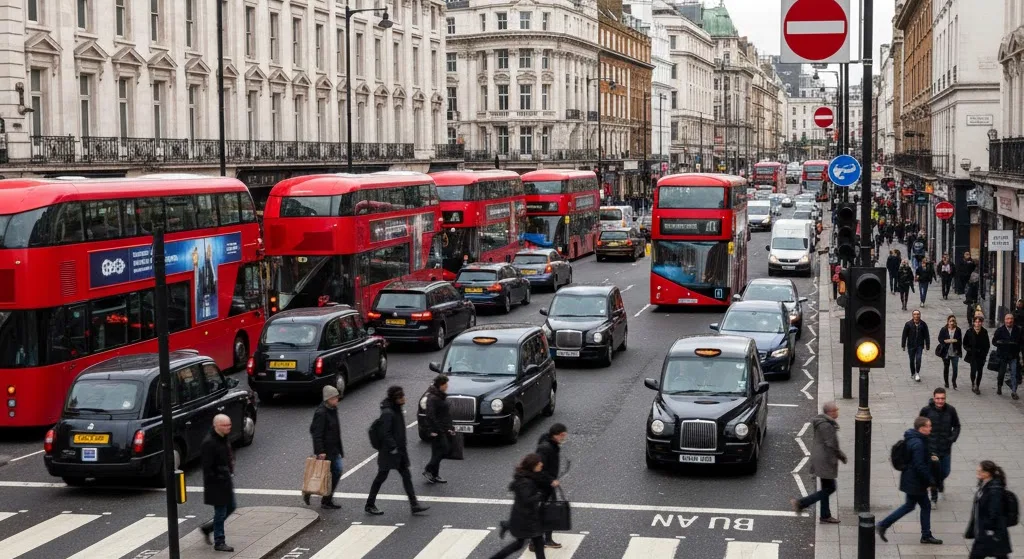
Driving in London is possible, but it requires preparation that goes well beyond any other UK city. London operates multiple overlapping charge zones, has some of the most densely camera-enforced roads in Europe, and offers some of the worst car journey times per mile in the world. The average speed across central London by car is around 7–10 mph — slower than a cyclist. This guide covers everything you need to know to drive in London legally and without expensive surprises: the charges, the rules, the parking, and the strategies that make it manageable.
Should You Drive in London at All?
For most visitors and for most journeys in central London, the honest answer is no. The Tube, buses, Elizabeth line, and National Rail services reach almost everywhere, and they're faster than driving in peak hours. The Congestion Charge (£15/day), ULEZ (£12.50/day if non-compliant), parking costs (£5–12/hour in central areas), and the sheer frustration of average speeds below 10 mph make driving in Zone 1 a costly and slow choice. However, driving makes sense for outer London areas, early morning departures, groups, or those with mobility needs.
London's Charging Zones Explained
London operates three distinct vehicle charge schemes, each covering a different area and targeting different vehicles. They are operated by Transport for London (TfL). Understanding which zones overlap for your specific vehicle is essential before entering.
Congestion Charge Zone (CCZ)
The CCZ covers central London — roughly the area inside the Inner Ring Road: Aldgate, Elephant and Castle, Vauxhall Bridge Road, Edgware Road, Euston Road, City Road, and Aldgate again. Driving within this zone during charging hours costs £15 per day regardless of vehicle type or emissions. There is no emissions exemption from the Congestion Charge — even fully electric vehicles pay.
| Charge | £15 per day |
| Hours (Mon–Fri) | 7:00am – 6:00pm |
| Hours (Sat–Sun) | 12:00pm – 6:00pm |
| Hours (Bank Holidays) | Same as Saturday/Sunday hours; does not apply Christmas Day |
| Payment deadline | Midnight on the day of travel; or 11:59pm the following day if using Auto Pay |
| Penalty for non-payment | £160 (reduced to £80 if paid within 14 days) |
| Payment methods | TfL website, TfL app, Auto Pay (direct debit), phone |
| Exemptions | Registered disabled (blue badge), NHS vehicles, some emergency services, motorcycles |
Auto Pay is strongly recommended for anyone driving regularly in London. You register your vehicle and a direct debit; charges are collected automatically. Auto Pay users get a slightly later payment deadline (midnight following day rather than midnight same day) and avoid the risk of forgetting.
Ultra Low Emission Zone (ULEZ)
Since August 2023, ULEZ covers all of Greater London — the entire area within the M25 boundary. It applies 24 hours a day, 7 days a week, every day of the year including bank holidays. Vehicles that don't meet the emissions standard are charged £12.50 per day.
| Charge | £12.50 per day (per vehicle) |
| Hours | 24 hours a day, 7 days a week, 365 days a year |
| Petrol compliance standard | Euro 4 — generally cars first registered after 2006 |
| Diesel compliance standard | Euro 6 — generally cars first registered after September 2015 |
| Penalty for non-payment | £160 (reduced to £80 if paid within 14 days) |
| Exemptions | Fully electric vehicles, hydrogen fuel cell vehicles, military vehicles, some disabled tax class vehicles |
Most cars made after 2015 are ULEZ compliant. Check your specific registration on the TfL ULEZ vehicle checker before entering Greater London if you're in any doubt.
Low Emission Zone (LEZ)
The LEZ covers most of Greater London and applies to larger diesel vehicles — lorries, buses, coaches, and heavier vans. Standard cars and small vans (under 3.5 tonnes) are generally not affected by the LEZ. If you're driving a hire van or a motorhome over 3.5 tonnes, check compliance at tfl.gov.uk/modes/driving/low-emission-zone.
What Do You Owe Per Day?
| Vehicle Type | ULEZ compliant? | Driving in CCZ on weekday? | Total daily charges |
|---|---|---|---|
| Modern petrol or diesel car (post-2015) | Yes (£0 ULEZ) | CC = £15 | £15 |
| Older petrol/diesel (pre-2006) | No (£12.50 ULEZ) | CC = £15 | £27.50 |
| Fully electric vehicle | Exempt (£0 ULEZ) | CC = £15 | £15 |
| Modern car, outside CCZ but in Greater London | Yes (£0 ULEZ) | No CC | £0 |
| Older car, outside CCZ but in Greater London | No (£12.50 ULEZ) | No CC | £12.50 |
Bus Lanes
London has an extensive network of bus lanes, and they are among the most strictly enforced in the UK. Key points:
- Most London bus lanes operate 24 hours a day, 7 days a week — unlike many other UK cities where bus lanes only operate during peak hours. Always check the sign at the start of the bus lane for its hours.
- Enforcement is entirely by camera — no warning, no discretion. The camera captures your plate, and a PCN (£160, reduced to £80) is posted.
- The camera cannot see your indicator or intentions — entering a bus lane briefly "to turn left" is still a violation if the turning occurs inside the bus lane restriction.
- Cyclists and motorcycles are generally permitted in bus lanes in London (check the signs — some say "Buses Only").
- GPS and sat nav apps do not always identify bus lanes correctly — Waze is generally the best for real-time bus lane identification, but still check signage independently.
Box Junctions
Yellow criss-cross markings at junctions are box junctions (formally called "yellow box junctions"). The rule: you must not enter the box unless your exit is clear. If traffic is queuing on the far side of the junction, you must wait at the stop line until your exit is clear before entering the box — even if you have a green light.
There is one exception: you may enter a box junction when turning right and are only prevented from completing the turn by oncoming traffic or pedestrians — i.e., you may wait in the box for a gap to turn right, provided you were able to clear the straight-on exit when you entered.
Box junction violations are captured by fixed cameras. The penalty is £160 (reduced to £80 if paid within 14 days). Key London box junctions with active enforcement include Oxford Street, Victoria Street, Gower Street, and most major Central London signalised junctions.
Speed Cameras and Speed Limits
London has an exceptionally dense speed camera network — fixed Gatso cameras, average speed (SPECS) systems on some corridors, and mobile units deployed by the Metropolitan Police.
The majority of London roads inside the North and South Circular are now 20 mph zones. This includes most residential streets, many major routes through borough centres (Hackney, Islington, Lambeth, Southwark have almost entirely gone 20 mph), and most routes through the West End. The A roads and key radial routes (A1, A10, A13, A2) remain at 30 mph or 40 mph on outer sections.
The key 20 mph routes to be aware of:
- The Embankment (A3211) — 20 mph throughout
- Victoria Embankment — 20 mph
- Most roads within the CCZ — 20 mph default
- Hyde Park Corner inner roads — 20 mph
- All TfL roads in most inner boroughs — 20 mph
Average speed camera systems on the A10 (Stoke Newington to Enfield) and several other corridors mean that slowing for one camera and accelerating between them is irrelevant — the system measures average speed over the full length of the cameras.
One-Way Systems and Red Routes
London's road network is heavily shaped by one-way systems, particularly in the City of London and West End. Sat nav handles these well, but there are a few notorious ones worth knowing:
- Aldwych — a sweeping one-way crescent with multiple exit/entry points
- Hyde Park Corner — effectively a roundabout but with multiple one-way approach roads and tunnel underpasses
- Old Street roundabout — complex junction with multiple one-way approaches; follow sat nav carefully
- Elephant and Castle — being redeveloped but still complex one-way system
Red routes are major arterial roads (A roads) designated as priority routes by TfL. Red lines on the kerb indicate stopping restrictions:
- Double red line — no stopping at any time, in any circumstances
- Single red line — no stopping during the hours shown on nearby signs
- Red routes include: A1 (Holloway Road), A2 (New Kent Road), A3, A10, A13, A23 (Brixton Road), Edgware Road, and many others
Cyclists and Pedestrians: London's Unique Hazards
London has more cyclists than any other UK city by some margin. In central London during peak hours, cyclists sometimes outnumber motor vehicles at junctions. Key rules:
- Advanced Stop Lines (ASL) — at many London junctions, there is a forward stop box for cyclists, with a secondary stop line behind it for other vehicles. You must stop at the rear stop line, not the cyclist box. If you stop in the cyclist box (even accidentally), you're liable for a penalty.
- Left turns at junctions — cyclists coming up on your left are a significant hazard when you turn left. Check your left mirror and blind spot immediately before the turn. Dooring (opening your door into a cyclist) and left-hook collisions are among the most common cycling accidents in London.
- Cycle superhighways and protected lanes — London has a network of segregated cycle lanes (CS1–CS10 and variants). These are physically separated from motor traffic and must not be driven or parked in.
- Pedestrians — at busy pedestrian crossing locations (Oxford Street, London Bridge, London Road), pedestrians frequently step into the road before the green man appears. In many areas, pedestrians legally have priority on shared surfaces. Drive at speeds that allow for pedestrian movement in high-density areas.
- Mopeds and scooters — high volumes of delivery riders on motorcycles and e-bikes weave through traffic constantly. They can appear suddenly from any direction. Check mirrors obsessively in central London.
Parking in London
Parking in central London is scarce, expensive, and complicated. Some key points:
On-Street Parking
Most on-street parking in central and inner London is controlled by Controlled Parking Zones (CPZs). These are residents-only bays during certain hours (check the sign carefully — the hours shown on single yellow lines and on CPZ signs are the restriction hours). Outside those hours, general parking is usually permitted.
Payment for unrestricted on-street bays is almost entirely by smartphone app — RingGo, PayByPhone, and JustPark are the most common. Download these before your trip; coin-operated pay-and-display machines are rare in central London. You'll need to input the bay number (on the bay markings or nearby sign) and your vehicle registration.
Car Parks
Multi-storey and surface car parks are the most practical option in central London, but they're expensive — typically £5–12 per hour in Zone 1 and £3–6 per hour in Zone 2. Pre-booking via JustPark, NCP's app, or similar sites can save 20–40% compared to turn-up rates. Major operators include NCP, Q-Park, and Westfield (the shopping centres have large adjacent car parks at somewhat lower rates if you validate your ticket).
Park and Tube Strategy
The most cost-effective strategy for driving to London from outside the M25 is to park at a tube or train station in the outer zones (Zone 3–6) and take public transport for the final stretch. Stations with large car parks include: Hatfield, St Albans (Thameslink), Watford Junction, Woking, Guildford, and Bromley South. This also avoids the ULEZ charge (outer zones are outside the M25 boundary) and eliminates the Congestion Charge entirely.
Navigating London: Apps and Tips
- Waze — the best app for real-time London traffic routing. Integrates crowd-sourced hazard reports, police locations, and route diversions around incidents.
- Google Maps — good for general routing but less responsive to bus lane and incident alerts than Waze. Better for finding parking.
- TfL Go app — shows all TfL charge zones, planned road closures, and charge payment history.
- Congestion Charge and ULEZ payment — pay via tfl.gov.uk or the TfL app; set up Auto Pay to avoid manual daily payments.
- Average speed in central London is genuinely around 7–10 mph during peak hours. A 3-mile journey in central London at 9am can take 30–45 minutes. Allow time accordingly.
- London has 24-hour CCTV on most roads — moving contraventions (bus lanes, box junctions, no entry) generate automatic penalty notices. There is almost no leeway or discretion from camera systems.
Best Times to Drive in London
| Time | Congestion Level | Notes |
|---|---|---|
| Before 7am weekdays | Low | Before Congestion Charge starts; best time for central London |
| 7am–9am weekdays | Very high | Morning peak; slowest time to drive in London |
| 9am–11am weekdays | Moderate | Post-rush but still busy; CC applies |
| 11am–3pm weekdays | Moderate | Relatively free-flowing by London standards; best window during day |
| 3pm–6pm weekdays | Very high | School run + afternoon peak; avoid if possible |
| After 6pm weekdays | Low–moderate | CC ends at 6pm; roads clear quickly |
| Weekend mornings (before noon) | Low | CC doesn't start until noon Sat/Sun; best weekend window |
| Weekend afternoons | Moderate–high | Shopping/leisure traffic; CC applies noon–6pm |
Frequently Asked Questions
How do I pay the London Congestion Charge?
Pay online at tfl.gov.uk, via the TfL app, by phone (0343 222 2222), or by text. Payment must be made by midnight on the day of travel. The most convenient option for regular use is Auto Pay — you register your vehicle and direct debit details and TfL charges you automatically after each day you enter the zone.
Do motorcycles pay the Congestion Charge?
No. Motorcycles, mopeds, and scooters are exempt from the Congestion Charge. They are also exempt from the ULEZ if they meet the emissions standard (Euro 3 for motorcycles). However, motorcycles must still comply with parking rules and road regulations.
What is the speed limit in London?
Most roads in central and inner London are 20 mph. Major arterial A roads (A1, A2, A3, etc.) are typically 30 mph in built-up areas and 40–50 mph on outer sections. Check your sat nav and road signs at all times — the 20 mph zones have spread significantly across London since 2020.
Can I park for free anywhere in central London?
Almost nowhere in Zone 1 offers free parking. Some side streets in outer areas have unrestricted parking during evenings and weekends, but these are at least 30 minutes from Zone 1 attractions by public transport. The practical options for central London visits are: pre-booked car parks, Park and Tube from outer zones, or accepting the cost of central car park rates.