London Congestion Charge 2026: Complete Guide
James has been writing about UK roads, traffic law, and vehicle regulation for over 8 years. He holds a full UK Category B licence and has driven extensively on the UK motorway network.
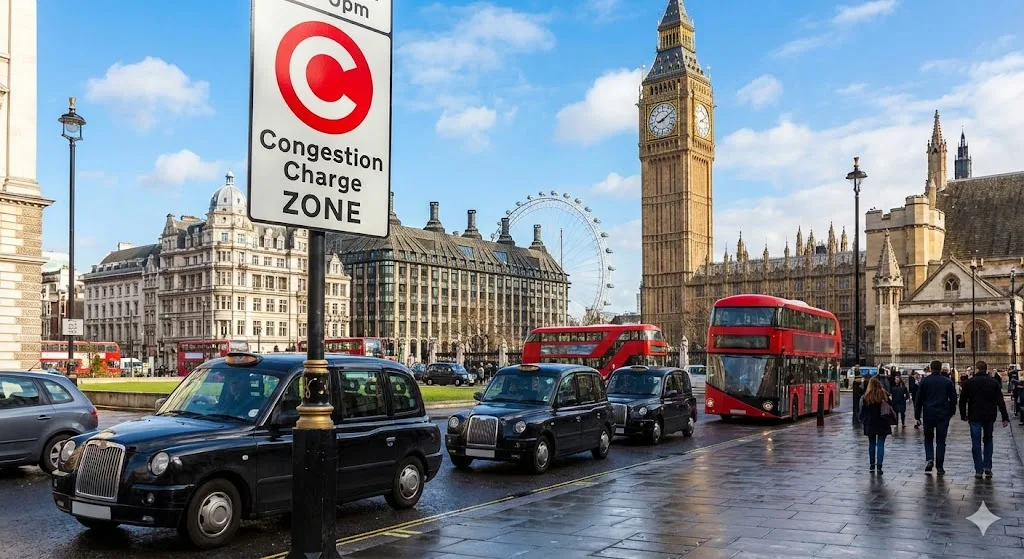
The London Congestion Charge is one of the most significant road pricing schemes in the world and one of the most misunderstood by drivers. Many visitors to London are unaware they owe it until a Penalty Charge Notice arrives in the post. This guide explains exactly where the zone is, when the charge applies, who qualifies for exemptions and discounts, how to pay (and set up Auto Pay so you never forget), and what happens if you don't pay.
What is the Congestion Charge?
The London Congestion Charge is a daily fee for driving a motor vehicle within a defined zone in central London during charging hours. It was introduced by Transport for London (TfL) in February 2003 — the first major urban congestion charge in the UK — and has significantly reduced the number of vehicles entering central London during peak hours.
Its primary purpose is not revenue but traffic reduction: before its introduction, the area within the zone was experiencing some of the worst urban congestion in Europe. Studies by TfL found that it reduced traffic volume within the zone by around 15% in its early years, with significant improvements in average travel speeds for buses and private vehicles alike.
The charge is separate from the ULEZ (Ultra Low Emission Zone) and the Dartford Crossing's Dart Charge, though all three schemes use ANPR cameras to enforce payment. A single trip into central London in a non-compliant older diesel vehicle could result in owing all three charges — the Congestion Charge, the ULEZ, and the Dart Charge (if you crossed the Thames at Dartford to reach London).
The Congestion Charge Zone: Where Exactly Does It Apply?
The Congestion Charge Zone (CCZ) covers central London, bounded roughly by:
- North: Euston Road and Marylebone Road
- East: Tower Bridge Road and Borough High Street
- South: Elephant and Castle, Vauxhall Bridge Road
- West: Edgware Road, Park Lane
The zone covers approximately 22 square kilometres and encompasses areas including the City of London, Westminster, Holborn, Mayfair, Southwark, and the South Bank. Major landmarks inside the zone include the Houses of Parliament, Buckingham Palace (close to the western boundary), St Paul's Cathedral, the Tower of London, and Trafalgar Square.
Critically, the charge applies to any vehicle entering, driving within, or exiting the zone during charging hours — including through traffic that is simply passing through without stopping. There is no minimum distance threshold.
The zone is signposted at entry points with the distinctive white "C" on a red background sign. However, given the density of streets in central London, the most reliable way to know if you are in or near the zone is to use TfL's online zone checker with your specific route.
Current Charge: How Much is It in 2026?
| Detail | Information |
|---|---|
| Daily charge (most vehicles) | £15.00 |
| Charging hours (Mon–Fri) | 7:00am – 6:00pm |
| Charging hours (Sat–Sun) | 12:00pm – 6:00pm |
| Bank holidays | No charge |
| Christmas period | No charge 25 Dec – 1 Jan |
| Payment deadline | Midnight the same day (or in advance) |
The £15 charge is a flat daily fee — you pay once regardless of how many times you enter and exit the zone on the same day, or how long you are in the zone. Driving through the zone once and spending 4 hours there cost the same: £15.
Congestion Charge + ULEZ: Two Separate Charges
The Congestion Charge and ULEZ are completely separate schemes, though both are enforced by TfL using ANPR cameras. If you drive a non-ULEZ-compliant vehicle into central London during Congestion Charge hours, you may owe £15.00 (CC) + £12.50 (ULEZ) = £27.50 for that day. Always check both.
Who Pays? Vehicle Categories
The Congestion Charge applies to virtually all motor vehicles — cars, vans, lorries, buses, coaches, taxis, and motorcycles — unless they qualify for an exemption or discount. There is no weight threshold below which vehicles are exempt.
Motorcycles and mopeds are fully exempt from the Congestion Charge and always have been — one of the few blanket exemptions that has not changed since 2003.
Large vehicles (lorries, buses, coaches) pay the same £15 daily charge as cars. There is no higher rate for larger vehicles in the Congestion Charge zone, unlike the ULEZ where HGVs pay £100 per day.
Exemptions and Discounts
Full exemptions (pay nothing)
- Motorcycles and mopeds: Exempt since the scheme's launch in 2003.
- Fully electric vehicles (EVs): Currently exempt. TfL has been reviewing this exemption and it may change — check the current status on the TfL website before assuming EV exemption applies.
- Disabled Tax Class vehicles: Vehicles taxed as Disabled or Disabled Passenger Vehicle are exempt. The vehicle must be registered in this tax class — it is not sufficient to have a Blue Badge holder as a passenger.
- Military vehicles: UK Ministry of Defence registered vehicles.
- NHS emergency vehicles and ambulances.
- Vehicles used by roadside recovery and breakdown services (with registration).
- Vehicles registered as agricultural.
The Residents' Discount (90% reduction)
Residents who live within the Congestion Charge zone receive a 90% discount, paying £1.50 per day instead of £15. This discount must be applied for each year through TfL and requires proof of residence within the zone. Only residents of qualifying addresses within the CCZ boundary are eligible — living just outside the zone does not qualify.
Fleet discounts and accounts
Businesses operating large fleets of vehicles in London can set up business accounts with TfL that simplify payment management. Fleet accounts provide consolidated billing and reports but do not automatically provide discounts on the standard daily charge.
How to Pay the Congestion Charge
The Congestion Charge is enforced purely by ANPR cameras — there are no toll booths, barriers, or manned checkpoints. You must pay proactively, by midnight on the day of travel, or set up Auto Pay so the charge is applied automatically.
Option 1: Pay online (same day)
Pay on the TfL website or TfL app by midnight on the day you drive in the zone. You enter your vehicle registration and the date of travel, and pay by credit or debit card. You can also pay up to 90 days in advance if you know you will be travelling into London.
Option 2: Auto Pay (strongly recommended for regular users)
Auto Pay is TfL's automatic payment system. You register your vehicle and a payment card with TfL. If your vehicle is detected in the zone during charging hours, the charge is automatically applied to your card — you never have to remember to pay manually. Auto Pay accounts also provide a full history of charges for expense tracking.
Setting up Auto Pay is free and takes a few minutes on the TfL website. It is the most reliable way to ensure you never receive a Penalty Charge Notice due to forgetting to pay.
Option 3: Pay by phone
You can pay by calling TfL on 0343 222 2222. This is slower than online payment and requires your vehicle registration number and a payment card.
Beware of unofficial payment websites
Numerous unofficial third-party websites appear when you search for "pay Congestion Charge" and charge additional processing fees — sometimes £5–10 on top of the actual charge. Always pay directly via the official TfL website (tfl.gov.uk) or the TfL app. The official URL for Congestion Charge payments starts with tfl.gov.uk, not any other domain.
Penalty Charge Notice: What Happens if You Don't Pay?
If TfL's ANPR cameras record your vehicle in the zone during charging hours and no payment is received by midnight, a Penalty Charge Notice (PCN) will be issued to the registered keeper of the vehicle.
| Stage | Amount | Timeline |
|---|---|---|
| PCN — paid within 14 days | £80 | 50% discount period |
| PCN — full amount | £160 | After 14 days |
| Charge Certificate | £240 | After 28 days unpaid |
| Order for Recovery | £240 + costs | Further escalation |
At the Order for Recovery stage, TfL can apply to register the debt as a County Court Judgment (CCJ) and instruct enforcement agents (bailiffs) to recover the debt. This can include clamping or removing the vehicle.
Appealing a PCN: If you believe a PCN was issued incorrectly (for example, you did pay but the payment was not recorded, or the ANPR misread your plate), you can make a formal representation to TfL. If rejected, you can escalate to London Tribunals — the independent adjudicator for London PCNs. Always appeal in writing and provide evidence.
Durham Congestion Charge: The UK's Other Scheme
Outside London, Durham operates the UK's only other congestion charge. It covers a small section of the historic city centre — Saddler Street, which leads to the Cathedral — and was introduced in 2002, actually predating London's scheme.
- Charge: £2.00 per crossing
- Hours: Monday to Saturday, 10:00am – 4:00pm
- Purpose: Protecting the pedestrianised cathedral area from traffic
- Exempt: Residents, disabled badge holders, and emergency vehicles
The Durham scheme is enforced by a rising bollard at the entry point — vehicles must stop and pay before the bollard lowers to allow access. It is a very localised scheme with no ANPR enforcement.
Alternatives to Paying the Congestion Charge
For drivers making occasional trips to central London, alternatives to paying the daily charge are often more economical:
- Public transport: Elizabeth Line, Underground, Overground, and National Rail provide excellent access to central London from most of the south-east and beyond. For a day trip from, say, Reading or Brighton, the combination of car + rail is usually cheaper and faster than driving and parking in the centre.
- Park and Ride / boundary parking: Free or paid car parks at Tube or rail stations on the outskirts of London allow you to drive most of the way and take public transport the last leg. Avoid parking on residential streets near Tube stations — many are within Controlled Parking Zones.
- Route planning: If your destination is on the edge of the zone, consider whether a different route avoids entering the zone entirely. The zone boundary is not always where you might expect — some major roads near the edge cross in and out of the zone.
- Cycle hire: Santander Cycles (Boris Bikes) are available throughout central London for short journeys within the zone once you have arrived by public transport.
Quick Summary: Congestion Charge Key Facts
- £15/day for most vehicles entering the zone.
- Applies Mon–Fri 7am–6pm and Sat–Sun 12pm–6pm (not bank holidays).
- Pay by midnight the same day via TfL website or app, or set up Auto Pay to never forget.
- Motorcycles, currently EVs, disabled tax class vehicles, and zone residents (90% discount) are exempt.
- The ULEZ and Congestion Charge are separate — you may owe both on the same day.
- Non-payment: £160 PCN, reduced to £80 if paid within 14 days.
- Use only the official TfL website to pay — avoid unofficial sites that charge extra fees.
Frequently Asked Questions
Do I pay the Congestion Charge and ULEZ separately?
Yes — they are separate schemes with separate charges. A non-compliant vehicle in central London during CC hours could owe £15 (CC) + £12.50 (ULEZ) = £27.50 on the same day. Compliant ULEZ vehicles pay only the £15 CC.
Is my electric car exempt from the Congestion Charge?
Currently yes — fully electric vehicles are exempt. However, TfL has been reviewing this exemption. Always confirm the current exemption status on the TfL website before your trip, as this policy has changed before and may change again.
What if I'm just passing through — do I still have to pay?
Yes. If your vehicle enters the zone during charging hours — even just driving straight through — the charge applies. There is no minimum time or distance threshold within the zone.
Can I pay the next day?
No — you must pay by midnight on the day of travel. There is no "next day" payment option for the Congestion Charge. The only exception is if you set up Auto Pay, which handles payment automatically.