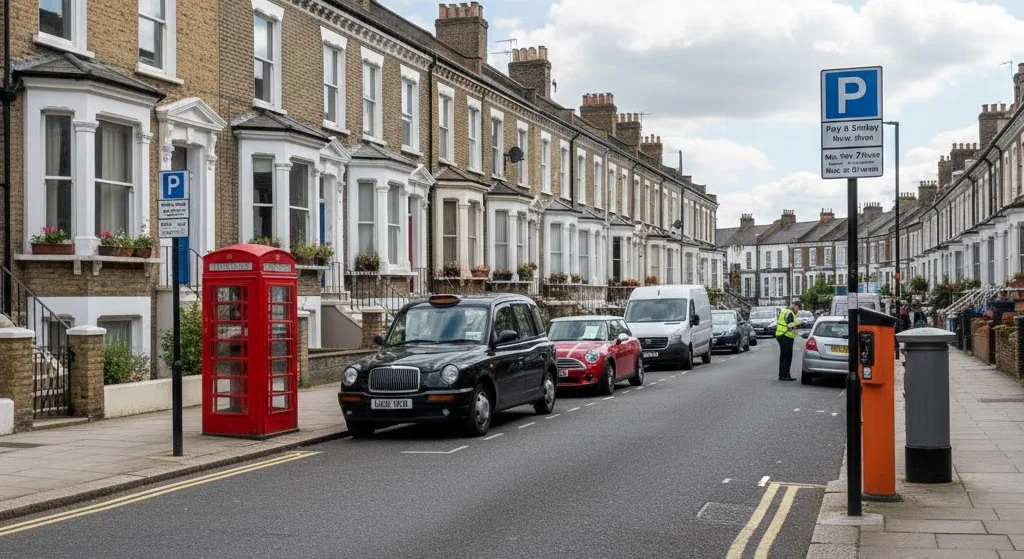
UK parking rules are more complex than they first appear, and getting them wrong can result in fines of up to £130 — or higher in some cases. This guide covers every type of parking restriction you will encounter on UK roads: what each line and sign means, where and when you can stop or park, how Penalty Charge Notices work, and how to successfully challenge one if you believe it was issued unfairly.
Yellow Lines: The Complete Rules
Yellow lines are the most common parking restriction you will encounter on UK roads. They appear on the carriageway edge (the road, not the pavement) and control when you can and cannot wait with your vehicle. Understanding the difference between waiting, loading, and parking is important — yellow lines restrict waiting (stopping and remaining), but loading rules are separate and indicated by kerb markings.
Double Yellow Lines
Double yellow lines — two parallel yellow lines painted at the edge of the road — mean no waiting at any time. You cannot stop and remain with your vehicle here at any point, on any day of the week, at any time of day or night, including weekends and bank holidays.
Exceptions to double yellow lines:
- Loading and unloading: You may stop to load or unload goods unless there are kerb marks (yellow lines on the kerb itself) that prohibit loading. Kerb marks are a separate restriction from the road markings. A single yellow kerb mark means no loading during certain hours; a double yellow kerb mark means no loading at any time.
- Blue Badge holders: Holders of a Blue Badge (disabled parking permit) can wait for up to 3 hours on double yellow lines where there are no kerb marks and where waiting is not otherwise prohibited by a sign. They must display the Blue Badge and set the parking clock if one is required.
- Emergency situations: Stopping briefly in an emergency is not an offence, but this is a narrow exception that does not apply to convenience stops.
Single Yellow Lines
A single yellow line means no waiting during restricted hours. The specific hours of restriction must be shown on a nearby sign — without a sign, the restriction does not apply. Signs are typically metal plates attached to lamp posts or wall-mounted brackets near the relevant section of single yellow line.
Common restriction patterns include:
- "Mon-Sat 8am-6pm" — the most common restriction, meaning no waiting during business hours on weekdays and Saturdays. You can park here on Sundays and bank holidays (subject to any separate restrictions).
- "Mon-Fri 8am-9am, 4:30pm-6:30pm" — rush hour restrictions only. You can park here at other times on weekdays and all day on weekends.
- "Mon-Sun 8am-8pm" — seven-day restrictions, common in busy areas. You can only park outside these hours.
- "8am-10am" (no days shown) — implies every day, including weekends. This is increasingly rare; always check the sign carefully.
Outside the restricted hours shown on the sign, you can park on a single yellow line — but check for any additional local restrictions, such as resident permit requirements.
Always look for the sign
A single yellow line without a sign has no legal force — you cannot be penalised for parking where there is no sign indicating the restriction. However, if there is a sign anywhere on the relevant stretch of road (even if it is some distance away), it applies to the entire marked section. If you cannot find a sign, look at lamp posts and walls on both sides of the road. If there is genuinely no sign, you should be safe, but document this if you receive a PCN.
Kerb Markings: Loading Restrictions
Yellow marks on the kerb face — not the road — indicate loading and unloading restrictions. These are separate from the carriageway yellow lines and operate independently.
- Single yellow kerb mark: No loading or unloading during the hours shown on the associated sign (usually alongside a yellow line).
- Double yellow kerb marks: No loading or unloading at any time, on any day. This is the most restrictive kerb marking.
- No kerb marks: Loading and unloading is permitted even on double yellow lines, as long as it is a genuine delivery or collection and does not take unnecessary time.
Civil Enforcement Officers (the "traffic wardens") are trained to distinguish between genuine loading/unloading and drivers who are simply using the loading exception as an excuse to wait. If you stop and remain in the vehicle without any obvious loading activity, you may receive a PCN regardless of any loading exemption.
Red Routes (London and Some Other Cities)
Red routes are a stricter form of restriction used in London and a growing number of other cities. They are marked with red lines (single or double) instead of yellow, and apply to a network of key routes where traffic flow must be kept clear.
- Double red lines: No stopping, waiting, or loading at any time. More restrictive than double yellow lines — you cannot even stop briefly for loading on a double red route. Blue Badge holders cannot use the standard yellow line exemption on double red routes without specific local dispensation.
- Single red lines: No stopping during the hours shown on the sign. Outside those hours, stopping may be permitted, but check for any bay markings.
London's red route network covers around 5% of London's roads but carries around 30% of its traffic. Enforcement is strict and rapid — parking enforcement vehicles (camera cars) patrol red routes regularly, and you can receive a PCN within minutes of parking.
Parking Bays and Meters
Parking bays are marked sections of road where parking is permitted, often with time limits or payment requirements. Always check the bay sign — even if the bay appears to be free public parking, there may be restrictions that are not immediately obvious.
Pay and Display
Pay and Display bays require you to buy a parking ticket from a machine and display it clearly on your dashboard or inside the windscreen. Keep the ticket face-up and visible — a ticket tucked under a sun visor or placed on the back seat will not protect you from a PCN.
Most Pay and Display machines in city centres now also accept payment by app (using RingGo, JustPark, PayByPhone, or council-specific apps). These app payments can be extended remotely if you need more time, and receipts are sent by email — keep these in case of any dispute.
Pay by Phone / Cashless Parking
Many councils have removed pay and display machines entirely in favour of cashless payment via app. Where this is the case, there will be signs indicating which app to use and the bay number or zone code you need to enter when paying. Do not assume a bay is free simply because there is no machine — look for a sign.
Permit Holder Bays
Residential parking bays marked "Permit Holders Only" (usually for a named zone, e.g., "Zone A") are restricted to residents who have purchased the appropriate permit from the local council. Parking here without a valid permit will result in a PCN. Visitor permits exist in most councils and can usually be purchased by residents to allow their guests to park.
Limited Waiting Bays
Bays marked with a maximum stay time (e.g., "Max 2 hours, No return within 1 hour") allow free parking but only for the stated period. You must leave the bay within the time limit and cannot simply move to another nearby bay and return — "no return" restrictions apply to the zone, not just that individual bay.
Civil Enforcement Officers chalk tyre marks or use camera vehicles to track how long vehicles have been parked. A vehicle exceeding the maximum stay will receive a PCN.
Disabled Bays
Dedicated disabled parking bays — marked with the international wheelchair symbol — are reserved for vehicles displaying a valid Blue Badge. You must display the Blue Badge and, where required, set the parking clock to show your arrival time. Using a disabled bay without a Blue Badge is a civil parking offence carrying the same level of penalty as other PCNs.
Other Parking Prohibitions
Beyond yellow lines and bays, there are numerous other places where parking is prohibited by law or by safety convention:
- On the pavement: Parking wholly on the pavement is illegal in London under the Greater London Council (General Powers) Act 1974. Outside London, it is not generally illegal unless a Traffic Regulation Order specifically prohibits it — but causing an obstruction is an offence anywhere. The government has been consulting on a national pavement parking ban for several years.
- Dropped kerbs: Parking across a dropped kerb (including a drive entrance or a kerb dropped for wheelchair access) is illegal and will result in a PCN. This applies even if the dropped kerb is for a private driveway.
- Zig-zag lines near zebra and pedestrian crossings: No stopping during restricted hours. Zig-zag markings extend on both sides of crossings and are strictly enforced because stopping here blocks pedestrian sightlines.
- Bus stops and bus stands: No stopping for any reason in a bus stop zone (marked with yellow lines and a yellow bus stop box on the road). Stopping briefly to drop someone off is also prohibited.
- School keep clear markings: The "KEEP CLEAR" box markings outside schools carry full parking restrictions during school hours. These are enforced even in areas without civil parking enforcement — a police officer can issue a fixed penalty notice.
- Taxi ranks: Reserved exclusively for licensed taxis.
- Fire hydrant access areas: Marked with an "H" sign — parking here can obstruct emergency service access.
- Clearways: Signs showing a red "X" over a car mean no stopping at any time. Common on major roads and approaches to motorways.
Penalty Charge Notices: How They Work
A Penalty Charge Notice (PCN) is issued by a Civil Enforcement Officer (on-street) or by the local authority's camera and ANPR systems (for camera-enforced zones). It is different from a Fixed Penalty Notice, which is issued by police.
PCN penalty amounts
| Contravention level | Full amount | Reduced (paid within 14 days) |
|---|---|---|
| Higher level (London, red routes, bus stops) | £130 | £65 |
| Lower level (yellow lines, bay contraventions) | £70 | £35 |
| Outside London (varies by council) | £50–£110 | 50% reduction if paid within 14 days |
The 14-day discount: always pay if you are guilty
If you have received a PCN and believe the contravention occurred, pay within 14 days to receive the 50% discount. If you do not pay and do not appeal, the penalty escalates: to the full amount after 28 days, then to a Charge Certificate (increased by 50%) after a further 28 days, and ultimately to an order for recovery enforced by bailiffs. A valid PCN that is simply ignored will cost you significantly more than the original discounted amount.
How to Appeal a Parking Fine
If you believe a PCN was issued incorrectly or unfairly, you have the right to challenge it. The appeals process has several stages:
Stage 1: Informal representation
Within 28 days of receiving the PCN, you can make an informal representation to the issuing council. Do this in writing (email or letter), clearly stating:
- The PCN reference number
- Your vehicle registration
- The grounds for your challenge (see below)
- Any supporting evidence — photographs, receipt for a Pay and Display ticket, Blue Badge details, etc.
While your representation is being considered, you are not required to pay. If the council rejects your representation, you will receive a Notice to Owner, at which point you have a further 28 days to make a formal representation or pay the full penalty.
Stage 2: Formal representation
If the informal representation is rejected, you can make a formal representation to the council. This triggers a formal consideration process and the right to an independent appeal if rejected.
Stage 3: Independent adjudicator
If the formal representation is rejected, you can appeal to an independent adjudicator — the Traffic Penalty Tribunal (England and Wales, outside London) or London Tribunals (for London PCNs). This is a free service, the adjudicator is completely independent of the council, and their decisions are binding. Councils lose a significant proportion of appeals taken to adjudication, particularly where there are procedural errors in how the PCN was issued.
Valid grounds for appeal
- The vehicle was not parked in contravention. You did not park where the PCN says, or the parking was within the permitted hours.
- The PCN was incorrectly issued. Procedural errors by the CEo — wrong details, wrong contravention code, failure to follow the correct procedure.
- Inadequate or missing signage. If the signs indicating the restriction were obscured, missing, or inadequate, the PCN may be invalid.
- The vehicle was on hire. If the vehicle was rented out, you can redirect the liability to the hirer.
- The vehicle was stolen. With a crime number, you can prove you were not responsible.
- Compelling circumstances. A genuine emergency (medical emergency, vehicle breakdown) may succeed at adjudication even if the technical contravention occurred — but this requires strong evidence.
- Blue Badge in use. If you were correctly using a Blue Badge and this was not acknowledged.
Parking in London: Special Considerations
London has the most complex and strictly enforced parking rules in the UK. Key points for London:
- Evening and weekend parking: Many residential areas in London require resident permits at all times, including evenings and weekends. Do not assume a bay is free after 6pm without checking the sign.
- Controlled Parking Zones (CPZ): Large areas of London are within CPZs, where residents' parking bays and restricted parking apply throughout the zone, not just on individual streets. Look for signs at the zone boundary.
- Camera enforcement: Many PCNs in London are now issued by automatic ANPR camera systems rather than CEOs on foot. These can be issued hours or days after the vehicle left the location. Your first notification may be a Notice to Owner through the post.
- Congestion Charge zone parking: Parking within the Congestion Charge zone during charging hours may attract both a parking PCN and the daily Congestion Charge — check whether you need to pay the charge even if the parking is paid for.
Blue Badge Parking Rights: A Summary
Blue Badge holders have significant parking concessions throughout the UK:
- Parking on single yellow lines for up to 3 hours, unless kerb marks prohibit loading.
- Parking on double yellow lines for up to 3 hours, unless kerb marks prohibit loading.
- Free parking in on-street pay and display bays and council car parks without time limit (unless local rules specify a limit).
- Use of dedicated disabled bays — must display Blue Badge and clock where required.
- Exemptions from some pedestrian zones (check local rules).
Blue Badge concessions do not apply to red routes (double red lines) unless specifically signed; to some private car parks which have their own rules; or to loading bays marked with kerb markings. Always check the local rules in unfamiliar cities.