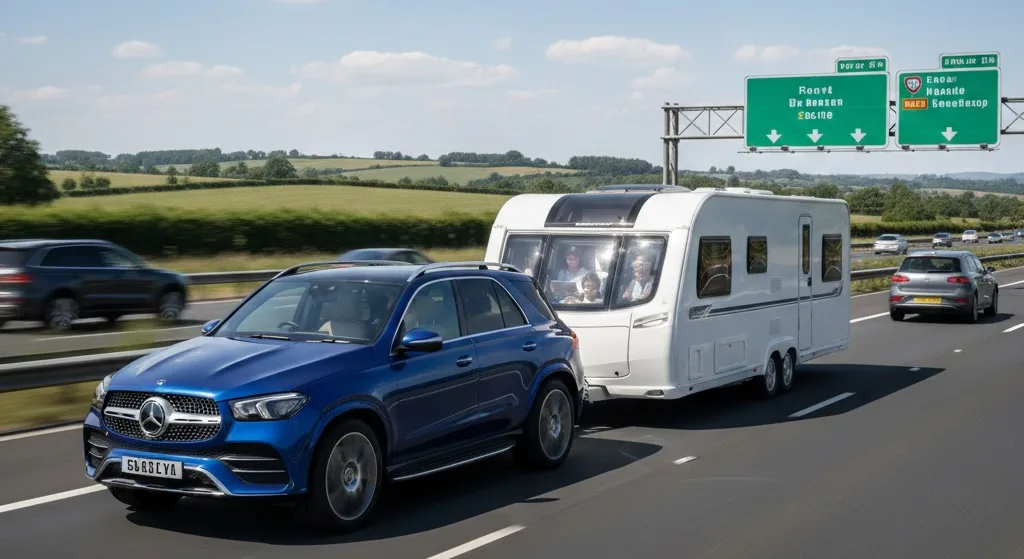
Towing a caravan or trailer in the UK is governed by a surprisingly wide range of rules — covering your driving licence, how much weight you can legally tow, speed limits, which motorway lanes you can use, how toll charges change with a trailer, and how to keep the outfit stable on the road. Whether you're a first-time caravanner or a seasoned tower, this guide brings together everything you need to know for 2026.
Licence Requirements: What Can You Legally Tow?
Your legal towing entitlement depends primarily on when you passed your driving test.
Passed on or After 1 January 1997
The rules were significantly relaxed in September 2021. If you passed your Category B car test on or after 1 January 1997, you can now tow a trailer or caravan with a Maximum Authorised Mass (MAM) of up to 3,500kg — without taking a separate towing test. Previously, the limit was 750kg MAM without a test, and anything heavier required a Category B+E test.
In practical terms, this means the vast majority of touring caravans, boat trailers, horse trailers, and general-purpose trailers commonly used by private motorists are within the scope of a standard Category B licence.
Passed Before 1 January 1997
If you held a full UK driving licence before 1 January 1997, your licence already includes Category B+E entitlement, which allows you to tow a trailer with a MAM up to 8,250kg (the combined weight of your car plus trailer). This grandfathered entitlement is printed on your photocard licence under the category codes — check the code list on the back of your card.
When You Still Need an Additional Test
Even with the 2021 rule relaxation, a separate B+E test is still required in these circumstances:
- Towing a trailer with a MAM above 3,500kg (very heavy horse boxes, large commercial trailers)
- Towing commercially (i.e. as part of a business activity) in some circumstances — check with your employer or insurer
- You have penalty points that restrict your towing entitlement
The DVLA's official guidance is at gov.uk/towing-with-car. Your specific towing entitlement is listed on your photocard licence — look for the category codes and check the permitted combinations.
Tip: Even If Legal, Consider Training
The fact that you're now legally permitted to tow up to 3,500kg doesn't mean you should attempt it without any experience. Towing a large caravan at 60 mph for the first time is a very different experience to driving a solo car. Many caravan clubs offer affordable towing courses — highly recommended before a first trip.
Weight Rules: The 85% Rule and MAM Explained
Knowing the legal maximum isn't the same as knowing how much you should tow. There are two distinct weight calculations that matter:
Maximum Authorised Mass (MAM)
The MAM (also called Gross Vehicle Weight or GVW) is the maximum legal weight of the trailer when fully loaded — including the trailer's own weight plus everything inside it. This figure is stated on the trailer's manufacturer plate (a metal plate fixed to the chassis). You must not load the trailer beyond its MAM — this is both illegal and a safety risk.
The 85% Rule
The 85% rule is an industry guideline (not law) promoted by the National Caravan Council (NCC) and most caravan manufacturers: the Maximum Technically Permissible Laden Mass (MTPLM) of the caravan should not exceed 85% of the towing vehicle's kerbweight.
Example: A car with a kerbweight of 1,500kg should not tow a caravan with an MTPLM above 1,275kg (85% of 1,500kg = 1,275kg).
Exceeding the 85% threshold significantly increases the risk of snaking — the caravan starting to swing from side to side, which at speed can cause the towing vehicle to lose control. Experienced towers with suitable vehicles and stabilisers may exceed 85% up to 100%, but anything above 100% (the caravan is heavier than the car) is almost universally unsafe regardless of experience.
Nose Weight
Nose weight is the downward force the trailer exerts on the tow ball. Too little nose weight causes instability; too much overloads the tow ball and rear axle of the towing vehicle. Most tow balls have a maximum nose weight of 75kg or 100kg — check your vehicle's handbook. The ideal nose weight is typically 5–7% of the trailer's laden weight.
When loading a caravan, place heavier items low and forward (over the axle or slightly ahead of it), lighter items above or at the rear. Avoid loading heavy items at the back — this reduces nose weight and destabilises the outfit.
Speed Limits When Towing
When towing a caravan or trailer, you are subject to lower speed limits than solo cars on most road types. These apply regardless of the size or weight of what you're towing — even a small tent trailer puts you under the lower limits.
| Road Type | Standard Car | Car + Caravan/Trailer |
|---|---|---|
| Built-up areas (30 mph zone) | 30 mph | 30 mph |
| Single carriageway (national speed limit) | 60 mph | 50 mph |
| Dual carriageway | 70 mph | 60 mph |
| Motorway | 70 mph | 60 mph |
Posted limits apply where lower than these defaults (e.g. roadworks, 20 mph zones). These limits apply to a car towing a standard trailer or caravan — different rules apply to goods vehicles and buses.
Speeding while towing is enforced in the same way as for solo vehicles — by fixed cameras, average speed cameras, and mobile units. Towing at 70 mph on a motorway is illegal and the excuse "I didn't know the limit was lower" is not accepted as mitigation. Speeding offences while towing attract the same penalty structure as standard speeding: a minimum £100 fine and 3 penalty points, rising to disqualification and unlimited fines in court for serious excess speeds.
Motorway Lane Restrictions
Vehicles towing caravans or trailers are banned from using the right-hand (outside) lane on motorways with three or more lanes. This restriction applies even when overtaking — you may use only lanes 1 and 2 (left and middle lanes).
On a two-lane motorway, you may use both lanes. The restriction is specific to three-or-more-lane motorways because the combination's 60 mph limit and bulk make it dangerous in a fast-moving outer lane, and because it impedes the flow of other traffic more severely in that position.
This means on many sections of the M25, M6, and M1 (which have four lanes in some areas), you are restricted to lanes 1, 2, and 3 but not lane 4.
Towing Equipment Requirements
Tow Ball and Coupling
The tow ball must be type-approved and rated for the nose weight and trailer weight you're towing. Many modern cars have detachable tow bars — check the ball is properly locked in place before every journey. The coupling head on the caravan or trailer must engage securely onto the ball and the coupling latch must be properly locked.
Breakaway Cable
A breakaway cable (or breakaway lanyard) is mandatory in the UK for trailers over 750kg MAM, and very strongly recommended for all trailers. If the trailer becomes disconnected from the towing vehicle, the breakaway cable applies the trailer's brakes automatically — preventing a runaway trailer. The cable must be attached to a secure point on the towing vehicle (not the tow ball itself) and should be long enough to allow the trailer to follow normal curves but short enough to apply before the coupling fully separates.
Check the breakaway cable is not kinked, corroded, or frayed before every trip. It's a safety-critical item.
Trailer Lights and Number Plates
Your trailer or caravan must display:
- The same number plate as the towing vehicle — the trailer's rear plate must match the tow vehicle's registration. This is a legal requirement and failure to display it can result in a fine.
- Tail lights, brake lights, and indicators functioning correctly and correctly synchronised with the tow vehicle. These are wired via the tow vehicle's 7-pin or 13-pin plug.
- Rear fog light(s) — at least one red rear fog light is required, active when the towing vehicle's fog lights are on
- Rear reflectors — red triangular reflectors on each rear corner
Check all trailer lights every time before you depart, ideally with a second person behind the trailer while you work the pedals and switches. A trailer with failed lights is not just illegal — it's a serious safety hazard.
Towing Mirrors
You must be able to see clearly behind and to the sides of the trailer. If the trailer or caravan is wider than the towing vehicle (which almost all touring caravans are), you must fit towing mirrors that extend far enough to provide an adequate rear view. This is a legal requirement under Regulation 33 of the Road Vehicles (Construction and Use) Regulations 1986.
Clip-on or strap-on towing mirrors are widely available and relatively inexpensive (£20–70). Using a caravan without towing mirrors when required can result in a £1,000 fine. Towing mirrors must themselves be in good condition and properly adjusted — a wobbly, vibrating mirror that's technically fitted but useless is not compliance.
Caravan Stability and Anti-Sway
Caravan snaking — where the caravan begins to oscillate from side to side — is the most dangerous hazard specific to towing. It can occur when:
- Speed is too high relative to the caravan's weight
- The caravan is overloaded at the rear
- Nose weight is too low
- A vehicle overtakes rapidly, creating a pressure wave
- Crosswinds are strong, especially on exposed routes
- The road surface is uneven
What to Do If the Caravan Snakes
- Do not brake suddenly or sharply — this is the most dangerous instinct to follow. Sudden braking reduces tow vehicle speed faster than caravan speed, which amplifies the oscillation.
- Do not try to steer against the sway — keep the steering wheel straight and resist the urge to correct.
- Gently ease off the accelerator and allow the outfit to slow naturally
- Apply the caravan's manual override brake if fitted — a steady, smooth application via the dashboard control can damp the oscillation
- Keep slowing gradually until the snaking reduces and stops, then pull over at the earliest safe opportunity to investigate the cause
Stabilisers and Electronic Stability
Many modern caravans come fitted with AL-KO ATC (Automatic Trailer Control) or similar electronic stability systems that detect the onset of snaking and apply individual brakes to correct it before it becomes dangerous. These systems are fitted to the trailer and work independently of the towing vehicle.
Friction stabilisers (mounted between the tow ball and coupling head) also help damp oscillation for older outfits without electronic systems. They are less effective than ATC but significantly better than no stabiliser.
Towing vehicles with Trailer Stability Assist (TSA) — a feature in Volvo, BMW, Ford, and many other modern vehicles — can also detect and correct trailer snaking by applying individual wheel brakes on the towing vehicle. If your car has this feature, ensure it's enabled and not overridden.
Tolls and Charges When Towing
Dartford Crossing (M25)
The Dartford Crossing uses ANPR cameras to read the towing vehicle's number plate. The charge is applied to the towing vehicle's category — not the combined outfit. This means:
- Car towing a caravan or trailer = Class B: £2.50 (same as a solo car)
- The trailer or caravan is not separately charged
Payment must be made online at Dart-Charge (dartcharge.co.uk) by midnight on the day after your crossing. The crossing is cashless — there are no staffed toll booths.
M6 Toll Road
The M6 Toll charges based on vehicle classification, and a car towing a trailer or caravan is classified as a Car + Trailer (Class C), which attracts a higher rate than a solo car. The M6 Toll has staffed toll plazas where you pay directly — cash and card both accepted.
| Vehicle Class | Examples | 2026 Rate |
|---|---|---|
| Class A | Motorcycles, bikes | £3.80 |
| Class B | Cars, motorhomes ≤3,500kg | £7.60 |
| Class C | Car + caravan/trailer, car + motorhome trailer | £11.40 |
| Class D | Small commercial vehicles (2 axles) | £11.40 |
Rates are subject to change. Always check the current charges at m6toll.co.uk before travelling.
Other UK Toll Roads and Crossings
Most other UK toll roads and crossings (Mersey Tunnels, Humber Bridge, Severn Crossings) also charge based on vehicle category, with cars towing trailers typically classified at a higher rate than solo cars. When planning a long-distance towing journey, check the toll operators' websites for current rates.
| Toll Road / Crossing | Car Rate | Car + Trailer | Notes |
|---|---|---|---|
| Dartford Crossing | £2.50 | £2.50 (same) | Trailer not separately charged |
| M6 Toll | £7.60 | £11.40 | Class C rate applies |
| Mersey Tunnels (Kingsway/Queensway) | ~£2.10 | ~£2.10 | Check current rates; ANPR payment |
| Humber Bridge | £1.50 | ~£3.00 | Multi-axle rate; check humberbridge.co.uk |
| Mersey Gateway Bridge | £2.30 | ~£2.30 | Car rate; check merseygateway.co.uk |
Rates are indicative for 2026 and subject to change. Check individual operators' websites for current charges before travelling.
Insurance Considerations When Towing
Your car insurance covers the towing vehicle but may or may not cover the trailer or caravan. Check your policy carefully:
- Third-party liability — most UK car insurance policies extend third-party cover to a trailer or caravan being towed. This means if you cause an accident, your car insurer pays the third-party claim. But your own caravan or trailer damage is not covered under the car policy.
- Caravan insurance — covers the caravan itself (fire, theft, accidental damage) when towed and when sited. Most static and touring caravan policies also include public liability cover specific to the caravan. If you own a caravan, a standalone caravan insurance policy is strongly recommended.
- Trailer insurance — general trailers (horse boxes, boat trailers, flatbeds) are not automatically covered under car insurance for their own damage. A separate trailer insurance policy or a trailer endorsement on your car policy may be needed.
Motorway Driving Tips Specific to Towing
Motorways are generally the most comfortable roads for long towing journeys — good quality tarmac, no roundabouts, clear lane markings — but they require adjusted driving habits:
- Plan fuel stops carefully — with a lower speed limit, your journey takes longer, and a large motorhome or caravan dramatically increases wind resistance and fuel consumption. Calculate fuel needs in advance and identify fuel stations on your route
- Maintain large following distances — stopping distances increase significantly with a towed load. The loaded trailer adds inertia that the car's brakes must work against. In wet conditions, add even more distance
- Watch for crosswinds on exposed sections — motorway bridges, viaducts, and open moorland sections (notably the A9 in Scotland, the M62 across the Pennines, and parts of the M4 in Wales) can generate strong crosswinds that dramatically affect a caravan's stability
- Overtaking lorries requires care — when a large HGV passes in the opposite carriageway on a non-motorway road, the pressure wave can initiate snaking. Maintain speed and steering and it should pass
- Service area access — most motorway service areas can accommodate car and caravan combinations, but check height barriers and turning circle at the entry and exit points. Some have dedicated caravan/motorhome parking areas
Towing Abroad: Channel Tunnel and European Rules
If you're taking your caravan abroad via the Channel Tunnel (Eurotunnel) or ferry:
- Eurotunnel — caravans and trailers are accommodated in the vehicle shuttle, but must be booked in advance as an "oversized vehicle." Check the maximum height, width, and length limits on Eurotunnel's website before booking
- Ferries — DFDS, P&O, Stena Line, and Brittany Ferries all carry caravans and trailers. Book as a "car + caravan" or "car + trailer" to ensure sufficient deck space is reserved
- European speed limits differ — when towing in France, Germany, Spain, or other European countries, different national speed limits apply to towing combinations. These vary significantly — in France, for example, the caravan speed limit on autoroutes is 110 km/h if the caravan is lighter than the car, but 90 km/h if heavier
- European toll roads — most continental toll roads charge by number of axles. A car with a single-axle caravan may be charged as a two-axle combination in France; a twin-axle caravan may attract a three-axle rate
Pre-Journey Checklist
Run through this checklist before every towing trip:
| Check | What to Verify |
|---|---|
| Coupling | Properly engaged, latch locked, jockey wheel fully raised and secured |
| Breakaway cable | Attached to vehicle (not tow ball), not kinked, correct length |
| Lights | All rear lights, brake lights, indicators, and fog lights working |
| Number plate | Rear number plate visible and matches towing vehicle |
| Tyres | Caravan/trailer tyre pressure (often higher than car), tread depth, no sidewall damage |
| Loading | Caravan not overloaded, heavy items forward and low, nose weight in range |
| Towing mirrors | Fitted, adjusted, secure (not loose or vibrating) |
| Caravan doors and hatches | All locked. Roof lights closed. TV aerial stowed. Steps retracted. |
| Gas | Gas turned off at the bottle during transit |
| Handbrake | Caravan handbrake off (if manually applied) |
Frequently Asked Questions
What is the towing speed limit on motorways?
When towing a caravan or trailer, the motorway speed limit is 60 mph, not 70 mph. The same 60 mph limit applies on dual carriageways. On single-carriageway roads outside built-up areas, the limit is 50 mph. In built-up areas (30 mph zones), the standard 30 mph limit applies.
Can I tow a caravan with a standard car licence?
If you passed your UK driving test on or after 1 January 1997, the 2021 rule changes mean you can tow a trailer or caravan with a MAM of up to 3,500kg on a standard Category B car licence, without any additional test. This covers most touring caravans used by private motorists.
Do I need towing mirrors by law?
Yes, if the trailer or caravan is wider than the towing vehicle, you are legally required to fit towing mirrors that provide an adequate rearward view. Driving without them when required can result in a fine of up to £1,000 for using a vehicle in a dangerous condition.
What happens if the caravan starts to snake?
If the caravan starts to snake (oscillate from side to side), do not brake suddenly or steer against the sway. Ease off the accelerator gently and allow the outfit to slow naturally. If fitted, apply the caravan's manual override brake steadily. Once stable, pull over and investigate the cause — usually rear-heavy loading, excessive speed, or a gust of wind.