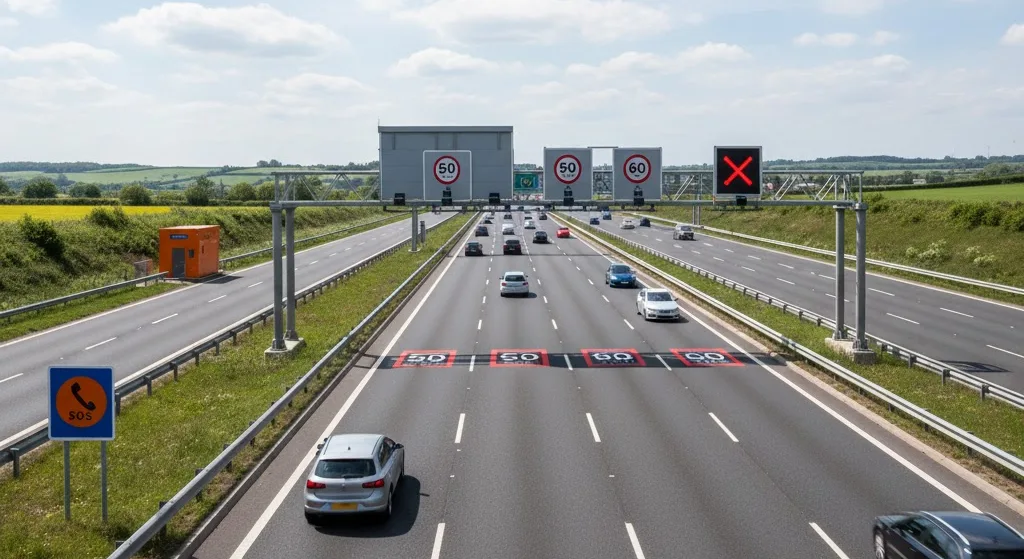
Smart motorways have fundamentally changed how millions of UK drivers experience the motorway network — yet many drivers remain confused or unaware of the specific rules, signals, and emergency procedures that apply to them. This comprehensive guide covers everything from the three different types of smart motorway to the ongoing parliamentary debate about their safety, so you can drive with confidence on any section of the UK's 500+ miles of smart motorway.
What Exactly is a Smart Motorway?
A smart motorway (sometimes called an Active Traffic Management or ATM motorway) uses technology — overhead gantries, sensors, CCTV, and variable message signs — to actively manage traffic flow in real time. The system monitors vehicle speeds, densities, and incident locations, then adjusts speed limits and lane availability to prevent stop-start congestion before it forms.
Highways England (now National Highways) began rolling out the first smart motorway scheme on the M42 near Birmingham in 2006. Since then, the technology has been applied to over 500 miles of motorway across England, with more sections planned through the 2020s — though several schemes have been paused or cancelled following the safety debate described later in this guide.
The core proposition is that by using the hard shoulder as a running lane during peak hours, roads can carry more vehicles without new construction — and by smoothing out speed fluctuations, average journey times actually improve even if maximum speeds are lower.
The Three Types of Smart Motorway
Not all smart motorways work the same way. Understanding which type you are driving on is crucial because the rules for the hard shoulder differ significantly.
1. Controlled Motorway
This is the most straightforward type. The motorway has three or more lanes with variable speed limits shown on overhead gantries, but retains a traditional hard shoulder for emergencies. The speed limit can be reduced from 70 mph down to as low as 20 mph (usually 40 or 50 mph in practice) to manage congestion or incidents.
If there is no speed limit displayed on the gantry, the national speed limit of 70 mph applies. If you see a blank or dark gantry sign, assume 70 mph unless other signs indicate otherwise.
Examples: Parts of the M25 around the M23 junction, sections of the M1 in Northamptonshire.
2. Dynamic Hard Shoulder (DHS)
On DHS motorways, the hard shoulder can be opened as a running lane during busy periods. When the hard shoulder is open to traffic, a speed limit will be shown on the overhead gantry above it. When it is closed (reverting to emergency use only), a Red X or no sign will be displayed above it.
This type is becoming rarer as older DHS sections are converted to All Lane Running (below). The critical rule: only use the hard shoulder as a running lane when a speed limit is displayed above it.
Examples: Certain sections of the M42, parts of the M6.
3. All Lane Running (ALR) — The Most Controversial Type
All Lane Running is the type generating the most public concern. The hard shoulder is permanently converted into a running lane, so there is no traditional hard shoulder at all. Instead, Emergency Refuge Areas (ERAs) are built at intervals to provide a place of safety if you break down.
This is the type that has featured most prominently in the safety debate, because a vehicle that breaks down between ERAs can be stranded in a live lane — a deeply dangerous situation. National Highways has committed to increasing the frequency of ERAs and improving detection technology to address this.
Examples: M25 Junctions 23–27, M1 between Junctions 28–35a, M3 Junctions 2–4a, sections of the M6, M62, and many others.
How to tell which type you're on
Look for the orange Emergency Refuge Areas (marked with a blue sign showing a phone). If you see them regularly and there is no traditional hard shoulder, you are on an All Lane Running motorway. Controlled motorways keep the hard shoulder painted in the traditional way. When in doubt, look for overhead gantries — if every lane including the leftmost has a gantry sign above it, that lane is a running lane.
The Red X Rule: The Most Important Rule on a Smart Motorway
NEVER drive in a lane with a Red X overhead
A Red X on an overhead gantry means that lane is closed. It is illegal to drive in a lane displaying a Red X. Penalty: £100 fine and 3 penalty points. In serious cases, prosecution through the courts with a much higher fine.
The Red X is displayed when a lane needs to be closed — usually because of a broken-down vehicle, an accident, debris on the road, or emergency services working in or near the carriageway. It is one of the most important signals on the motorway network precisely because it protects people who are already in a vulnerable situation.
Despite its importance, compliance has historically been poor. Research by National Highways found that approximately 1 in 10 drivers ignore Red X signals. To address this, fixed Red X cameras are now being rolled out across the network and are actively enforced. The cameras can capture violations automatically, and you will receive a Notice of Intended Prosecution (NIP) by post.
What to do when you see a Red X:
- Move out of the closed lane as soon as it is safe to do so.
- Do not wait until the last moment — exit the lane as early as possible.
- Reduce your speed and be prepared for hazards ahead.
- Do not re-enter the closed lane, even if it appears clear further ahead.
Variable Speed Limits: How They Work and Why They Matter
Variable speed limits (VSLs) are displayed on the overhead gantries in red circles — identical in appearance to a standard speed limit sign but mounted overhead. These are legally mandatory and enforced by average speed cameras that calculate your speed between gantries.
The system works by detecting when traffic density is building up and proactively reducing the speed limit before a jam forms. This smooths out the "accordion effect" — where vehicles alternately brake and accelerate — which is both the main cause of motorway congestion and the main cause of rear-end collisions.
Studies by Transport Research Laboratory found that smart motorway VSLs can reduce personal injury accidents by up to 26% and cut journey time variability by around 30%, even if average speeds are marginally lower.
Speed limit rules at a glance
- If a speed limit is shown in a red circle on the gantry, it is mandatory — treat it like any other speed limit sign.
- If the gantry shows a blank sign or no speed limit, the national speed limit (70 mph) applies.
- If the gantry shows an advisory speed (no red circle, just a number in amber or white), it is not legally enforceable but strongly recommended.
- Average speed cameras are commonly active between gantries — your average speed is checked, not just your speed at a fixed point.
Emergency Refuge Areas (ERAs): What They Are and How to Use Them
On All Lane Running motorways, Emergency Refuge Areas replace the traditional hard shoulder as a place of safety. They are marked with blue and orange signs showing a telephone symbol, and are spaced approximately every 1.5 miles (though in practice some older sections have gaps of up to 2.5 miles — something National Highways has pledged to address).
Each ERA contains an SOS telephone connected directly to the National Highways Traffic Officer Service. There is no charge for the call and the service operates 24/7.
What to do if you need to use an ERA
- If you notice a problem developing (warning lights, loss of power, tyre blow-out), try to coast to the next ERA rather than stopping in a live lane.
- As you enter the ERA, switch on your hazard lights.
- Pull as far into the ERA as possible, away from the running lanes.
- Exit from the passenger side (left side) to avoid stepping into traffic.
- Move behind the barrier if one is present — do not stay in the vehicle unless it is safer to do so (e.g., in poor weather with no barrier).
- Use the SOS phone to contact Highways England. Give your location (ERA number shown on the sign) and describe your situation.
- Wait for assistance — a Traffic Officer will typically arrive within 20–30 minutes. Do not attempt repairs yourself or try to walk along the carriageway.
- When leaving the ERA, use the ERA to build up speed before re-entering the live lane, and watch for a gap in traffic.
ERA Detection Technology
Since 2020, National Highways has been retrofitting Stopped Vehicle Detection (SVD) technology to all lane running motorways. SVD uses radar to detect stationary vehicles in live lanes and automatically triggers a Red X closure within 20 seconds. As of 2026, SVD coverage has expanded significantly, but not all sections are yet equipped. Always aim to reach an ERA rather than relying on SVD to protect you.
What to Do if You Break Down in a Live Lane
If your vehicle stops in a running lane and you cannot reach an ERA or the next exit, you are in a serious situation. Stay calm and act quickly:
- Switch on your hazard lights immediately to warn approaching drivers.
- Call 999 — this is a life-threatening emergency. Give your location using the nearest distance marker or junction number.
- If you can safely exit the vehicle (check mirrors and blind spots first), get out from the passenger side and climb over the barrier if one is present.
- If it is not safe to exit (e.g., heavy fast traffic passing closely), stay in the vehicle with your seatbelt on and call 999 from inside the car.
- Do not stand in or near the traffic lanes, and do not attempt to push the vehicle.
The Stopped Vehicle Detection systems are designed to detect your stationary vehicle and automatically close the lane above you, usually within 20–30 seconds. However, this does not mean other drivers will always react in time — the safest outcome is always to reach an ERA if at all possible.
The Smart Motorway Safety Debate
Smart motorways — particularly All Lane Running — have been at the centre of a significant public and parliamentary debate since around 2019. The core concern: removing the hard shoulder means that a broken-down vehicle has nowhere safe to go if it cannot reach an ERA, leaving occupants exposed to fast-moving traffic.
A BBC Panorama investigation in 2019 and subsequent inquest evidence highlighted multiple fatal accidents on ALR motorways involving vehicles stopped in live lanes. The House of Commons Transport Select Committee launched an inquiry, and in January 2022 the government announced a pause on new ALR schemes until a five-year safety evaluation was complete.
In 2023, the then-government announced that it would not proceed with 11 planned new ALR schemes, though it did not commit to reinstating hard shoulders on existing ALR sections. The debate over whether to retrofit hard shoulders continues as of 2026.
What National Highways has done in response
- Committed to installing Stopped Vehicle Detection on all ALR sections.
- Increased the frequency of ERA monitoring and signage.
- Introduced a national Red X enforcement camera rollout.
- Published a Five-Year Action Plan with specific safety milestones.
- Committed to reducing ERA spacing where possible on existing sections.
Overhead Gantry Signs: A Complete Reference
Understanding every type of sign you may see on a smart motorway overhead gantry is essential:
| Sign | Meaning | What to do |
|---|---|---|
| Red X | Lane closed | Move out of the lane immediately |
| Speed limit in red circle | Mandatory variable speed limit | Slow to that speed — legally enforced |
| Blank / no sign | National speed limit applies | Maximum 70 mph |
| Advisory speed (amber) | Recommended speed — not mandatory | Follow if safe to do so |
| Text messages | Incident warnings, fog, ice alerts | Read and act on the information given |
| Green arrow | Lane open | Lane available for use |
Smart Motorways and Penalties: What Can You Be Fined For?
The offences unique to smart motorways — or those more commonly encountered on them — carry significant penalties:
- Driving in a Red X closed lane: £100 fixed penalty, 3 penalty points. Can be prosecuted in court for repeat offending or dangerous circumstances.
- Exceeding a mandatory variable speed limit: £100 fixed penalty, 3 penalty points (same as any speeding offence). Average speed cameras enforce this.
- Using a mobile phone while driving (applies to all roads): £200 fixed penalty, 6 penalty points. New drivers (less than 2 years post-test) face automatic disqualification.
- Tailgating (careless driving on a motorway): £100 fixed penalty, 3 penalty points via Operation Tramline enforcement cameras.
Preparing Your Vehicle for Motorway Travel
The best way to handle a smart motorway breakdown is to avoid breaking down in the first place. Before any significant motorway journey:
- Check tyre pressures — including the spare. Under-inflated tyres are the leading cause of motorway breakdowns. Check cold, before you set off.
- Check engine oil and coolant — running low on either can cause catastrophic engine failure. Check with the engine cold.
- Check fuel — running out of fuel on a motorway is now an offence in some circumstances (causing unnecessary obstruction). Plan fuel stops in advance, especially late at night when services are quieter.
- Check wiper blades and screen wash — poor visibility at motorway speeds is extremely dangerous.
- Check that all lights work — a blown bulb is an easy fix before you set off but can lead to fines and accidents if ignored.
- Check your breakdown cover — know the number to call before you need it. Save it in your phone.
Key Smart Motorway Routes in the UK
The following are among the most heavily used smart motorway sections you are likely to encounter:
- M25: Junctions 23–27 (ALR), plus controlled sections throughout — the UK's busiest motorway, extensive smart motorway coverage.
- M1: Junctions 24–25, 28–35a, 39–42 — long ALR sections through the Midlands and South Yorkshire.
- M6: Junctions 10a–13 (DHS/ALR) through the West Midlands — includes the M6 Toll junction.
- M3: Junctions 2–4a — ALR south-west of London.
- M62: Various sections across West Yorkshire — important trans-Pennine route.
- M4: Junctions 3–12 — ALR between London and Reading.
- M42: Junctions 3a–7 — one of the original smart motorway sections near Birmingham.
Summary: The 6 Rules to Remember
- Never drive in a Red X lane — it is illegal and protects someone who may already be in danger.
- Obey variable speed limits — they are mandatory and average-speed-camera enforced.
- Know your ERA locations — look for the orange and blue signs with the telephone symbol.
- If you break down, try to reach an ERA — coasting in neutral is better than stopping in a live lane.
- If you must stop in a live lane, call 999 — this is an emergency, not a recovery situation.
- Prepare your vehicle before you travel — the most common smart motorway breakdowns are caused by easily preventable problems like low tyre pressure or lack of fuel.