Dartford Crossing Guide 2026: Dart Charge, Costs & How to Avoid a Fine
James has been writing about UK roads, traffic law, and vehicle regulation for over 8 years. He holds a full UK Category B licence and has driven extensively on the UK motorway network.
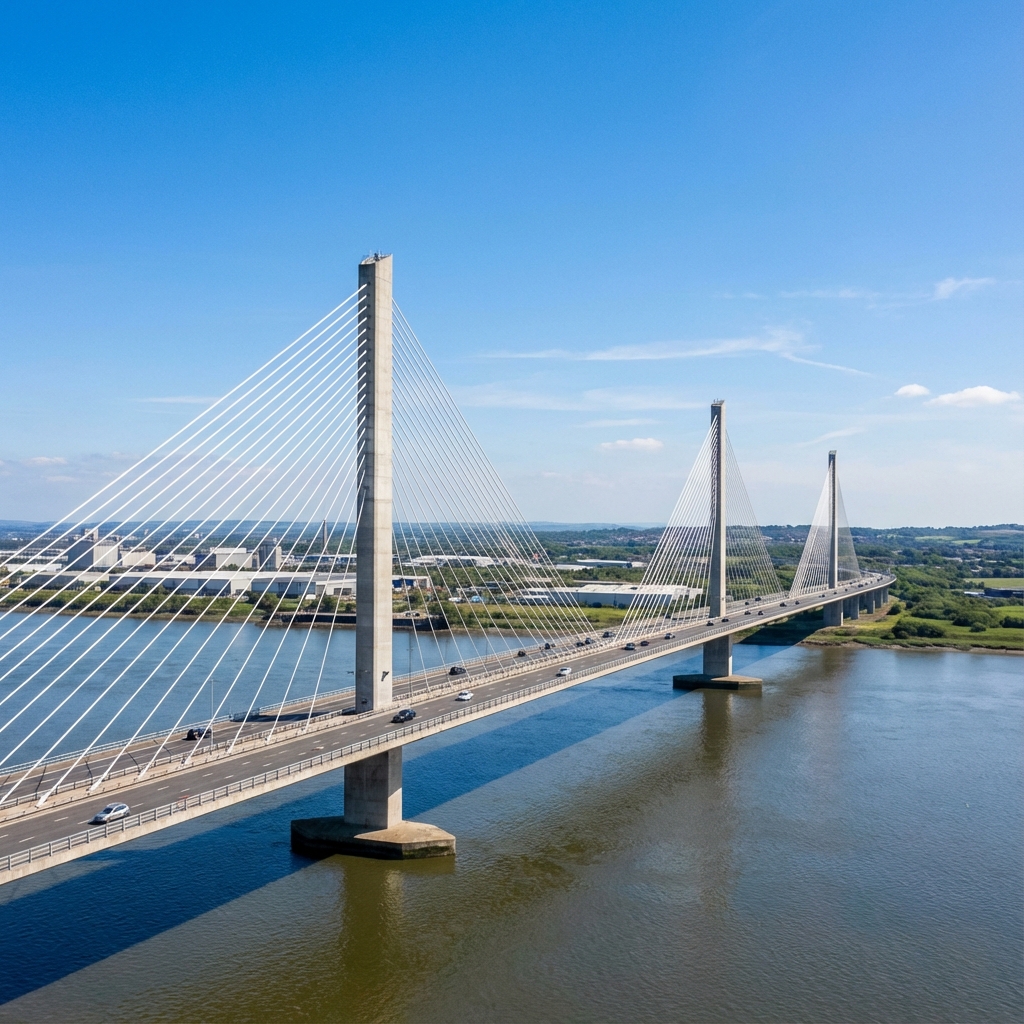
The Dartford Crossing carries around 180,000 vehicles per day between Kent and Essex — making it the busiest river crossing in the UK. There are no toll booths. Payment is handled entirely by the Dart Charge system, and thousands of drivers receive £70 fines every year simply because they did not know they needed to pay online by midnight. This guide covers the 2026 charges, how to pay, free crossing times, fines, and how to set up an account so you never get caught out again.
Dart Charge 2026 — quick reference
What is the Dartford Crossing?
The Dartford Crossing consists of two tunnels (carrying northbound traffic from Kent into Essex) and the Queen Elizabeth II Bridge (carrying southbound traffic from Essex into Kent). It sits on the M25 orbital motorway between junctions 1A and 31. The crossing opened its first tunnel in 1963; the QE2 bridge opened in 1991 and remains the longest cable-stayed bridge in the UK at 450 metres.
Toll booths were removed in 2014 and replaced with Dart Charge — a free-flow electronic system that reads your number plate as you pass through and charges you for the crossing. There is no way to pay on the spot. Payment must be made online, by phone, or at a PayPoint outlet before midnight on the day after your crossing.
The crossing operates 24 hours a day, 365 days a year. Congestion is severe at peak times — the M25 around junctions 1A and 31 is consistently among the most congested sections of road in the UK, and delays of 30–60 minutes are common on weekday mornings and bank holiday weekends.
Dart Charge Costs 2026
Charges are split between casual (unregistered) and account rates. Account holders pay less per crossing and benefit from automatic payment and the monthly cap:
| Vehicle type | Casual rate | Account rate |
|---|---|---|
| Car / motorcycle | £2.50 | £2.00 |
| Van / light goods (up to 3.5t) | £3.00 | £2.50 |
| HGV / heavy goods (3.5t+) | £6.00 | £5.50 |
| Bus / coach | £6.00 | £5.50 |
| Motorcycles | £2.50 | £2.00 |
Charges apply 6am–midnight. Crossings between midnight and 6am are free for registered account holders only.
The Monthly Cap — Worth Knowing
If you cross the Dartford regularly — commuters, delivery drivers, or anyone making more than 10 return crossings per month — the £20 monthly cap makes a Dart Charge account excellent value. At the casual rate of £2.50 per crossing, 10 one-way crossings already costs £25. The monthly cap covers unlimited car crossings for £20, making the account not just convenient but financially significant for frequent users.
The cap resets on the 1st of each month. If you make your 10th crossing on the 28th, you only save on that month's crossings — there is no rollover. For occasional users (fewer than 8 crossings a month), the casual rate with an account still saves 50p per crossing over the unregistered rate.
Free Crossing Times
The Dartford Crossing is free between midnight and 6am. However, this is often misunderstood — the free window works differently depending on whether you have an account:
- Account holders: Crossings between midnight and 6am are automatically free — no charge is deducted from your account. You do not need to do anything
- Casual payers (unregistered): The system still records your plate crossing. You will receive a charge notification. You must still pay — the free window does not apply automatically to unregistered vehicles. This catches many overnight lorry drivers and early-morning travellers who assume the crossing is free
If you make an overnight crossing and receive a charge you believe should have been free, you can apply for a refund via Dart Charge if you have an account. Without an account, there is no automatic mechanism for the free window to apply.
How to Pay Dart Charge
Payment must be received by midnight on the day after your crossing. So if you cross on Monday, you must pay by 23:59 on Tuesday. There are four ways to pay:
| Method | How | Notes |
|---|---|---|
| Online | dartcharge.co.uk | Fastest. Debit/credit card. Can pay in advance or up to midnight next day |
| Phone | 0300 300 0120 (24/7) | Automated system accepts card payments round the clock |
| PayPoint | Participating retail outlets | Find a location via paypoint.com. Cash or card. Allow time for payment to be processed before midnight deadline |
| Dart Charge account | Automatic on crossing | Best for regular users. Top up with pre-paid credit or set auto top-up from a bank card |
Fines for Not Paying — PCN Explained
If payment is not received by midnight on the day after your crossing, a Penalty Charge Notice (PCN) is issued to the registered keeper of the vehicle. The PCN is sent by post — usually within 14 days of the unpaid crossing.
| Stage | Amount | Timeframe |
|---|---|---|
| PCN issued | £70 | Sent within 14 days of unpaid crossing |
| Early payment discount | £35 | Pay within 14 days of PCN date for 50% reduction |
| Late payment | £105 | If PCN not paid within 28 days, charge increases |
| Debt recovery / court | £105 + costs | Referred to debt collection; vehicle may be clamped or court order issued |
A PCN can be challenged (formally, a "representation") if you believe it was issued incorrectly — for example, you paid on time but the payment was not recorded, or you were not the driver and the correct keeper was not identified. Submit a formal representation via the Dart Charge website or in writing. Do this within 28 days of the PCN date — after that, the right to challenge expires and the full amount becomes due.
Setting Up a Dart Charge Account
A Dart Charge account is free to open and takes around 10 minutes online. It is worth doing for anyone who crosses more than occasionally. Here is how to set one up:
- Go to dartcharge.co.uk and click "Sign up / Register"
- Enter your personal details — name, address, email, and phone number
- Add your vehicle(s) — enter the registration plate(s) you want to register. You can add multiple vehicles to one account
- Add payment — either load a pre-paid balance (minimum £10) or set up auto top-up from a debit or credit card. Auto top-up triggers when your balance falls below a threshold you choose (e.g. top up £20 when balance drops below £5)
- Confirm your email — a verification link is sent to your inbox
Once registered, your vehicle plate is linked to your account. Every time you cross, the charge is deducted automatically. You receive email statements and can view crossing history online. There is no need to log in or do anything before each crossing — it happens in the background.
If your account balance runs to zero, crossings are still recorded but not charged — you will receive a reminder to top up, and the unpaid crossings appear as a balance due. If you do not top up within 14 days, these convert to PCNs. Enable auto top-up to avoid this.
Exemptions and Free Crossings
The following categories may be eligible for reduced charges or exemptions:
Vehicles registered in Dartford or Thurrock
Free for residents of the local council areas — a Dart Charge account with a valid address is required
Emergency vehicles
Police, fire, ambulance and other emergency services registered with the operator
NHS vehicles on duty
Must be registered — not automatic
Vehicles with a disability exemption
Blue Badge holders may qualify — apply separately via Dart Charge account
Motorcycles classified as invalid carriages
Specific medical classification — not a general motorcycle exemption
Crossings between midnight and 6am
All vehicles free during this window (account holders only — casual payers still charged)
Hire Cars and Foreign Vehicles
This is where many visitors get caught out. If you are driving a hire car in the UK, the Dart Charge is typically handled one of two ways by the rental company:
- Charge passed through: The rental company is invoiced for the crossing, then charges you via your card on file — usually plus an administration fee of £5–£20. This is the most common approach and happens automatically. You will see the charge on your card statement after your rental ends
- Pay yourself: Some rental companies tell you to pay via dartcharge.co.uk using the hire car's registration plate before midnight the next day. In this case, enter the plate number exactly as shown on the vehicle — errors cause the payment to fail
Ask your rental company explicitly before your trip which approach they use. Do not assume the charge is handled automatically — if it is not and you cross without paying, the PCN goes to the rental company, who will recover it from you plus their administration charge.
Foreign-registered vehicles crossing the Dartford are subject to the same charges. ANPR cameras read EU and other international plates. Enforcement for foreign vehicles historically has been less straightforward, but the UK government has increased international enforcement cooperation post-Brexit for unpaid road charges.
Avoiding Congestion at the Dartford
The crossing itself is not the bottleneck — the M25 approaches on both sides are. The worst congestion typically occurs:
| Direction | Worst times | Why |
|---|---|---|
| Northbound (tunnels, Essex-bound) | 7–9am weekdays | Commuter traffic into Essex and East London; tunnel capacity lower than bridge |
| Southbound (QE2 bridge, Kent-bound) | 4–7pm weekdays | Evening commuter return; M25 J2 backup extends miles in bad conditions |
| Both directions | Bank holiday Fridays and Sundays | Holiday traffic adds to already-busy M25; can add 60–90 minutes in worst cases |
| Northbound (tunnels) | Any incident in tunnels | Tunnels close for HGV incidents frequently; can back up to J3 and beyond within minutes |
There is no viable alternative crossing for most journeys. The nearest Thames crossings are the Woolwich Ferry (free, but no HGVs, limited hours) and the Rotherhithe Tunnel (London, no HGVs). The planned Lower Thames Crossing (a new tunnel near Gravesend) has been delayed repeatedly and is not expected to open before 2032 at the earliest. For now, the Dartford is the only practical M25-level crossing east of London.
Practical tips to reduce Dartford delays: use Google Maps or Waze and check the M25 around J1A/J31 before joining. If the approach is red, consider waiting at a service area or taking a break — even a 30-minute wait can clear a 60-minute queue. Crossing between 6am–7am or 8pm–midnight dramatically reduces delay without needing the overnight window.
Frequently Asked Questions
How much does the Dartford Crossing cost in 2026?
Cars pay £2.50 as a casual charge or £2.00 with a registered Dart Charge account. Account holders can cap monthly car crossings at £20 (unlimited). Vans pay £3.00 casual / £2.50 account. HGVs and buses pay £6.00 casual / £5.50 account.
When is the Dartford Crossing free?
Midnight to 6am — but only automatically free for registered Dart Charge account holders. Unregistered casual payers are still charged even during this window and must pay by the next-day deadline or receive a PCN.
What is the fine for not paying Dart Charge?
A Penalty Charge Notice of £70. Pay within 14 days and it reduces to £35. After 28 days it rises to £105. Continued non-payment results in debt collection and possible court proceedings.
How do I pay Dart Charge?
Online at dartcharge.co.uk, by phone on 0300 300 0120, at a PayPoint retail outlet, or automatically via a registered Dart Charge account. Payment must be received by midnight on the day after your crossing. There are no payment booths at the crossing.
Can I pay Dart Charge in advance?
Yes — you can pre-pay up to 90 days ahead via dartcharge.co.uk. With a registered account, crossings are deducted automatically so advance action is not needed. Pre-payment is most useful if you are crossing on a day you might forget to pay later.
Calculate Your Full Journey Cost
Include the Dartford Crossing alongside fuel and other UK tolls
Open Toll Calculator